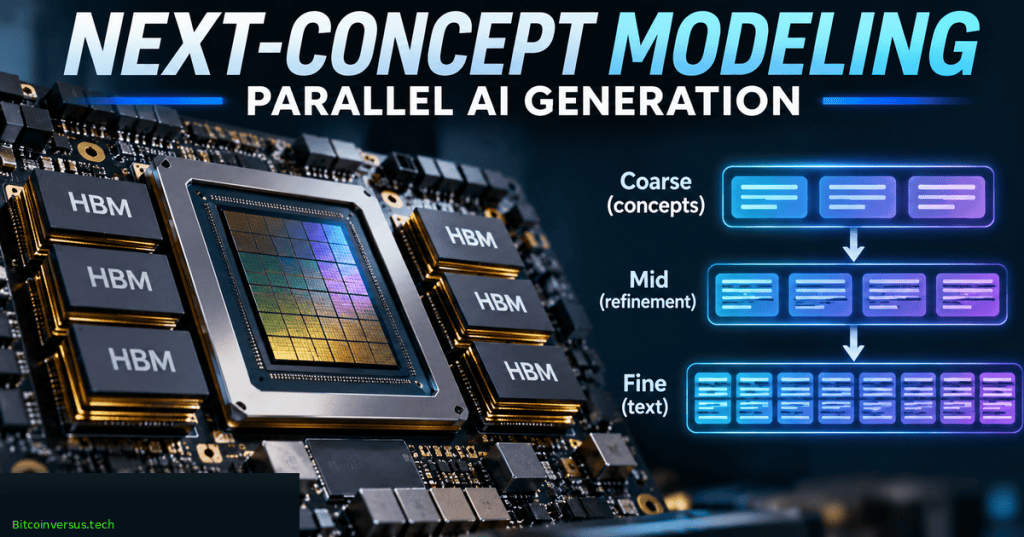
Stanford University researchers have developed a coarse-to-fine approach to artificial-intelligence text generation that ran up to 31 times faster than selected diffusion-language-model baselines in controlled tests. Their October 9, 2026 preprint, Next-Concept Modeling, reports faster generation without establishing that high-bandwidth memory (HBM) can be eliminated or that frontier AI now fits on consumer graphics cards.
Most deployed large language models use autoregressive decoding: each new token depends on earlier output. A word is not necessarily one token. Repeated computation can expose memory-bandwidth limits, although a key-value (KV) cache avoids recalculating earlier attention states at the expense of memory capacity. The broader cost of inference is explored in BitcoinVersus.Tech’s token-value-per-watt analysis.
Video: “Stanford Paper Could Make Nvidia’s Memory Chips Unnecessary,” supplied by the original explainer. The research findings below were checked against the Stanford preprint; independent YouTube playback and channel verification were unavailable during publication.
What next-concept modeling changes
NCM first trains a multiscale residual vector-quantized autoencoder (VQ-VAE) to represent text as discrete codes arranged from broad structure to fine detail. A transformer then predicts all codes within each level in parallel, moving sequentially between levels. Instead of claiming an entire response is created in one computation, the architecture reduces the number of serial generation steps. The required count varies by experiment: eight evaluations for XSum summarization, 12 for Sudoku and 32 for OpenWebText.
Two training methods address the difficulty of building accurate representations. Nested dropout samples a cutoff and retains only earlier code levels during tokenizer training, encouraging coarse levels to hold useful information. Conditioning corruption replaces some conditioning codes with alternatives during generator training, helping the network cope with errors made at earlier generation stages. Neither mechanism implies guaranteed factual self-correction.
The measured gains and the Sudoku result
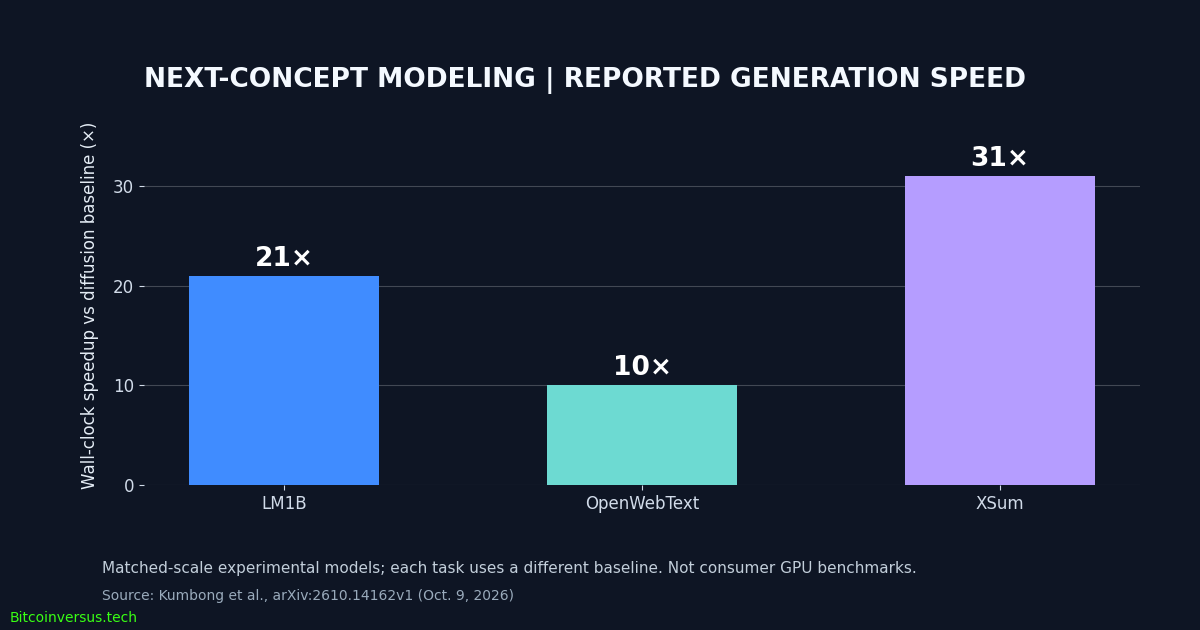
The paper reports 21× faster generation on LM1B, 10× on OpenWebText and 31× faster XSum summarization than respective diffusion baselines at broadly comparable scales. Researchers compared wall-clock sampling time and generation quality rather than only counting forward passes. Their main models had roughly 100 million parameters, far below the largest commercial AI systems.
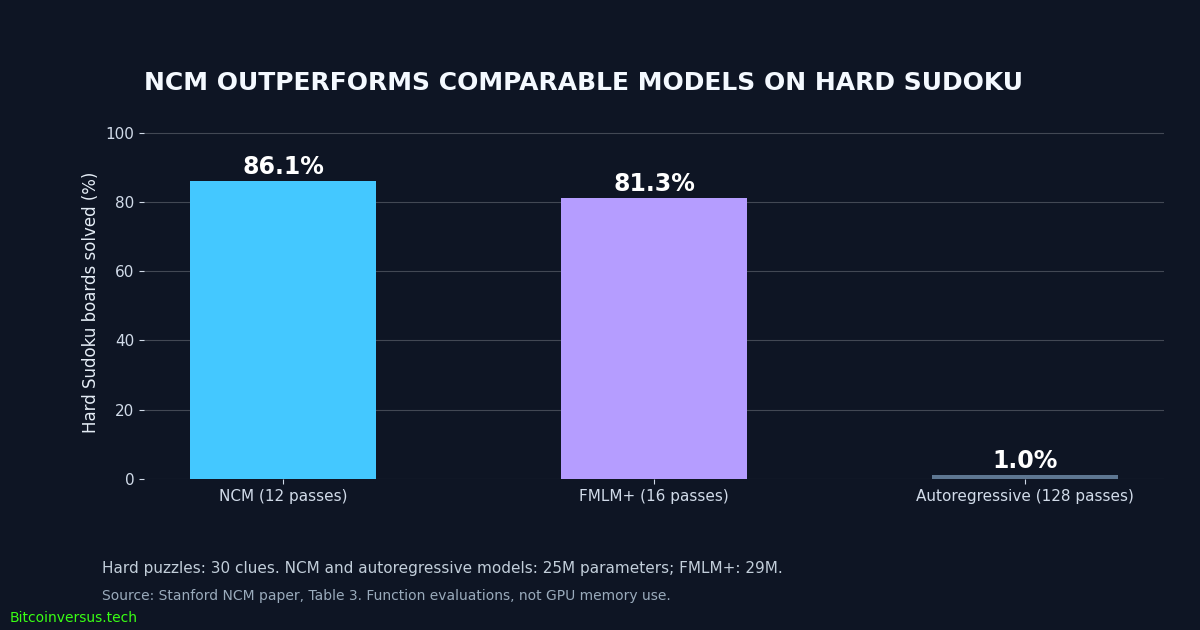
On hard Sudoku puzzles with 30 initial clues, a 25-million-parameter NCM generator solved 86.1% of boards using 12 function evaluations. A 29-million-parameter FMLM+ baseline solved 81.3% using 16; a 25-million-parameter greedy autoregressive baseline managed 1.0% using 128. Different architectures and parameter counts matter when interpreting the comparison. Related model-computation tradeoffs appear in BitcoinVersus.Tech’s exascale computing history.
The researchers separately tested minimum Bayes risk selection, generating multiple candidate summaries or translations and choosing a candidate with high average similarity to others. On XSum, NCM plus the selection method reached ROUGE-L 29.6, versus 28.6 for the guided AURORA-LM baseline. Consensus among generated candidates is not independent proof of truth, and the Sudoku figures do not represent a test of that selection method.
Why HBM remains part of the story
The efficiency benchmark ran on a single NVIDIA H100 SXM 80GB GPU. NVIDIA’s published H100 specifications list 80GB of GPU memory and up to 3.35 terabytes per second of bandwidth. NCM reduces serial generation work, but the study does not isolate HBM traffic, demonstrate a reduction in required model-weight memory, or establish lower total serving costs for frontier-scale systems. HBM memory comes from specialized memory manufacturers and is integrated into AI accelerators.
Consumer deployment depends on weight precision, total model size, activation and KV-cache requirements, operating-system overhead, compute capacity, latency and software optimization. Faster generation alone does not remove the capacity constraint. Similar efficiency questions apply to underused data-center hardware and the role of AI across semiconductor fabrication.
The authors identify limits including fixed hierarchy lengths, independently trained tokenization, occasional coarse-level output artifacts and scaling tested only to 725 million parameters. Their results warrant further hardware profiling and independent replication before drawing conclusions about HBM demand, GPU economics or consumer-device deployment.
Primary sources and research notes
Stanford Next-Concept Modeling preprint, October 9, 2026; research code repository; NVIDIA H100 product specifications. Benchmark speedups, function evaluations, Sudoku accuracy and limitations are researcher-reported. BitcoinVersus.Tech did not independently retrain or benchmark NCM.
Editor’s Note: The 21×, 10× and 31× speedups describe comparisons with selected diffusion-language-model baselines under the paper’s evaluation conditions. No reported experiment establishes the elimination of HBM or frontier inference on consumer GPUs. Featured artwork is conceptual, not a photograph of Stanford hardware. Both in-story charts are original editorial visualizations of published research measurements.
Support BitcoinVersus.Tech
To make an optional 5,000-satoshi contribution, scan the original BitcoinVersus.Tech QR below with a compatible Bitcoin wallet. On mobile, use a second device to scan or open the image with a wallet’s supported QR-import feature. Always verify the payment destination before approving a transaction.

We volunteer daily to ensure the information on this platform is Verifiably True. If you would like to support the research, please scan QR code.


Leave a Reply