
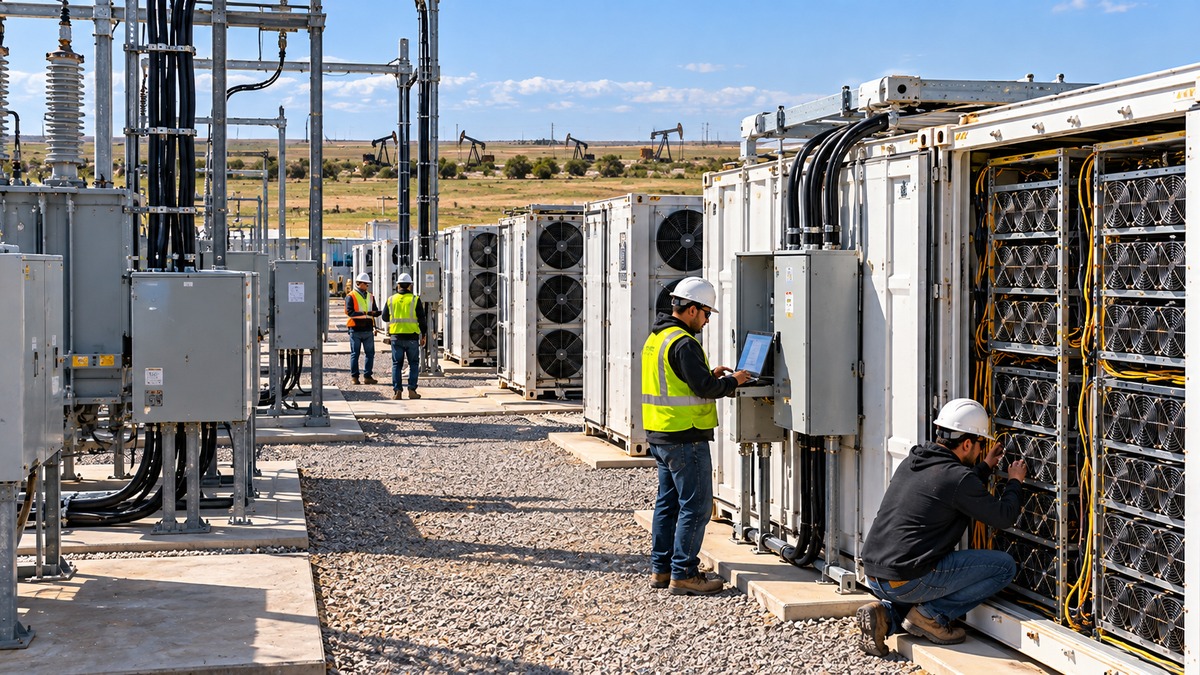
BitFuFu’s 51 MW Oklahoma mining site has cleared a U.S. national-security review, but the approval comes with unusually specific operating limits. Under a September 29 SEC filing, the facility must be used solely for specified cryptocurrency-mining operations unless U.S. monitoring agencies approve otherwise.
The same agreement restricts deployment of certain advanced computing hardware without prior written approval, subjects facility improvements to prior non-objection, and requires advance government notification before modifications to existing mining equipment. For an industry rapidly repurposing mining campuses for AI, the practical inference is clear: this site cannot freely follow the same mining-to-AI path as many peers.
CFIUS Cleared the Deal With Conditions
BitFuFu agreed in February 2025 to acquire 51% of Uni-Titan LLC, which owns and operates the Oklahoma facility. The company formally submitted the transaction to the Committee on Foreign Investment in the United States, or CFIUS, in December 2025.
On September 28, 2026, CFIUS notified BitFuFu that it had found no unresolved national-security concerns. But clearance came together with a national security agreement signed by BitFuFu, Uni-Titan, the U.S. Department of Homeland Security, and the Department of the Treasury as monitoring agencies.
The agreement remains in effect until the monitoring agencies terminate it in writing. That makes the restrictions an ongoing operating condition rather than a one-time closing requirement.
The Site Cannot Freely Pivot to AI Hardware
The most important clause for miners is the restriction on advanced computing hardware. The SEC filing says certain advanced computing equipment cannot be deployed at the Oklahoma site without prior written approval from the monitoring agencies.
That matters because Bitcoin mining companies are increasingly treating powered campuses as optionality for AI and high-performance computing. BitcoinVersus recently showed how public miners shed an estimated 75 EH/s while redirecting power toward higher-value data-center workloads.
BitFuFu’s Oklahoma site is different. Its power infrastructure may be valuable, but the company cannot simply replace ASIC racks with advanced AI systems on its own schedule. Any such deployment covered by the agreement requires government approval first.
Even Mining-Site Changes Face Oversight
The agreement reaches beyond AI hardware. Improvements to the facility are subject to prior non-objection from the monitoring agencies, while modifications to existing cryptocurrency-mining equipment require advance notification.
That does not mean every routine repair requires federal approval. The filing distinguishes between facility improvements, advanced-computing deployments, and modifications to existing mining equipment. But it does mean BitFuFu has an additional compliance layer that most ordinary mining sites do not face.
That could matter for future fleet upgrades, especially because BitFuFu has been actively developing BitFuFuOS and expanding its use of newer ASIC hardware. Changes that affect equipment configuration now sit inside a monitored national-security framework.
The 51 MW Site Was Built for Low-Cost Mining
BitFuFu’s original acquisition announcement described the Oklahoma facility as an air-cooled, containerized mining site that had been operating since 2022 with more than 95% uptime and net electricity cost around $0.03/kWh.
The company priced the transaction at $400,000 per MW. Applied to 51 MW, that implies about $20.4 million of transaction value on the company’s stated per-megawatt basis.
BitFuFu also said the site could add more than 3 EH/s using Antminer S21-series hardware. BitcoinVersus later tracked BitFuFu as its managed mining hashrate moved above 20 EH/s.
The Rules Protect Mining but Limit Optionality
For BitFuFu, the agreement cuts both ways. CFIUS clearance removes a major uncertainty around control of the Oklahoma operation and allows the mining acquisition to remain in place. The facility keeps access to low-cost power, existing infrastructure, and a proven mining operating history.
But the site now has less strategic flexibility than a comparable unencumbered data-center property. In a market where companies such as Hut 8, CleanSpark, IREN, Cipher, and Bitdeer are trying to monetize power through multiple workloads, BitFuFu’s Oklahoma facility is effectively being kept in a narrower operating lane unless regulators approve a change.
That makes the site unusually valuable as a case study: the same physical infrastructure that gives a Bitcoin miner optionality can also attract regulatory scrutiny precisely because it could host more advanced compute.
Watch BitFuFu Discuss U.S. Mining Pressure
At Bitcoin 2026, BitFuFu Vice President of Investor Relations Charley Brady joined a mining panel covering U.S. utility pressure, hosted mining, AI/HPC competition, and where large-scale mining is moving next.
What the Rules Mean
- The 51 MW Oklahoma acquisition cleared CFIUS review.
- The facility must remain in specified cryptocurrency-mining operations under the national security agreement.
- Certain advanced computing hardware requires prior written government approval.
- Facility improvements require prior non-objection.
- Modifications to existing mining equipment require advance notification.
- The agreement remains active until the monitoring agencies terminate it in writing.
The wider mining industry is trying to make every powered campus flexible enough to host whatever compute pays best. BitFuFu’s Oklahoma site now shows the opposite case: a valuable 51 MW asset where the U.S. government has explicitly limited that flexibility. The mine can keep hashing, but changing what those megawatts compute is no longer solely BitFuFu’s decision.


Leave a Reply