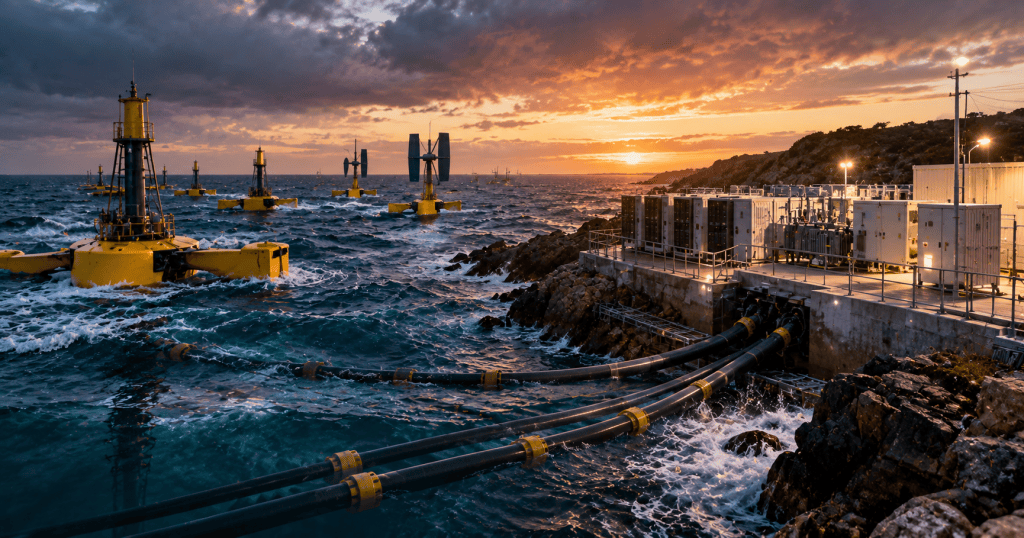
Stony Brook University is developing an “ocean power grid” that can coordinate wave energy, tidal energy, storage, and marine microgrids instead of treating each ocean-energy device as a standalone machine.
Stony Brook announced two U.S. Department of Energy projects totaling $1 million. The three-year efforts began in March 2026 and focus on the power electronics, control systems, and communications needed to turn variable marine energy into dependable electricity for coastal communities.
The First Project Is A Self-Coordinating Power Converter
The first project, called MREvolution, is being developed with Sandia National Laboratories. Its goal is a modular converter that can accept power from waves, tides, and energy storage at the same time and coordinate those sources automatically.
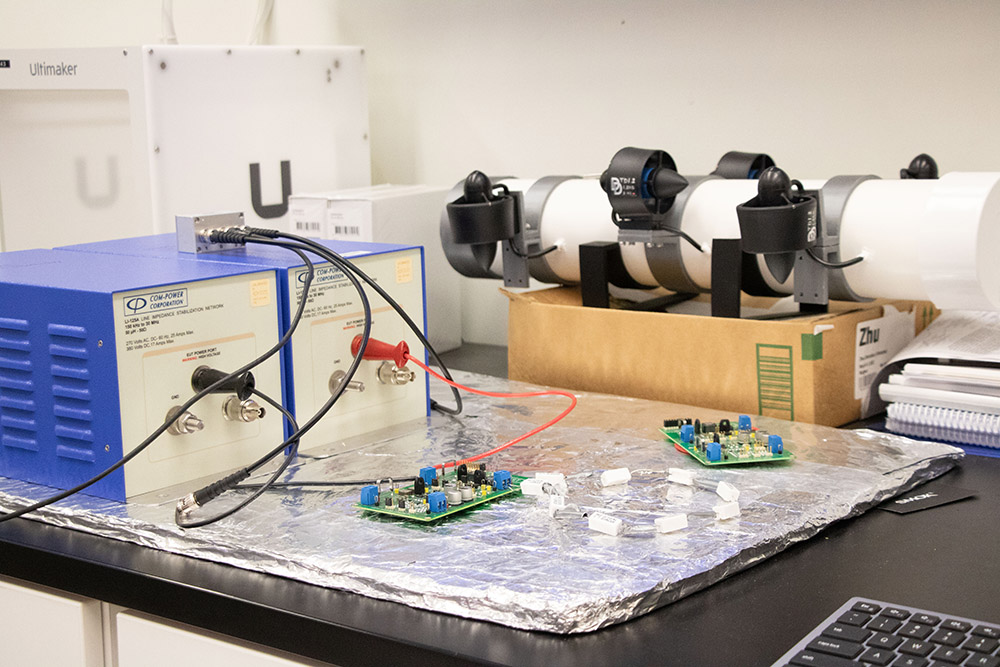
The converter uses silicon carbide and gallium nitride power semiconductors. Those wide-bandgap devices can switch efficiently at high voltages and frequencies, making them useful for compact power-conversion hardware where efficiency and thermal performance matter.
The design also includes digital-twin monitoring so operators on shore can track the condition of underwater equipment. Sandia will test prototypes at its Distributed Energy Technologies Laboratory in Albuquerque.
The Second Project Connects Multiple Marine Microgrids
The second project, developed with the CUNY College of Staten Island, is a real-time simulation and control framework for networks of marine-powered microgrids. The system is intended to model behavior across very different time scales, from millisecond electrical transients to long-term operating costs.
The two universities plan to demonstrate the approach using a linked two-microgrid testbed spanning their campuses. That makes the research less about a single turbine or buoy and more about how many marine-energy devices can operate together as an electrical system.
Underwater Communication Is Part Of The Grid Problem
A land-based grid can usually assume fast communications between substations, controllers, and protection systems. Underwater, that assumption breaks down. GPS is unavailable below the surface, ordinary radio does not propagate well through seawater, and acoustic links can be delayed and distorted.
That means the power system has to make useful decisions with incomplete information. Stony Brook professor Andrew Singer described the challenge as both a communications problem and a power-electronics problem: devices need to coordinate themselves even when the network connecting them is sparse or unreliable.
DOE Wants Marine Energy To Work With Microgrids
The work fits directly into the Department of Energy’s broader marine-energy research program. DOE’s foundational R&D program explicitly targets power electronics, controls, modeling, materials, and resource characterization, including technologies that can connect marine-energy devices to coastal-community microgrids.
DOE has previously identified power electronics as one of the core barriers between experimental marine-energy hardware and dependable electrical systems. Wave and tidal devices do not produce perfectly steady power, so converters, storage, controls, and communications have to smooth and coordinate what the ocean provides.
Why This Is Different From Another Wave-Energy Prototype
Marine-energy research often focuses on the mechanical machine that touches the water: a buoy, turbine, paddle, or oscillating structure. Stony Brook is attacking the layer behind those machines.
The question is not just whether one device can generate electricity. It is whether dozens of devices with different power profiles can share converters, storage, controls, and communications without destabilizing a microgrid.
That system-level approach connects with other grid work BitcoinVersus.Tech has covered, including distributed batteries acting together as a 580 MW virtual power plant, a California microgrid using long-duration flow batteries, and behind-the-meter systems combining generation, storage, and local loads.
What Comes Next
The immediate work is still laboratory and testbed engineering. Researchers need to prove that the converters can coordinate multiple energy sources, survive realistic fault and transient conditions, communicate through imperfect underwater links, and remain stable as the network grows.
If those pieces work, marine energy becomes less like a collection of experimental devices and more like an actual grid architecture—one built for an environment where the power source, hardware, and communications are all moving targets.
Editor’s Note
The featured image is original photorealistic editorial artwork created specifically for this story and is not reused in the body. The body image is a separate Stony Brook University laboratory photograph. The YouTube video is implemented as a responsive native Gutenberg player, and the Reddit discussion is embedded directly in the article. No normal story text is placed inside cards, panels, callouts, or text boxes.
BitcoinVersus.Tech content is provided for informational and educational purposes.


Leave a Reply