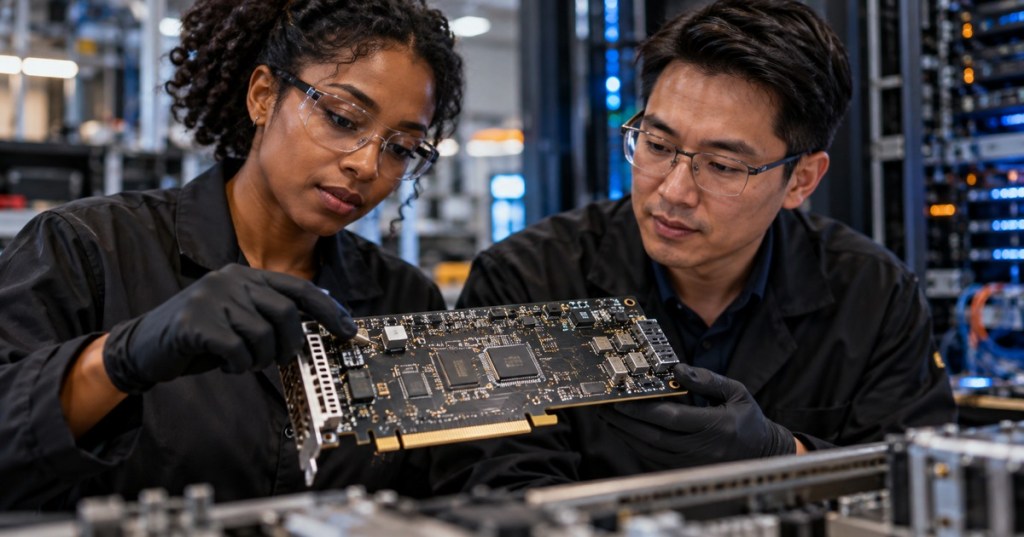
A PCIe retimer is a high-speed signal-conditioning device that receives a degraded PCI Express signal, recovers its timing and data, then retransmits a fresh copy so the link can travel farther or pass through a more difficult electrical channel.
That sounds like a small job, but at modern PCIe speeds it can decide whether a GPU, accelerator, storage device, network card or other expansion device forms a reliable link at all. As PCIe generations get faster, the signal has less margin for loss, jitter, reflections and connector imperfections across a motherboard, riser, backplane or cable.
What A Retimer Actually Does
The simplest explanation is that a retimer does more than make a weak signal louder. The PCI-SIG description of retimers and redrivers says a retimer is protocol-aware: it recovers the incoming data, extracts the embedded clock, cleans up the signal, and retransmits a new copy using fresh timing.
That effectively divides one difficult electrical path into two shorter PCIe link segments. PCI-SIG says PCIe 4.0 and PCIe 5.0 retimers participate in link equalization and adjust their operating data rate and link width together with the upstream and downstream ports. Up to two retimers can be used between those ports when extra reach is required.
The device still looks small compared with a CPU or GPU, but internally it performs clock-and-data recovery, equalization and retransmission. It also understands enough of the PCIe physical-layer behavior to participate correctly in link training instead of behaving like a blind analog amplifier.
Retimer Versus Redriver
A redriver and a retimer are not the same thing. A redriver boosts and equalizes the existing electrical waveform. It can help compensate for loss, but noise and timing problems already present in the signal can still pass through.
A retimer instead reconstructs the data stream and sends it again with recovered timing. That gives system designers more freedom on difficult channels, although the extra digital processing generally adds power, cost and some latency compared with a simpler redriver.
- Redriver: boosts and equalizes the existing signal.
- Retimer: recovers the bits and timing, then retransmits a fresh signal.
- Passive channel: uses only traces, connectors and cables, with no active signal-conditioning component.
Why Faster PCIe Makes Retimers More Important
PCIe has kept increasing its signaling rate while servers have also become physically more complicated. A short connection on a simple desktop board is easier than a path that crosses a CPU board, riser, cable assembly, switch board and accelerator tray.
That is why retimers appear most often in high-end systems rather than basic consumer PCs. Dense servers can contain multiple PCIe x8 and x16 links, accelerators, storage devices and network adapters competing for physical routing space. The electrical path may be long enough that the original transmitter and receiver can no longer maintain adequate signal integrity without help.
At PCIe 6.x speeds, the challenge grows again because the link uses PAM4 signaling at 64 GT/s. Astera Labs says its current Aries PCIe/CXL retimer family is designed to extend reach in AI and cloud systems, with products spanning PCIe 4.0, PCIe 5.0 and PCIe 6.x generations.
Where Retimers Show Up
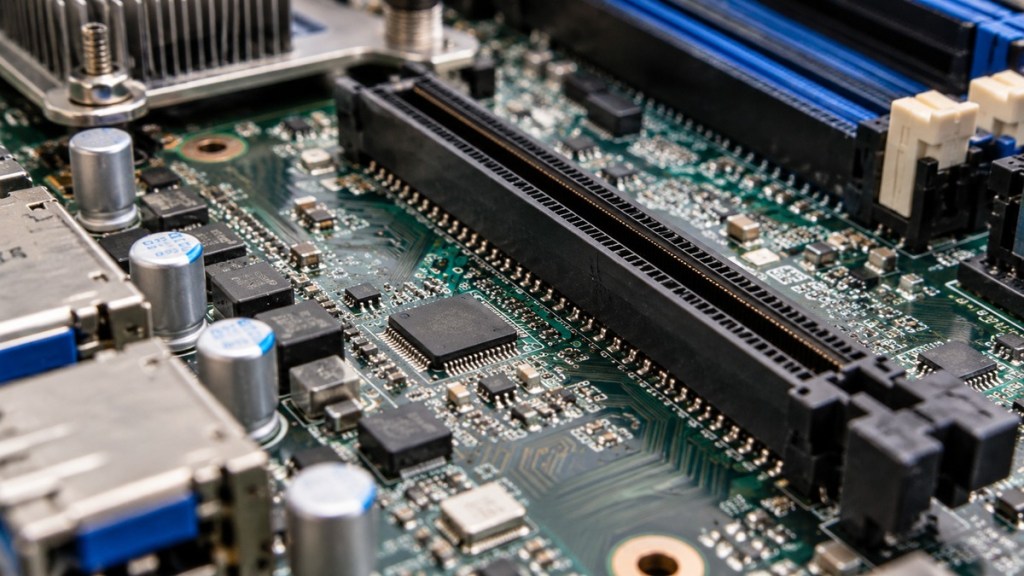
Retimers can appear on server motherboards, riser cards, backplanes, accelerator baseboards, storage systems and active cable modules. They are especially useful when a long path or multiple connectors push the channel beyond what a direct PCIe connection can tolerate.
In an AI server, for example, the CPU may need to reach several GPUs or other accelerators through complex board and cable topologies. BitcoinVersus.Tech recently covered HPE systems moving to PCIe 6 and Astera Labs pushing PCIe 7 across AI racks. Retimers sit in the less-visible layer that helps those faster links survive real physical layouts.
Retimers Do Not Make PCIe Faster
A retimer does not turn a PCIe 4.0 device into PCIe 5.0 or give a link more lanes. The endpoints still determine the negotiated generation and width. A retimer’s job is to preserve the integrity of the link that already exists.
That distinction is useful when troubleshooting. If a x16 device negotiates at x8 because of lane availability, platform configuration or hardware limitations, adding a retimer does not create eight missing lanes. Likewise, if software or firmware is causing a device problem, signal conditioning cannot fix the logic above the physical layer.
Retimers solve a physical-channel problem. They are most valuable when the path between devices is the reason the link is unstable, unable to train at its intended speed, or operating with too little electrical margin.
The Tradeoffs
Retimers are powerful, but they are not free. They consume power, create heat, add components to the board, require firmware or configuration work in some designs, and increase system cost. Designers also have to validate interoperability and make sure every link segment still meets PCIe requirements.
That is why a well-designed system does not add retimers everywhere. Short, clean links often need none at all. The component becomes valuable when the physical reach, connector count or channel loss justifies the extra complexity.
Why This Small Chip Matters
Modern computing depends on more than the headline processor. A DMA-capable device can move data efficiently, a fast GPU can process enormous workloads, and a high-bandwidth NIC can move traffic outside the server—but all of those advantages depend on the internal links actually working at their intended speed.
A PCIe retimer is one of the components that makes that possible. It receives a damaged high-speed signal, rebuilds the timing and data, and sends a clean copy onward. As PCIe speeds rise and servers spread across larger boards, cables and racks, that quiet signal-repair job becomes increasingly important.


Leave a Reply