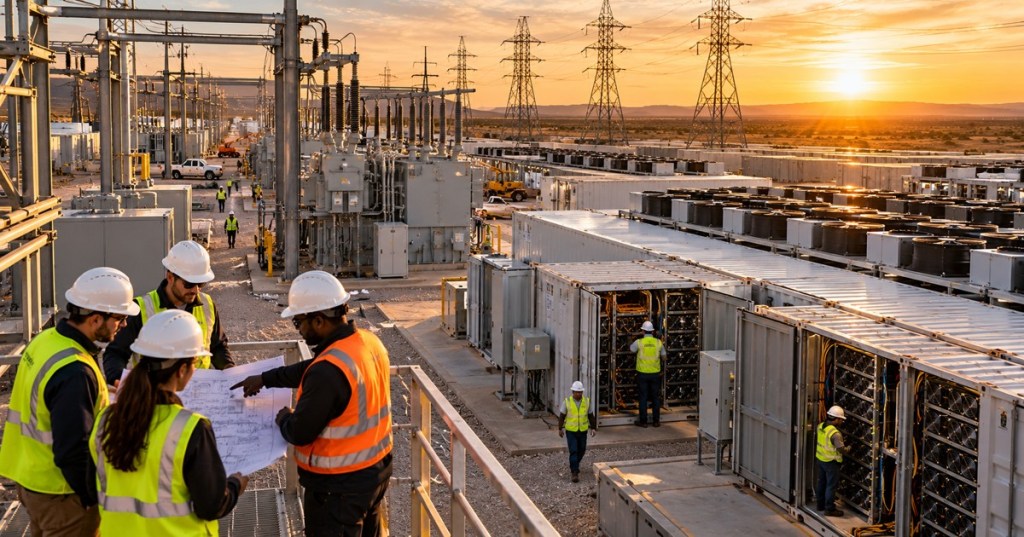
Hut 8 has won court approval to acquire Poolin’s Texas mining assets in a transaction worth up to $180 million, completing a sale process that was reopened after competing bidders challenged the earlier result.
The final structure matters more than the headline number. According to TheEnergyMag’s review of the court documents, Hut 8’s affiliates agreed to pay $100 million at closing plus as much as $80 million in future milestone payments. Bloomberg Law reported on October 2 that the bankruptcy court approved the sale after the auction redo.

The Deal Changed From $140 Million to $180 Million
BitcoinVersus previously covered Hut 8’s original $140 million winning bid for Poolin’s Texas data-center assets. That result did not survive unchanged.
After objections from rival bidders, the bankruptcy court reopened the process. Hut 8 remained in the auction and ultimately received approval under a structure that can reach $180 million. Compared with the earlier $140 million headline, the maximum consideration increased by about 28.6%.
But the extra $40 million should not be read as additional guaranteed cash at closing. The approved structure shifts a large portion of the value into future milestones.
Forty-Four Percent of the Maximum Price Is Conditional
The $80 million milestone component equals about 44.4% of the $180 million maximum transaction value. It is also equal to 80% of the $100 million paid at closing.
The milestone language is especially important for Bitcoin mining. The additional payments are tied to qualifying data-center transactions involving uses such as AI, high-performance computing, cloud computing and colocation. Facilities used primarily for cryptocurrency mining are excluded from the qualifying definition described in the court documents.
That makes the deal a clear example of the industry shift BitcoinVersus has been tracking. Public miners have already shed an estimated 75 EH/s while increasingly treating energized land, substations and power rights as infrastructure that can be monetized through workloads beyond SHA-256 mining.
The Upfront Cash Covers About 58% of Poolin’s Reported Obligations
Poolin entered bankruptcy with about $173.1 million in pre-bankruptcy obligations, including roughly $163.7 million in unsecured IOUs connected to customers after Poolin Wallet froze withdrawals in 2022.
The $100 million closing payment equals about 57.8% of the reported $173.1 million obligation figure. If every contingent milestone were eventually earned, the $180 million maximum would equal roughly 104% of that obligation figure.
That does not mean creditors will recover 58% or 104%. Bankruptcy expenses, priority claims, secured claims, transaction costs, the legal structure of the estates and whether the future milestones are actually achieved all affect recoveries. The arithmetic only shows how the purchase consideration compares with the previously reported obligation total.
Power Rights Are Driving the Value
The court documents show why the Texas sites attracted attention beyond Bitcoin mining. The Pyote agreement requires confirmation of at least 54 MW of firm available capacity. The Tarbush agreement requires approvals related to 176 MW at an adjacent property and contemplates potential expansion to 300 MW by the end of 2029.
Those figures are contractual conditions and potential capacity—not proof that 230 MW or 300 MW is already operating. But they show what buyers are actually pursuing: access to electrical infrastructure in a market where large-load interconnection has become one of the hardest parts of building a new data center.
Hut 8 has already built its strategy around that idea. BitcoinVersus previously covered the company’s $1.07 billion credit facility for power and data-center development and its 1 GW Beacon Point project in Texas.
The Assets Are Worth More If They Become Data Centers
The structure creates a direct financial link between the Poolin estate and Hut 8’s ability to turn former mining infrastructure into higher-value data-center projects. Up to $80 million of additional consideration depends on those future transactions.
That means the sellers are effectively sharing in part of the upside if the power rights become AI or HPC infrastructure. If the sites remain primarily cryptocurrency-mining facilities, the milestone framework described in the sale documents does not provide the same path to the full $180 million headline value.
The deal therefore puts a number on something miners increasingly understand: a powered site can become more valuable than the ASIC fleet originally installed there.
Watch Hut 8 Explain the Mining-to-AI Shift
Hut 8 CEO Asher Genoot discussed the company’s transition from Bitcoin mining infrastructure toward large AI data centers in the 2026 interview below, including how power access and site development now shape the company’s strategy.
What the Deal Shows
- The approved Poolin sale can reach $180 million.
- $100 million is due at closing and up to $80 million is contingent.
- The contingent portion represents about 44.4% of the maximum deal value.
- The milestone payments are tied to AI, HPC, cloud or colocation transactions rather than primarily cryptocurrency mining.
- Pyote and Tarbush carry valuable power rights and future capacity potential, but the cited MW figures should not be treated as fully operating load today.
The original story was that Hut 8 outbid rivals for failed mining infrastructure. The updated story is more revealing: nearly half of the deal’s maximum value now depends on converting those assets into something other than a traditional Bitcoin mine. The bankruptcy court approved the sale, but the final economic value will depend on what Hut 8 can build on top of the power.


Leave a Reply