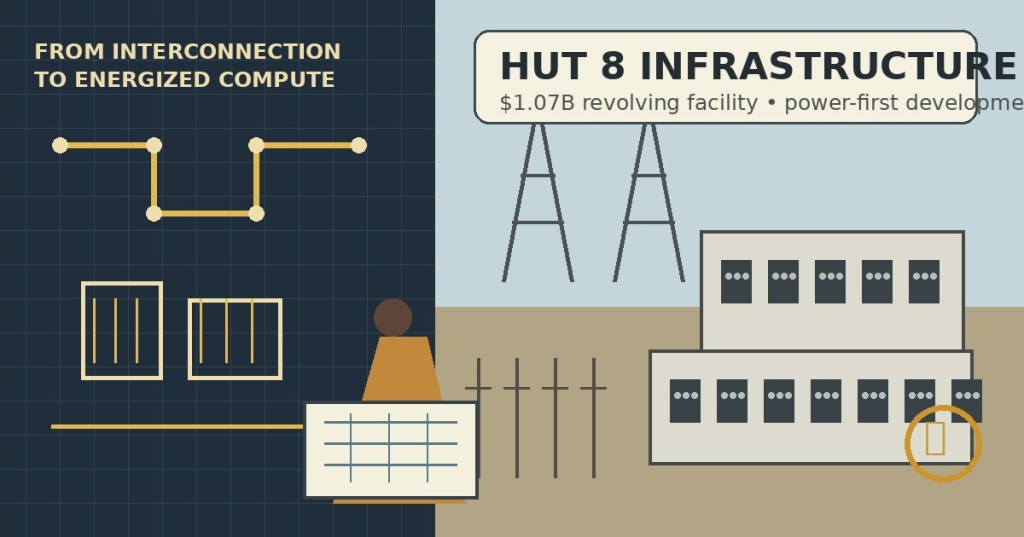
Hut 8 has closed a $1.07 billion four-year senior secured revolving credit facility, giving the former Bitcoin-mining specialist a large pool of parent-level liquidity as it develops power and data-center infrastructure for ASIC compute and artificial intelligence.
The September 28 announcement is important for what the facility is—and what it is not. The company says the revolver provides up to $1.07 billion of committed capacity, but Hut 8 had drawn zero dollars at closing. It is available capital, not $1.07 billion of new cash already spent.
The Credit Line Can Support the Infrastructure Before Compute Arrives
For Bitcoin miners becoming power-and-data-center developers, the difficult part increasingly begins before a rack is energized. Grid interconnection deposits, utility obligations, equipment orders, construction mobilization and working capital can tie up large amounts of cash while a project is still being de-risked.
Hut 8’s new facility includes a matching $1.07 billion letter-of-credit sublimit. The company specifically says letters of credit can support collateral requirements tied to site development, including interconnection deposits and obligations to utilities and equipment vendors. That makes the financing directly relevant to the electrical infrastructure behind both mining and AI campuses.
BitcoinVersus.tech recently covered Beacon Point’s progress through the ERCOT power process. A project can have land, customers and a development plan and still depend on transmission studies, deposits, switchgear, transformers and utility milestones before compute can operate.
JPMorgan Leads a 12-Lender Syndicate
JPMorgan Chase serves as administrative agent, collateral agent, lead-left arranger and bookrunner. Citi, Goldman Sachs and Morgan Stanley are joint lead arrangers and joint bookrunners, with twelve lenders participating in total.
According to Hut 8’s SEC filing, borrowings can be repaid and reborrowed through the fourth anniversary of September 24, 2026. Term SOFR borrowing margins range from 1.50% to 2.00%, with an initial margin of 1.75%.
Bitcoin Mining Helped Build the Power-First Platform
Hut 8 now describes itself as an energy-infrastructure platform spanning power, digital infrastructure and compute, but Bitcoin mining remains part of the operating foundation that gave the company experience running large electrical loads. That history matters because ASIC sites teach many of the same field disciplines needed for high-density data centers: power distribution, cooling, network uptime, equipment commissioning and rapid response to failed hardware.
The transition is visible across the sector. BitcoinVersus.tech’s recent analysis found that miners increasingly treat secured power as their most valuable AI-era asset. Hut 8 is one of the clearest examples of that evolution.
The Revolver Sits Above Project-Level Financing
Hut 8 says the new corporate facility complements $7.5 billion of fully amortizing, non-recourse investment-grade project financing already secured for its River Bend and Beacon Point AI campuses. The distinction matters. Project financing is tied to specific developments, while the revolver gives the parent company flexible liquidity earlier in the development cycle.
That structure can reduce the need to raise equity or leave large amounts of cash trapped as collateral while projects move through interconnection and construction. It also helps explain why Hut 8’s $140 million bid for two Poolin Texas data centers fits into a broader infrastructure strategy rather than a simple expansion of miner count.
A $1.07 Billion Facility Is Not $1.07 Billion of Debt Yet
The SEC filing confirms no borrowings were outstanding when the facility closed. Hut 8 pays for access to the committed capacity and can draw, repay and redraw subject to the agreement. That is materially different from issuing $1.07 billion of debt on day one.
The facility is secured by first-priority liens on substantially all assets of Hut 8 and its guarantors, subject to exclusions. Beginning with the quarter ending March 31, 2027, the agreement also introduces minimum-liquidity requirements tied to the facility’s stabilization framework.
For mining operators watching Hut 8’s transformation, the larger lesson is that the capital stack is becoming as important as the compute stack. ASIC fleets can be installed in months. Securing power, interconnection positions, substations, construction capital and long-term customers can take years.
That power-first approach also connects with Hut 8’s support for tighter Texas data-center development standards: the company is increasingly competing on its ability to turn power rights and development pipelines into financeable infrastructure.
BitcoinVersus.Tech Editor’s Note
Support independent technology reporting: BTC donations may be sent to 3C9o19EH5HSiwEPyCTmEKzxhNCbo2X6TTb.
Follow BitcoinVersus.tech on X/Twitter for Bitcoin mining, ASIC hardware, AI infrastructure, semiconductor and data-center reporting.
Disclaimer: BitcoinVersus.tech is not a financial advisor. This media platform reports on financial subjects purely for informational purposes.


Leave a Reply