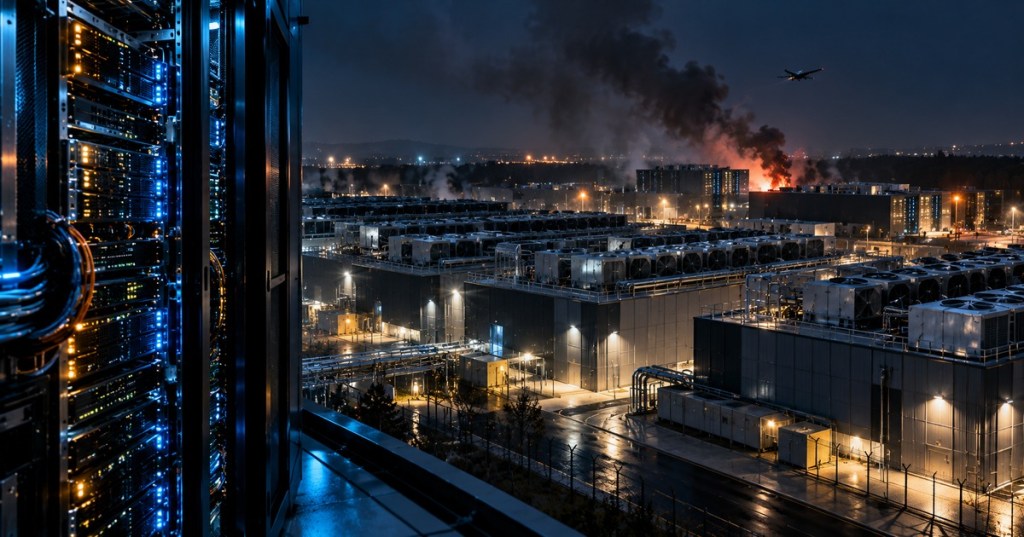
Three major Yandex data centers in Russia have been disrupted by drone attacks in four days, turning a regional infrastructure story into a real-world test of cloud failover, physical redundancy, and AI compute concentration.
The newest incident came on October 11, when Yandex said its data center in Russia’s Vladimir region was damaged and completely shut down. No employees were injured, but some Yandex services became unavailable. The outage followed attacks on Yandex facilities in Sasovo and Kaluga on October 8 and 9.
Yandex’s own infrastructure update said its Sasovo site was seriously damaged and fully shut down, while part of the Kaluga facility was taken out of service. The company said specialists were still assessing the damage and could not give a firm recovery timeline.

The third outage changes the technical picture
One data center going offline is a serious incident. Multiple large facilities being disrupted in rapid succession tests a different layer of architecture: whether workloads, data, and control systems can fail over cleanly when more than one physical site is constrained at the same time.
That is the same reliability problem discussed in BitcoinVersus’ data center reliability engineering lesson. Redundancy only works when independent failure domains are truly independent—and when the remaining capacity is large enough to absorb the load that gets moved.
Sasovo matters because it also housed AI supercomputing
The Sasovo site is especially important because it housed two of Yandex’s three major supercomputers used in AI development. Reuters reported that the facility contains tens of thousands of servers and that the status of the supercomputers after the strike was initially unclear.
That does not mean Yandex has lost all AI capability. It does mean the incident highlights a recurring infrastructure problem: high-end AI systems are expensive enough that compute tends to become physically concentrated. The more specialized the hardware, networking, storage, and cooling, the harder it can be to recreate the same capacity somewhere else on short notice.
Cloud failover is more than copying files
A cloud provider can replicate data to another region and still face trouble if the destination site lacks enough spare compute, storage performance, network capacity, identity infrastructure, or control-plane services to take over immediately.
The same principle appears at the web-delivery layer. BitcoinVersus’ CDN explainer shows how distributing content across multiple locations can reduce dependence on one origin. But application state, databases, AI clusters, internal services, and cloud control planes are more complicated than caching static files near users.
Operators therefore design for several different failure classes: loss of a server, rack, power feed, network path, room, building, availability zone, or entire region. A system that survives one of those failures is not automatically prepared for all of them.
Power backup cannot solve a site-level physical loss
Data centers normally carry layers of electrical protection—UPS systems, batteries, generators, multiple feeds, switchgear, and transfer logic. Those systems are built to ride through utility problems and equipment failures, not to make a damaged building instantly usable.
BitcoinVersus’ UPS guide explains why backup power bridges short electrical interruptions. Physical destruction, fire, damaged cooling, broken fiber routes, or unsafe access creates a different recovery problem in which the workload may need to leave the site entirely.
The user impact spread beyond one web service
Yandex operates search, maps, ride-hailing, payments, cloud infrastructure, entertainment, e-commerce, and AI services. That breadth means a data-center incident can affect both Yandex’s own consumer products and outside organizations that rent infrastructure from Yandex Cloud.
Reuters reported on October 11 that the Vladimir data center was completely shut down, that some Yandex services were unavailable, and that the incident followed the Sasovo and Kaluga disruptions. Earlier Reuters reporting also documented outages affecting organizations outside Yandex itself after the first attacks.
What data-center operators can learn from this
- Separate failure domains: Critical replicas should not depend on the same building, utility path, metro fiber route, or physical security perimeter.
- Reserve failover capacity: A secondary region is only useful if it can absorb the workload during a real emergency.
- Test control-plane independence: DNS, identity, monitoring, orchestration, secrets, and deployment systems need redundancy too.
- Plan for specialized hardware: AI clusters, high-speed fabrics, and large storage systems may take far longer to replace than commodity virtual machines.
- Exercise regional recovery: Teams should test what happens when an entire site—not just one server or rack—becomes unavailable.
This is an infrastructure story before it is a cloud story
Cloud services can make computing feel locationless, but the hardware is always somewhere. Servers occupy racks. Racks need power and cooling. Networks enter buildings through physical fiber. AI clusters often concentrate enormous value inside a small number of sites.
The Yandex incidents are an extreme example, but the engineering lesson applies far beyond wartime conditions. Fire, flooding, earthquakes, grid failures, fiber cuts, equipment faults, and other physical events can create the same architectural question: if this site disappears from the network, does the service keep working?
BitcoinVersus.Tech Editor’s Note: This story focuses on infrastructure and service resilience. Yandex confirmed damage and shutdowns at its facilities; Reuters attributes the earlier Sasovo and Kaluga strikes to Ukraine. Claims from battlefield social media are used only as supporting media and are not treated as primary confirmation.
Follow BitcoinVersus.Tech on X for data centers, cloud infrastructure, AI hardware, networking, Bitcoin mining, and cybersecurity reporting.
Support independent technology reporting: Bitcoin donations help fund BitcoinVersus.Tech research and publishing.
Disclaimer: BitcoinVersus.Tech provides technology news and analysis for informational purposes only.


Leave a Reply