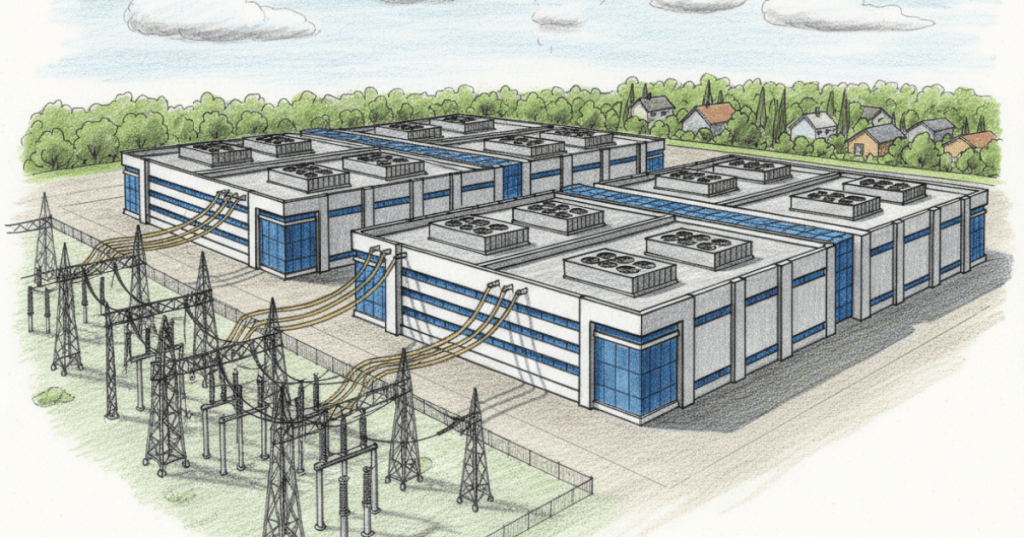
America’s data-center capacity buildout is running into harder questions about electricity, grid connections, local costs, and community opposition—but the pipeline is still growing fast. Reuters reported on October 5 that Goldman Sachs now expects U.S. data-center capacity to reach 64 GW by the end of 2026 and 90 GW by the end of 2027.
The important part is not just the size of those numbers. Goldman raised its 2026 estimate by 5 GW while trimming the 2027 estimate by 5 GW, suggesting that some projects are moving around in time rather than disappearing. The bank’s conclusion, as summarized by Reuters, is that rising political and community opposition has not yet broken the near-term U.S. growth story.
The 2027 Forecast Was Trimmed, Not Broken
Goldman’s newer estimate is slightly lower than its own earlier outlook. In May 2026, Goldman Sachs Research projected roughly 95 GW of U.S. data-center capacity by the end of 2027. That earlier work estimated that U.S. data centers would use about 31 GW of power in 2025, 41 GW in 2026, and 66 GW in 2027, assuming roughly 70% capacity utilization.
The October update lowers the end-2027 capacity figure from about 95 GW to 90 GW. That is a meaningful revision, but it still implies an enormous expansion from the 2025 base. It also reinforces a distinction that matters operationally: installed or available capacity is not the same thing as actual power draw. A campus may have electrical capacity available for future halls, reserved capacity that is not yet loaded, or phased construction that ramps over time.
That distinction is similar to the difference between a facility’s planned megawatts and its live IT load. BitcoinVersus.Tech’s guide to IT load, PUE, rack density, and growth headroom explains why a site can be designed for much more power than it is consuming on day one.
The Real Bottleneck Is Power Delivery
The limiting factor is increasingly the electrical infrastructure around the building. Goldman Sachs Research said in September that delays for connecting data centers to regional U.S. power grids can stretch as long as seven years. A server hall can be designed and equipment can be ordered much faster than a new transmission project, utility upgrade, or major electrical substation can necessarily be permitted, financed, built, tested, and energized.
That is why BitcoinVersus.Tech has been tracking the shift toward behind-the-meter power, on-site gas generation, batteries, fuel cells, and other ways to bring generation physically closer to the load. The same constraint is behind projects that ask whether a data center can run partly or entirely off-grid.
Even after power reaches the campus, the electrical chain is not finished. Facilities still need switchgear, transformers, generators, UPS systems, power distribution, and often busway to move electricity from the utility service to individual rows and racks. A 90 GW national headline is therefore the sum of thousands of smaller engineering problems.
Community Pushback Is Becoming an Engineering Variable
Data-center opposition is no longer just a public-relations issue. Reuters notes that communities are raising concerns about electricity demand, utility costs, and other local impacts. Those concerns can affect zoning, water use, permitting, utility rate structures, and the timing of new transmission or generation.
BitcoinVersus.Tech has already seen that tension in projects such as the 320 MW HIVE BUZZ Oakville AI campus, where local development and the regional power path became inseparable. It also shows up at the grid-policy level: FERC and PJM cost-allocation fights are ultimately arguments over who should pay for infrastructure needed to support large new loads.
That means developers increasingly have to solve for two timelines at once. The first is the construction timeline for the data center itself. The second is the political and electrical timeline for the megawatts it needs. A project can have land, financing, customers, GPUs, and building permits yet still be constrained by where the power is coming from and when it will arrive.
Not Every Announced Megawatt Will Arrive on Schedule
Goldman’s May research estimated that only about 50% to 60% of data-center capacity scheduled for the following one to two years would come online on time because of delays and cancellations. That is one reason a giant development pipeline should not be read as guaranteed near-term electricity consumption.
The problem also includes what the industry sometimes calls ghost demand: multiple projects can request grid capacity before every development is certain to be built. Utilities then have to distinguish serious projects from speculative queue positions without underbuilding for real demand.
At the same time, the demand trend is real. BitcoinVersus.Tech’s coverage of record U.S. electricity demand in 2026 and 2027 shows why utilities cannot simply assume the queue will evaporate. AI infrastructure, cloud growth, industrial electrification, and other large loads are arriving together.
Wall Street Sees a Power Shortfall Too
A separate Reuters report on October 5 cited Morgan Stanley estimating a 34% net U.S. data-center power shortfall through 2028, equal to about 32 GW, even after accounting for measures such as behind-the-meter generation and fuel cells. That does not mean 32 GW of data centers vanish; it means power availability can delay deployments, change locations, or force operators toward alternative generation strategies.
This helps explain why the industry is exploring almost every credible power option at once. Operators are signing power purchase agreements, developing on-site generation, adding batteries, contracting for gas turbines, exploring small modular reactors, and testing ways for large campuses to flex their load with the grid.
More Capacity Also Means More Network and Rack Infrastructure
Every additional megawatt eventually turns into physical equipment. Higher-density AI halls need racks, cooling, fiber, high-speed switching, storage, power distribution, and increasingly complex controls. At the network edge of each rack, a top-of-rack switch may connect servers or accelerators into a larger fabric; on the power side, busway and rack PDUs distribute the electricity that made it through the utility and facility electrical systems.
That is why the 90 GW figure matters far beyond utilities. It implies continued demand for transformers, switchgear, cooling systems, generators, batteries, networking equipment, optical components, construction labor, controls engineers, and data-center technicians. The capacity forecast is also a supply-chain forecast.
The Simple Takeaway
U.S. data-center growth is slowing in places, shifting in time, and facing more resistance—but Goldman Sachs still sees a very large buildout ahead. The October forecast of 64 GW by the end of 2026 and 90 GW by the end of 2027 is lower than the bank’s earlier 95 GW 2027 capacity estimate, yet it still points to rapid expansion.
The biggest question is no longer whether companies can order more compute. It is whether utilities, developers, communities, equipment suppliers, and regulators can build the electrical infrastructure quickly enough to turn planned megawatts into operating data centers.
BitcoinVersus.Tech follows the hardware, power systems, networking, semiconductors, Bitcoin mining, and infrastructure behind the modern computing economy.
Editor’s Note
Capacity forecasts can change as projects move through permitting, utility interconnection, financing, construction, equipment delivery, and commissioning. This article distinguishes data-center electrical capacity from actual operating power demand and uses the latest figures reported by Reuters alongside Goldman Sachs Research’s earlier 2026 outlook.
Support and donation options are available through BitcoinVersus.Tech.
BitcoinVersus.Tech is not a financial advisor. Content is provided for informational and educational purposes.


Leave a Reply