FireFly Robotics, the Utah company building autonomous electric turf-care machines, filed on October 7, 2026 to list its shares on Nasdaq through a direct listing. Unlike a traditional IPO, the transaction is not designed to raise new money for FireFly: existing shareholders are registering up to 27,134,738 shares for resale.
That structure makes the listing especially interesting because FireFly is not entering public markets as a pre-product robotics concept. According to the filing details reported by Reuters, the company had more than 900 autonomous mowing platforms, robotic harvesters and automated mowers in service globally as of June 30.
A Direct Listing Is Not a Normal IPO
In a conventional IPO, a company usually creates or sells shares to raise capital, often with investment banks underwriting the deal and helping set an offering price. A direct listing instead allows existing shareholders to sell stock on the public market without the company issuing a new block of shares to fund itself.
FireFly says it will receive no proceeds from the registered shareholders’ sales. Reuters reports that FireFly had previously filed for an IPO in October 2025 seeking to raise up to $29.3 million, then withdrew that offering in March 2026. The new structure takes a different route to public-market liquidity.
The Robots Are Already Working
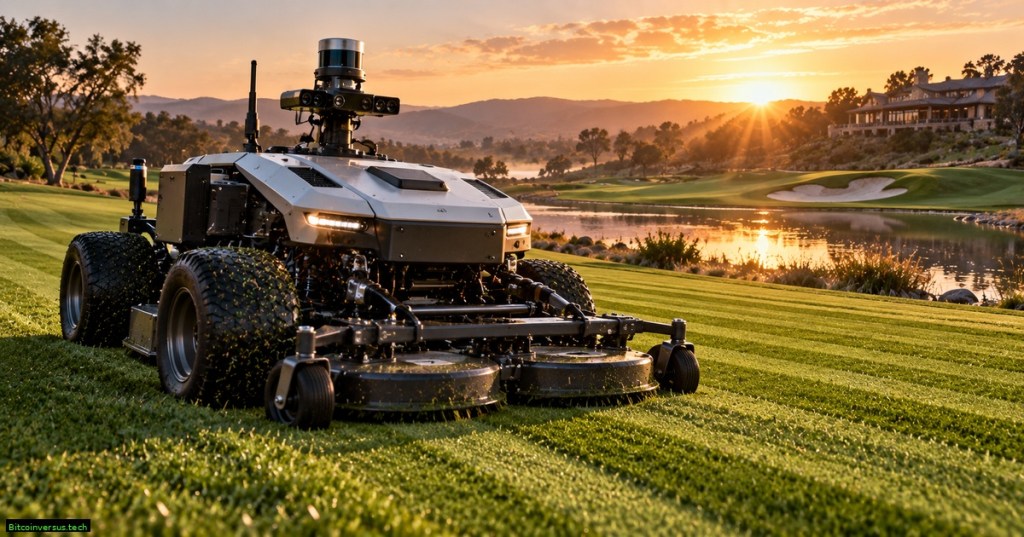
FireFly’s best-known product family is AMP, its Autonomous Mowing Platform for golf courses, sports fields and turf farms. The company describes AMP as an all-electric professional mower built around autonomous navigation rather than a conventional mower retrofitted later with autonomy.
The machine combines LiDAR, cameras, RTK-corrected GPS, cloud software and autonomous path planning. FireFly says four independent electric drive motors provide four-wheel traction, while its positioning and control stack lets the machine follow mapped fairways and fields without boundary wires.
That hardware stack is a practical example of how modern robotic drive systems increasingly combine electric propulsion, sensors and software rather than treating each layer as a separate machine subsystem.
FireFly Says AMP Has Crossed 100,000 Autonomous Acres
FireFly’s own operating history provides a second useful measure beyond unit count. In a May 2026 field report, the company said AMP had passed 75,000 acres of autonomous mowing; FireFly later updated the figure to more than 100,000 acres by July 22.
The company says AMP averages roughly 4.4 acres per hour in its field data. That does not make every deployment identical, but it does show that this robotics business is being measured in repetitive production work rather than only demonstrations or laboratory trials.
Revenue Is Growing, but Losses Are Growing Too
For the six months ended June 30, FireFly reported $30.5 million in revenue, up from $22.9 million in the same period a year earlier, according to Reuters’ summary of the filing. Net loss widened to $9.1 million from $6.1 million.
That is the central financial question behind the listing: FireFly has real machines, real customers and growing revenue, but it still has to prove that scaling its manufacturing, service and autonomy stack can eventually produce durable profits.
AI Is Only One Layer of the Machine
FireFly says its equipment uses artificial intelligence and machine learning alongside electric-drive technology. But the commercial value comes from the complete loop: perception, positioning, planning, traction, battery power, cutting hardware and software all have to work together reliably outdoors.
That distinction is similar to the broader split between AI training and inference. A mower in the field is mostly an inference-and-control machine: it has to use learned models and sensor data to make safe decisions in real time while moving through a changing physical environment.
FFLY Is Not Firefly Aerospace
FireFly Robotics intends to trade under the proposed Nasdaq symbol FFLY. That is distinct from Firefly Aerospace, the space-and-defense company that already trades on Nasdaq under FLY. The similar names make the ticker distinction worth watching once FireFly Robotics begins public trading.
What to Watch Next
The filing does not yet establish the market valuation investors will ultimately assign FireFly Robotics. The important next data points are the first reference price, trading volume, shareholder selling activity, gross margin, service revenue, unit growth and whether the installed fleet keeps expanding beyond golf and turf management.
The broader robotics lesson is more important than the listing mechanics. FireFly has reached the point where autonomous machines are doing enough repetitive physical work—and generating enough revenue—for public-market investors to start valuing the business directly.
BitcoinVersus.Tech
Advertisement
Editor’s Note
A direct listing is not the same as a traditional capital-raising IPO. FireFly Robotics will not receive proceeds from the registered shareholders’ sales, and the filing does not guarantee a particular valuation or future trading price.
Support and donation options are available through BitcoinVersus.Tech.
BitcoinVersus.tech is not a financial advisor. Content is provided for informational purposes.


Leave a Reply