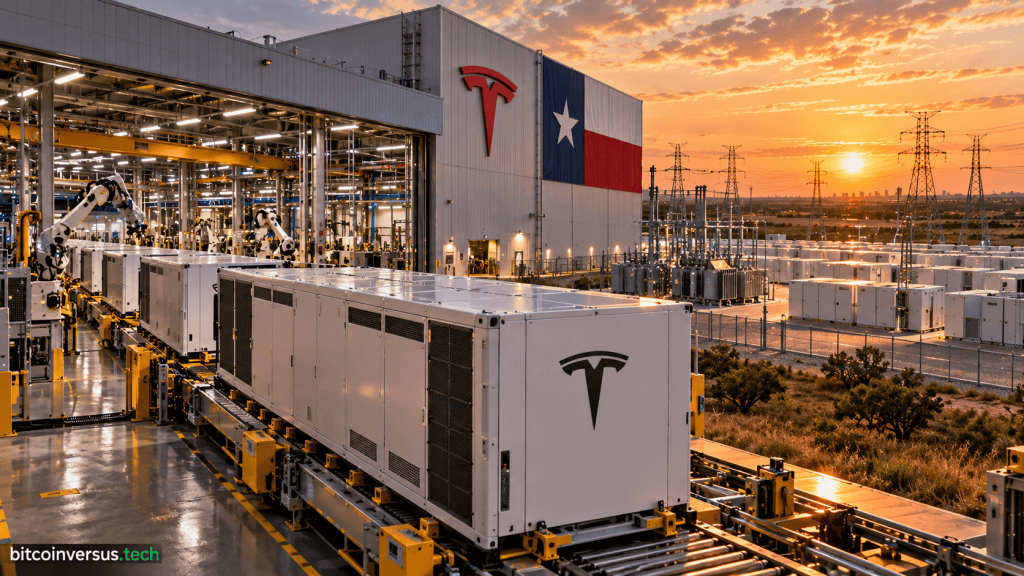
Tesla has started producing Megapack 3 at its newest Megafactory in Brookshire, Texas, turning a 16-month construction sprint into a new 50 GWh-per-year grid-battery production line. The milestone matters because the newest Megapack is not just a larger battery enclosure: it is part of a broader electrical-engineering shift toward pre-integrated, utility-scale storage that can be deployed faster, connected with fewer field interfaces and operated as grid infrastructure rather than as a collection of individual battery cabinets.
Tesla confirmed the production start in its official Megapack production update, saying the Brookshire factory moved from groundbreaking to operation in 16 months and was designed for 50 GWh of annual Megapack 3 output.
50 GWh a Year Changes the Scale of the Factory
A 50 GWh annual design target puts the Brookshire plant firmly in utility-scale territory. At roughly 5 MWh of storage per Megapack 3 unit, that level of output corresponds to the energy capacity of about 10,000 fully rated units per year if the factory ran entirely at nameplate output and product mix stayed constant.
The production milestone follows a major expansion in Tesla’s storage business. BitcoinVersus.Tech recently reported that Tesla deployed 13.7 GWh of energy-storage products in Q3 2026, showing how quickly stationary batteries are becoming a larger part of the company’s industrial footprint.
Megapack 3 Packs More Energy Into the Same Footprint
Independent reporting says Megapack 3 stores about 28% more energy in the same basic footprint as the previous generation. That density matters electrically because every additional megawatt-hour placed inside a standard site layout can reduce the amount of land, cabling, trenching and balance-of-plant hardware needed for a given project capacity.
The engineering advantage is not only inside the battery cells. Grid-scale storage projects are constrained by transformers, medium-voltage equipment, protection systems, controls, thermal management and construction sequencing. Increasing the energy contained in each factory-built unit can reduce the number of field connections required per installed megawatt-hour and simplify the path from factory production to energized site.
Megablock Turns the Battery Into an Electrical System
The official Tesla presentation above shows why Megapack 3 should be understood as part of an electrical system rather than as a standalone battery box. Tesla’s Megablock architecture combines multiple Megapack 3 units with the transformer and switchgear needed to form a larger repeatable block, pushing more engineering and integration work upstream into a standardized design.
That approach is especially relevant for high-load facilities. BitcoinVersus.Tech previously covered how xAI placed a massive Megapack fleet behind Colossus 2, using battery storage as part of a multi-gigawatt data-center power strategy rather than as a small backup system.
Factory Integration Can Move Work Away From the Construction Site
Utility battery projects are usually built from repeated electrical interfaces: DC battery strings, inverters, protection devices, transformers, medium-voltage feeders, supervisory controls and communications. Every field connection adds installation work, commissioning time and another point that must be inspected and tested before energization.
By increasing energy density and packaging more of the electrical system into repeatable factory-built blocks, Tesla is attacking the part of storage deployment that is hardest to scale with software: physical construction. The same trend appears elsewhere in the grid-storage market, including Energy Vault’s eight-hour Stoney Creek battery project, where project economics depend as much on power conversion and site integration as on cell chemistry.
Brookshire Is Really a Manufacturing Story About the Grid
The Brookshire milestone shows where utility storage is heading: larger factory throughput, denser battery modules and more pre-engineered electrical integration before equipment reaches the field. A 50 GWh annual line is not merely a battery factory. It is a manufacturing pipeline for substations, renewable projects, data centers and grid-balancing systems that increasingly depend on fast-response storage.
Megapack 3 therefore sits at the intersection of battery chemistry and classical electrical engineering. Cells store the energy, but busbars, protection, switchgear, transformers, thermal systems, controls and grid-forming behavior determine whether that stored energy can become dependable infrastructure.
BitcoinVersus.Tech
Advertisement
Editor’s Note
We volunteer daily to ensure the credibility of the information on this platform is Verifiably True.
BitcoinVersus.tech is not a financial advisor. This media platform reports on financial subjects purely for informational purposes.


Leave a Reply