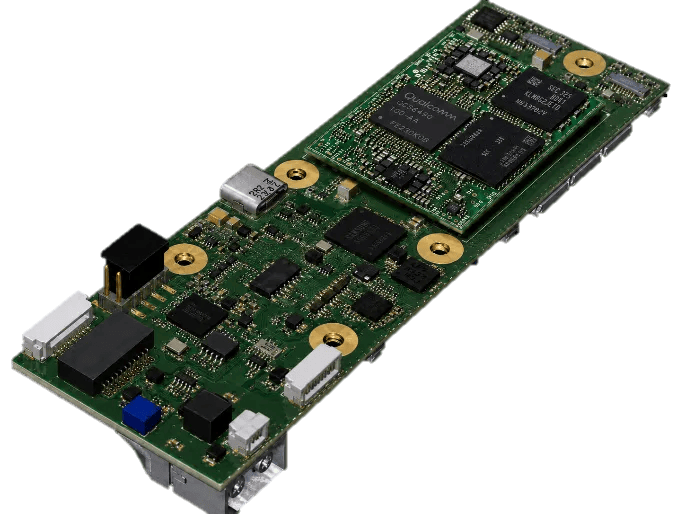
Lantronix has introduced Spotter, a compact robotics computing platform designed to give drones and mobile robots onboard AI, vision, sensing and vehicle control without requiring a large GPU system.
Lantronix’s product page lists the board at 42 × 120 mm and says it is built around Qualcomm’s Dragonwing QCS6490 system-on-chip. The company rates the platform at up to 12.5 TOPS of AI performance while operating at single-digit watts. Spotter is being previewed at AUSA 2026 in Washington, D.C., with availability planned for the fourth quarter of 2026.
The point is not to replace the highest-performance robot computers. Spotter targets the gap between inexpensive embedded boards that may lack enough AI compute and larger GPU platforms that can add cost, size and power draw to small autonomous vehicles.
Skydio’s work on multi-drone autonomy illustrates the broader class of navigation and coordination workloads that increasingly need capable onboard compute.
Spotter combines the QCS6490 with up to 8 GB of LPDDR5 memory and 64 GB of eMMC storage. Lantronix also lists dual MIPI CSI camera interfaces, analog video, Gigabit Ethernet, USB 3.1, PCIe Gen 3, dual IMUs, a barometer and a magnetometer. An optional STM32H7-class microcontroller can handle real-time flight or vehicle control.
Qualcomm Developer explains how the Dragonwing robotics family is designed to scale perception, control and autonomy across different robot classes.
The software support is unusually practical for drone builders. Lantronix says Spotter supports PX4, ArduPilot, Betaflight and MAVLink, allowing developers to integrate the board into aerial, ground and maritime systems without replacing the autonomy stack they already use.
The launch also fits Qualcomm’s broader move into robotics. BitcoinVersus.Tech recently covered Qualcomm’s expansion through its PickNik deal, which added more robotics software expertise around motion planning and manipulation.
Lantronix’s October 13 announcement says Spotter is intended for perception, navigation, inspection, surveillance and coordinated unmanned systems. Those are company claims, and real-world performance will depend on model size, sensor load, thermal limits and software optimization.
Qualcomm demonstrates a QCS6490 system running concurrent edge-AI workloads, showing the processor family behind Spotter in a real embedded application.
Compact edge AI is also appearing outside drones. BitcoinVersus.Tech has covered Arduino’s growing AI-capable UNO Q ecosystem and NEURA and SECO’s physical-AI hardware work. The common direction is moving more perception and decision-making onto the machine itself instead of depending on a remote data center.
For Spotter, the most important number may be power rather than raw TOPS. Small drones and robots operate under strict battery, payload and thermal limits. A useful onboard computer has to provide enough AI performance without consuming the energy budget meant for motors, sensors and communications.
If Lantronix can deliver its stated performance and software compatibility in production hardware, Spotter could give robotics teams another middle ground between minimal embedded controllers and much larger accelerator platforms.
BitcoinVersus.Tech Editor’s Note:
We volunteer daily to ensure the credibility of the information on this platform is Verifiably True. If you would like to support to help further secure the integrity of our research initiatives, please donate using the QR code provided

For best QR-code scanning results, please scan this donation code from a desktop or larger screen. Mobile screens may prevent camera recognition.


Leave a Reply