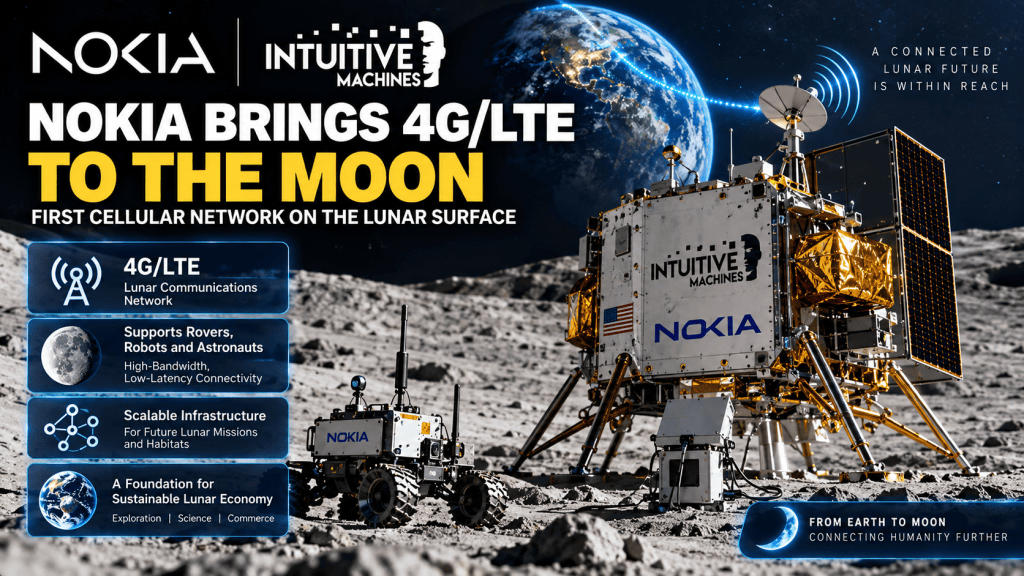
Nokia’s attempt to establish the first cellular network on the Moon reached the lunar surface aboard Intuitive Machines’ Athena lander, but the mission’s difficult landing prevented the planned rover-to-lander 4G/LTE demonstration. The hardware nevertheless provides a concrete blueprint for how future lunar robots and astronauts could communicate.
The system, called the Lunar Surface Communication System, was developed by Nokia Bell Labs with support from NASA’s Space Technology Mission Directorate. NASA’s current mission documentation describes the network as a lunar adaptation of the same standardized 4G/LTE technology used by billions of devices on Earth.
A cellular base station went to the Moon
Nokia compressed radio, base-station, routing and core-network functions into a ruggedized “network in a box” integrated with Intuitive Machines’ Nova-C lander Athena.
The plan was to connect Athena with Lunar Outpost’s Mobile Autonomous Prospecting Platform rover and Intuitive Machines’ Micro Nova hopper. Those links were designed to carry high-definition video, telemetry and command-and-control traffic across the lunar surface.
Nokia Bell Labs explains how its compact 4G/LTE network was engineered for the IM-2 lunar mission and communications between Athena and lunar exploration vehicles.
The landing changed the experiment
Athena reached the Moon in March 2025 but landed on its side. The orientation, power conditions and extreme environment shortened the mission before Nokia could complete the planned surface-network links to the vehicles.
Reporting after the landing says Nokia nevertheless powered its network hardware and exchanged commands and data with Intuitive Machines’ ground infrastructure. That is materially different from demonstrating the complete rover-to-lander cellular network, and the distinction matters.
The IM-2 mission delivered Nokia’s cellular hardware to the lunar surface, but the planned multi-node surface-network demonstration was not completed.
Why cellular networking makes sense beyond Earth
Standardized cellular technology brings an enormous terrestrial ecosystem of radios, protocols, security mechanisms and network-management experience. Instead of designing every lunar mission around a one-off communications link, future missions could potentially connect vehicles, instruments and astronauts through interoperable local networks.
NASA continues researching lunar 3GPP networking as part of its plans for longer-duration exploration around the Moon’s south pole. The region’s craters, terrain and potential water-ice resources make reliable local connectivity especially useful for robots operating beyond direct line of sight.
From robot telemetry to spacesuit video
The technology is not limited to rovers. Nokia and Axiom Space have also worked to integrate 4G/LTE communications into the Axiom Extravehicular Mobility Unit being developed for NASA lunar missions.
Space analyst Laura Forczyk discusses the Nokia and Axiom Space plan for high-speed cellular communications in next-generation lunar spacesuits.
Nokia says suit connectivity is intended to support voice, telemetry and real-time high-definition video. A moonwalker could therefore transmit what they see to scientists and mission controllers rather than relying exclusively on traditional point-to-point communications.
A networking problem as much as a space problem
The lunar project is fundamentally a rugged networking experiment. Radio propagation, antennas, routing, power budgets, temperature, radiation and physical placement all become harder when technicians cannot simply walk over and replace a failed device.
Those constraints echo terrestrial infrastructure topics BitcoinVersus.tech follows in high-bandwidth data-center networking, dense fiber infrastructure, energy-efficient network switches and 1.6T optical networking.
The first attempt still matters
The IM-2 result was not the complete cellular demonstration Nokia intended, but it moved terrestrial network architecture onto actual lunar hardware and exposed the system to a real mission rather than a laboratory approximation.
The next stage is less about putting a smartphone tower on the Moon and more about building dependable local infrastructure for machines and people. Rovers, hoppers, scientific instruments and eventually astronauts will need to exchange increasing volumes of data if lunar exploration becomes sustained rather than episodic.
Advertisement:
Support BitcoinVersus.tech’s independent technology reporting and research.
BitcoinVersus.Tech Editor’s Note & Disclaimer:
We volunteer daily to ensure the credibility of the information on this platform is Verifiably True. BitcoinVersus.tech provides news, technical analysis and educational information and does not provide financial or investment advice. Verify technical specifications and operational requirements with the manufacturer before making purchasing, deployment or investment decisions. If you would like to support to help further secure the integrity of our research initiatives, please donate here: 3C9o19EH5HSiwEPyCTmEKzxhNCbo2X6TTb


Leave a Reply