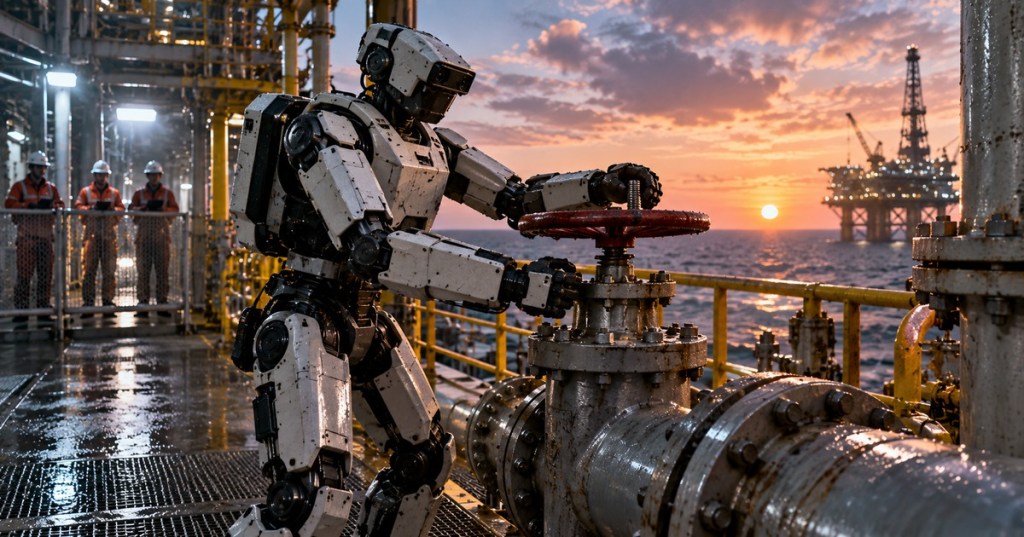
Minerva Humanoids has emerged from stealth with approximately $10 million in pre-seed funding and a very specific pitch for humanoid robotics: do not begin with household chores or warehouse demos. Begin with jobs where a human body should not have to enter the danger zone at all.
In its October 6 launch announcement, the San Francisco company introduced Roger, a purpose-built semi-autonomous humanoid for hazardous energy and public-safety operations. General Catalyst led the funding round, with Long Journey Ventures and Credo Ventures as co-leads.
Roger Keeps the Specialist in Control but Moves the Body Out of Danger
Minerva’s core design choice is not full autonomy. Its control stack keeps a trained human operator in command of critical manipulation while the robot handles balance, navigation and fall recovery. The operator uses a VR headset to see through Roger’s cameras and translate body motion into remote work.
That distinction matters in hazardous operations. Closing a valve during a gas leak, inspecting equipment on an offshore platform or handling a high-risk public-safety incident can demand human judgment and two-handed dexterity at exactly the moment when putting a person physically next to the problem carries the most risk.
BitcoinVersus.Tech recently covered SafeWorld’s $12.2 million push to stress-test GenAI robots before they work around people. Minerva is approaching the same safety problem from the opposite direction: rather than only making robots safer around humans, it wants the robot to replace the human body in the hazardous zone while preserving human judgment.
The First Target Is Hazardous Energy and Public-Safety Work
The company says its first paid pilots are launching this fall. Target applications include onshore and offshore oil and gas, high-voltage power environments, hazardous-material response and other high-risk public-safety work.
Minerva also says it has already completed on-site testing related to public-safety use cases at two of the world’s 10 busiest airports and presented its system to specialist safety organizations in Europe.
The industrial focus is not unique. BitcoinVersus.Tech previously examined Eni moving humanoid robots toward real industrial field testing, part of a broader shift away from stage demonstrations and toward machinery that can survive messy, hazardous operating environments.
A Five-Month Prototype Cycle Is Part of the Bet
Minerva says it moved from an idea to a fully functional walking prototype in five months. Its software and AI are primarily developed in the United States, while the first Roger prototypes are manufactured and assembled in Germany. The company says it ultimately plans production in both countries.
That supply-chain strategy matters because humanoid robotics is still constrained by actuators, motors, reducers, sensing, batteries, compute and specialized manufacturing. BitcoinVersus.Tech’s earlier look at Apptronik’s warning about the U.S. humanoid hardware bottleneck showed how difficult it is to scale physical AI when critical components are not available in volume.
The Founders Bring Tesla, MIT and Boston Dynamics Experience
CEO Sandor Felber previously worked on humanoid robotics research at MIT CSAIL and on Tesla’s Optimus program. CTO Maurice Rahme spent six years at Boston Dynamics and was a technical lead on the Stretch warehouse robot.
A recent Forbes Hungary profile traces Felber’s path from Tesla actuator work through MIT humanoid research and into Minerva, and describes the company’s funding as a record-setting pre-seed round for a startup with Hungarian founding roots.
The Safety Claim Needs One Important Qualification
Minerva says hazardous energy work is associated with roughly 7,000 deaths per year worldwide, or about one death every 75 minutes. That figure should not be read as a direct count from a global accident database. The company explicitly describes it as an estimate created by applying an International Labour Organization fatal-work-accident rate to an International Energy Agency estimate of the global energy workforce.
The larger point is still straightforward: many energy, industrial and public-safety tasks combine high consequence with environments that already justify remote operation. That makes them unusually strong early candidates for humanoid machines because the value proposition is not merely labor substitution. It is risk substitution.
Humanoids May Reach Dangerous Jobs Before They Reach Everyday Ones
The humanoid industry often sells a general-purpose future in which one machine eventually performs almost any physical job. Minerva is making the narrower argument that the fastest route to commercial value may be to start where the cost of putting a human in the work zone is already extremely high.
If the paid pilots work, Roger does not need to outperform a human at every task. It needs to let a skilled specialist apply judgment and dexterity from somewhere safer while the robot absorbs the physical exposure. That is a more modest definition of physical AI—but potentially a much easier one to justify economically.
BitcoinVersus.Tech
Advertisement
Editor’s Note
We volunteer daily to ensure the credibility of the information on this platform is Verifiably True. If you would like to support our research and publishing work, please donate here: 3C9o19EH5HSiwEPyCTmEKzxhNCbo2X6TTb
BitcoinVersus.tech is not a financial advisor. Content is provided for informational purposes.


Leave a Reply