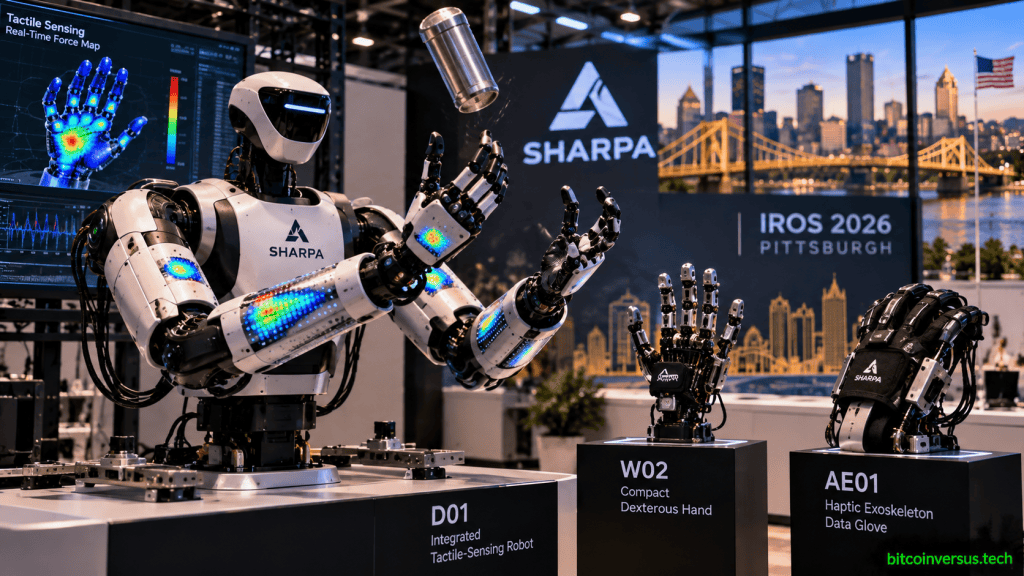
Sharpa has used IROS 2026 in Pittsburgh to unveil a three-part tactile robotics stack: the D01 integrated robot, W02 dexterous hand and AE01 haptic exoskeleton data glove. Together, the hardware targets one of physical AI’s hardest problems: collecting human demonstrations and turning them into fast, contact-aware manipulation.
D01 puts tactile sensing across the robot
The company says D01 combines dexterous hands, seven-degree-of-freedom arms and whole-body electronic skin. Sharpa specifies an approximately 1:1 arm payload-to-weight ratio, maximum end-effector speed above 10.5 meters per second, 1,000 Hz communications and 0.2 mm repeatability.
The electronic skin adds a second feedback loop. Sharpa lists a 100 Hz tactile sampling rate, a 0.1 to 20 newton force-sensing range and 0.2 N resolution. That allows the robot to detect contact across its body rather than depending only on cameras and joint position.
BitcoinVersus.tech recently covered contact-rich connector insertion with NVIDIA Isaac, where small errors in alignment make force feedback essential. D01 pushes the same principle into a larger integrated robot.
W02 shrinks a tactile hand to human scale
Supporting launch material describes W02 as a 21-degree-of-freedom hand weighing under 750 grams, with full-hand tactile sensing and IP54 dust and water resistance. The goal is to retain dexterity while reducing the size and mass hanging from a robot arm.
That direction complements the broader move toward robots that can use human tools rather than requiring a factory to redesign every object around a gripper. BitcoinVersus.tech has also tracked Agility’s latest Digit humanoid as commercial humanoid systems move toward more capable manipulation.
AE01 turns human motion into training data
AE01 closes the loop from human demonstration back to robot learning. The glove uses 22 encoders to capture hand motion and provides 256 levels of dynamic haptic feedback at each fingertip. Sharpa says it is calibration-free and designed to resist interference from electromagnetic fields, lighting, humidity and temperature changes.
That data pipeline matters because robot training increasingly depends on large volumes of high-quality demonstrations. Our recent coverage of XDOF’s robot-training data expansion showed how valuable real-world action data is becoming as physical-AI models scale.
Sharpa’s earlier hand shows why touch matters
The following English-language demonstration provides technical background on Sharpa’s tactile-manipulation approach. It covers the earlier Wave hand and CraftNet ecosystem that underpin the company’s newer hardware direction.
The IROS launch connects the three pieces into one development loop: AE01 captures a person’s movement and contact, W02 provides a compact tactile end effector, and D01 supplies an integrated robot body capable of high-speed contact-rich motion. The hardware is being shown at IROS in Pittsburgh through September 30.
BitcoinVersus.Tech Editor’s Note: Performance specifications in this story are manufacturer figures announced by Sharpa at IROS 2026. They should be treated as product specifications rather than independent benchmark results.
Support independent robotics, physical-AI and hardware reporting: 3C9o19EH5HSiwEPyCTmEKzxhNCbo2X6TTb
BitcoinVersus.tech is not a financial advisor. This media platform reports on financial subjects purely for informational purposes.


Leave a Reply