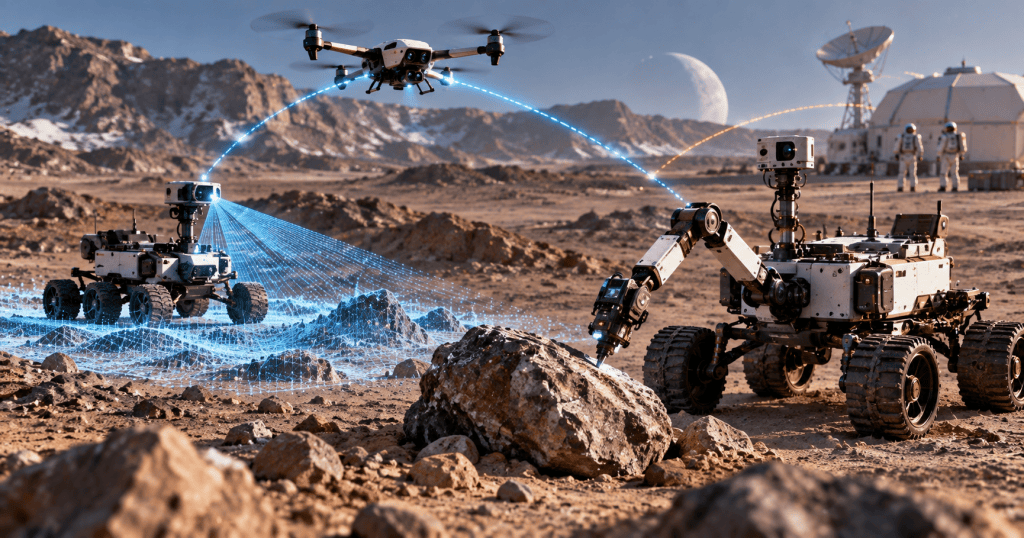
NASA is testing a different kind of planetary explorer: not one increasingly clever rover, but a small robotic science team that can decide which machine should investigate a discovery next.
During July field tests at the Virginia Tech Transportation Institute in Blacksburg, Virginia, NASA’s Adaptive Sensing Technology for Responsive Autonomy project—ASTRA—put a drone and two ground robots into a shared decision loop. According to NASA’s September 15 field report, the fleet was asked to behave less like three remote-controlled machines and more like an independent science team operating inside goals set by humans.
One Drone Scouts, Two Rovers Specialize
The machines did not all do the same job. The aerial drone carried environmental and science sensors and searched from above. One rover used lidar to build detailed terrain maps and provide navigation context. A second rover carried a robotic arm for collecting samples.
The interesting layer sat above the hardware. ASTRA’s software considered which robots were available, how far away they were, how quickly they could reach a target, the expected scientific payoff and the risk involved. It then assigned the job to the machine best suited to perform it.
A public X post highlighting the test neatly captured the difference: NASA is measuring fleet-level judgment, not simply whether one rover can navigate autonomously.
The Robots Can Notice Something New Without Losing the Mission
One test produced exactly the kind of situation that makes deep-space autonomy useful. While the fleet was already working on its original objective, the scouting drone identified another area of interest.
Instead of ignoring the discovery or abandoning the existing plan, the system paused long enough to evaluate the new opportunity and brought another robotic asset into the job. That is a more sophisticated problem than obstacle avoidance: the fleet had to preserve the original science objective while deciding whether an unexpected discovery deserved resources.
Independent coverage of the experiment emphasized the same distinction. The Virginia test demonstrated local decision-making under human-defined priorities; it did not establish that ASTRA is ready to independently explore Mars.
Why Deep Space Needs Decisions Onboard
The farther a mission travels from Earth, the less useful joystick-style control becomes. Communication delay means a robot can encounter a hazard or an interesting target long before a human team can receive the data, debate the response and send a new command.
ASTRA’s goal is not to remove scientists from the mission. Humans still establish the scientific priorities and acceptable risk. The autonomy layer tries to make tactical decisions inside those boundaries when waiting for Earth would waste time or when the terrain is too dangerous for people.
That complements the broader shift toward robotic exploration covered by BitcoinVersus.Tech. NASA’s recently selected Moon experiments target lava tubes, ice and surface hazards, all environments where machines capable of choosing and coordinating tasks could eventually become more valuable.
A Fleet Can Be More Useful Than One Giant Robot
A heterogeneous fleet also changes the failure model. Instead of building one machine that must fly, map, inspect and manipulate, a mission can distribute those capabilities across specialized platforms. The drone gets the high-angle view. The lidar rover maps. The arm-equipped rover physically interacts with the target.
The same modular logic is appearing elsewhere in space robotics. BitcoinVersus.Tech recently covered Honda and Redwire pairing a dexterous robotic hand with an orbital arm, another example of specialized robotic subsystems being combined into more capable machines.
ASTRA pushes that modularity outward: the “robot” is effectively the team. Sensors, mobility, mapping and manipulation can be distributed across separate vehicles while the decision software coordinates them around one science objective.
The Hard Part Is Trust
Giving robots more authority creates a tougher engineering requirement than simply making them smarter. Mission planners need to understand why a fleet selected one task over another, how it interpreted risk and what it will do when a sensor, communication link or robotic member fails.
NASA’s experiment is therefore best understood as a test of bounded autonomy. The system is not inventing its own mission. It is translating human scientific priorities into local choices while conditions change around it.
That distinction matters as physical AI expands from research demonstrations into real machines. BitcoinVersus.Tech has been tracking the same progression in terrestrial robotics, including robots gaining tactile sensing and dexterous manipulation. ASTRA adds another layer: deciding which robot should act, when it should act and whether the potential information is worth the risk.
Planetary Exploration Could Become Team Science
The July test was on Earth, not the Moon or Mars, and ASTRA still has a long path from field demonstration to mission-qualified autonomy. But the architecture points toward a compelling future.
Instead of mission control directing one rover through a queue of commands, scientists could define what they want to learn and give a mixed fleet enough autonomy to decide how to pursue it. A scout could discover. A mapper could characterize. A sampling robot could investigate. The fleet could adapt when something unexpected appears.
For distant worlds, the most important AI may not be the system that talks like a scientist. It may be the system that knows which robotic scientist should move next.
BitcoinVersus.Tech
Advertisement
Editor’s Note:
We volunteer daily to ensure the credibility of the information on this platform is Verifiably True. If you would like to support our research initiatives, please donate here: 3C9o19EH5HSiwEPyCTmEKzxhNCbo2X6TTb
BitcoinVersus.tech is not a financial advisor. This media platform reports on financial subjects purely for informational purposes.


Leave a Reply