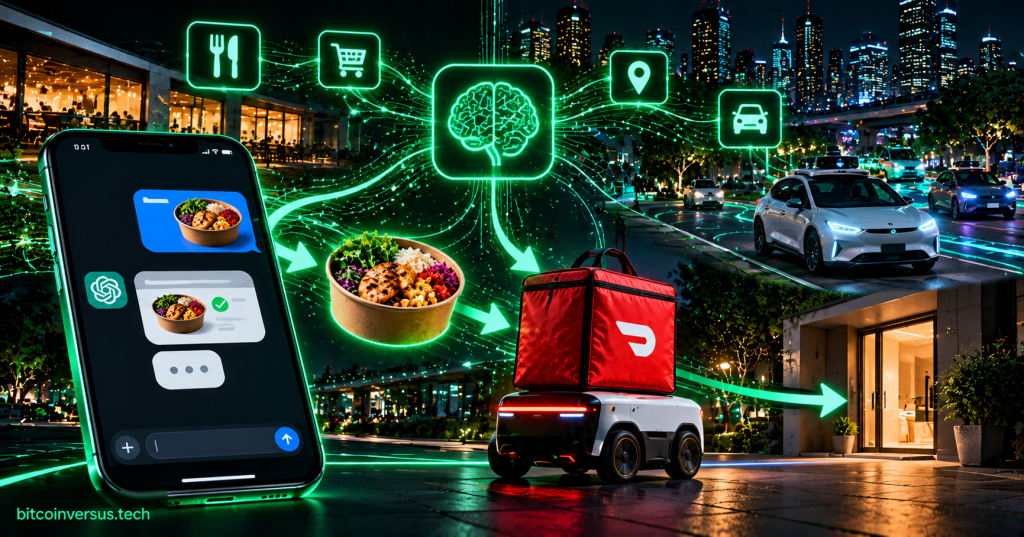
DoorDash is turning food delivery into an agentic-AI transaction. Instead of opening an app, searching restaurants, selecting modifiers and navigating checkout, U.S. iPhone users can join a beta that lets them text DoorDash what they want and let an AI agent do much of the work.
The shift is bigger than “AI recommendations.” DoorDash’s system can search local restaurants, remember preferences, assemble a suggested cart and manage checkout inside a text conversation. At the same time, AI is spreading across transportation platforms including Lyft, Uber and Waymo, where software is increasingly choosing, coordinating and even physically executing how people and goods move.
“Order my usual” is becoming an executable command
In DoorDash’s September 30 announcement, the company describes a text-based ordering beta that builds on Ask DoorDash. A customer can request a specific dish, ask for a recommendation based on mood or simply say “order my usual.” The system searches local options, suggests a cart and can complete checkout without requiring the customer to open the DoorDash app.
DoorDash co-founder Andy Fang described the larger idea in a public X post: the agent can learn from repeat orders, help find deals, coordinate group orders and even analyze a photo of a refrigerator to identify missing recipe ingredients. Fang called agents a new app paradigm.
DoorDash is also giving outside AI agents a way to act
The deeper technical development is DoorDash MCP. Through the Model Context Protocol, approved corporate tools and agents can discover restaurants and retailers, build carts, manage delivery details, submit orders, check status, fetch receipts and reorder from history after the user authorizes access.
That turns DoorDash into something closer to an action layer for AI. A workplace assistant could collect lunch requests in a Slack thread and place the group order. An inventory-aware office agent could notice snacks are running low and prepare a restock. The important transition is from an AI that produces text to an AI that can cause a real transaction and delivery to happen.
TechCrunch’s coverage notes that the U.S. text-ordering experience is currently a waitlist beta and positions the launch against delivery competitors including Uber Eats and Grubhub.
Rideshare is moving toward AI execution too
DoorDash is not alone in turning transportation and local commerce into an AI-coordinated system. Lyft announced in March that it would use NVIDIA technology for agentic AI, predictive modeling, mapping and future Level 4 autonomous fleet architectures. In September, Lyft began matching riders with fully autonomous Waymo vehicles in Nashville.
Uber is pursuing a similar hybrid marketplace strategy, combining human drivers with autonomous-vehicle partners. BitcoinVersus.Tech previously covered Uber’s partnership with May Mobility for self-driving rides, an early example of a ride-hailing interface becoming the front end for an autonomous driving system.
Waymo shows where that progression can lead. BitcoinVersus.Tech has followed the technology since a Waymo autonomous vehicle was stopped by Phoenix police after a traffic violation. Today, Waymo rides can be surfaced through third-party transportation platforms in selected markets, meaning a familiar rideshare app can increasingly become an interface to a vehicle whose driving decisions are made by software.
Food, freight and rides are converging around autonomous systems
The same pattern extends beyond passenger cars. BitcoinVersus.Tech recently reported on Aurora’s first commercial autonomous freight run in Texas. Put these developments together and a broader architecture is emerging: AI interprets intent, software selects a service, digital systems execute the transaction, and increasingly autonomous machines handle physical movement.
DoorDash’s new agent does not drive the delivery vehicle itself, and rideshare AI is not identical to an ordering agent. But they occupy adjacent layers of the same stack. One system decides what should be purchased and initiates the transaction; another can decide how a vehicle navigates the physical world.
The app may eventually disappear behind the agent
The most consequential part of DoorDash’s announcement may be that the company is deliberately letting customers skip the traditional app interface. If consumers become comfortable saying “order my usual,” “get me a ride home,” or “restock the office,” the competitive interface could shift from rows of app icons to whichever AI agent has permission to act.
That creates new questions about authorization, payments, privacy and accountability, but it also points toward a much simpler computing model: tell an agent the outcome you want, approve the important decisions, and let software coordinate the services underneath.
BitcoinVersus.Tech
Advertisement
Editor’s Note
We volunteer daily to ensure the credibility of the information on this platform is Verifiably True. If you would like to support to help further secure the integrity of our research initiatives, please donate here: 3C9o19EH5HSiwEPyCTmEKzxhNCbo2X6TTb
BitcoinVersus.tech is not a financial advisor. This media platform reports on financial subjects purely for informational purposes.


Leave a Reply