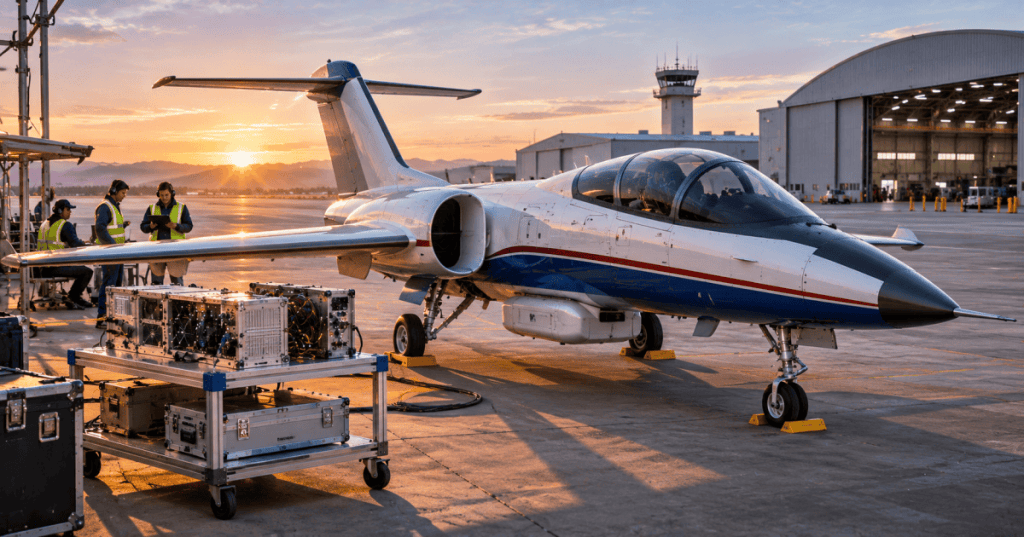
NASA unveiled the X-70 Fractal on November 4, 2026, introducing a crewed experimental aircraft intended to test advanced flight controls and rapidly interchangeable research payloads. Announced during the UP.Summit at Kennedy Space Center, the X-plane is designed to carry up to 2,000 pounds of experimental equipment. NASA expects its first flight under the agency’s banner within two years. The published performance figures are design targets rather than measured X-70 flight results.
The X-70 is conceived as a reusable flying laboratory. Engineers could replace internal or external instrumentation between experiments rather than dedicate a separate aircraft to every test. NASA says a rapidly reconfigurable flight-control system will support research into maneuverability in crewed flight. The agency has not disclosed the final airframe configuration, manufacturer, program cost or flight-test schedule.
NASA’s December 2025 retrospective covers the X-59’s first flight and engineering test program. X-59 is a separate research aircraft; the video does not show the new X-70 Fractal.
NASA’s proposed performance figures
The agency lists a 10,000-pound takeoff weight, cruise at Mach 0.75, an altitude capability of 45,000 feet, and range exceeding 1,500 nautical miles, or approximately 1,726 statute miles. The 2,000-pound experimental payload allowance includes equipment carried internally or externally. Those numbers describe intended capability, not successful performance measured during X-70 test flights.
Mach number compares aircraft speed against the local speed of sound, which changes with atmospheric conditions. A Mach 0.75 cruise is subsonic; the X-70 has not been announced as a hypersonic transport. Earlier BitcoinVersus.Tech coverage of China’s Mach 4 test-aircraft claims discusses a separate research objective, with different propulsion challenges and evidentiary requirements.
Swappable experiments need careful engineering
Flight-test aircraft carry sensors, data recorders, telemetry links and prototype control equipment to measure how real machines respond to commanded maneuvers. Rapid payload swaps could reduce preparation time between different research campaigns. Yet a 2,000-pound payload allowance does not reveal available electrical power, cooling capacity, mounting interfaces or permitted center-of-gravity changes for every experiment.
Integration and safety qualification remain essential. A changed research package must be evaluated for weight distribution, structural attachment, electrical compatibility, interference and crew safety. Similar experimental discipline appears in NASA’s autonomous science-robot testing and wireless-powered drone endurance work, although neither project is part of the announced X-70 program.
NASA Armstrong Flight Research Center documented the X-59’s June 2026 supersonic milestone. The footage illustrates the need for real flight measurements, not an X-70 demonstration.
An X-plane built for versatility
NASA’s X-plane lineage spans the Bell X-1, which broke the sound barrier in 1947, the rocket-powered X-15, and today’s X-59 quiet-supersonic aircraft. X-59 pursues acoustic research; X-70 is planned to support multiple experiments using modular hardware and reconfigurable flight controls. NASA has not yet supplied X-70 flight data showing how well the proposed design achieves its maneuverability goals.
The engineering logic resembles NASA’s Artemis docking-rehearsal planning: components and procedures need to be validated under real operating conditions before ambitious objectives can be considered demonstrated. An experimental aircraft is not an orbital launch vehicle, however, and its instrument payload rating should not be confused with the rocket payload concepts explained in the mechanics of multistage rockets.
NASA’s measurable milestones will be disclosure of a final configuration and test plan, safe integration of experiments, ground checks and eventually research flights. Until those events, the X-70 Fractal remains a development commitment, not proof of an already operational aviation capability.
Editor’s Note: NASA’s November 4 release is the primary source for design specifications and schedule expectations. The Verge and AeroTime provide independent context. The featured artwork is original conceptual illustration, not an official X-70 design or photograph. Both NASA videos depict the separate X-59 program.

For mobile scanning, open the article on another display and scan the original QR code with a compatible Bitcoin wallet. Verify the destination before donating 5,000 sats: 3C9o19EH5HSiwEPyCTmEKzxhNCbo2X6TTb.
We volunteer daily to ensure the credibility of the information on this platform is Verifiably True. If you would like to support our work and help further secure the integrity of our research initiatives, please scan the QR code below to donate 5,000 sats.
BitcoinVersus.tech is not a financial advisor. This media platform reports on financial subjects purely for informational purposes.


Leave a Reply