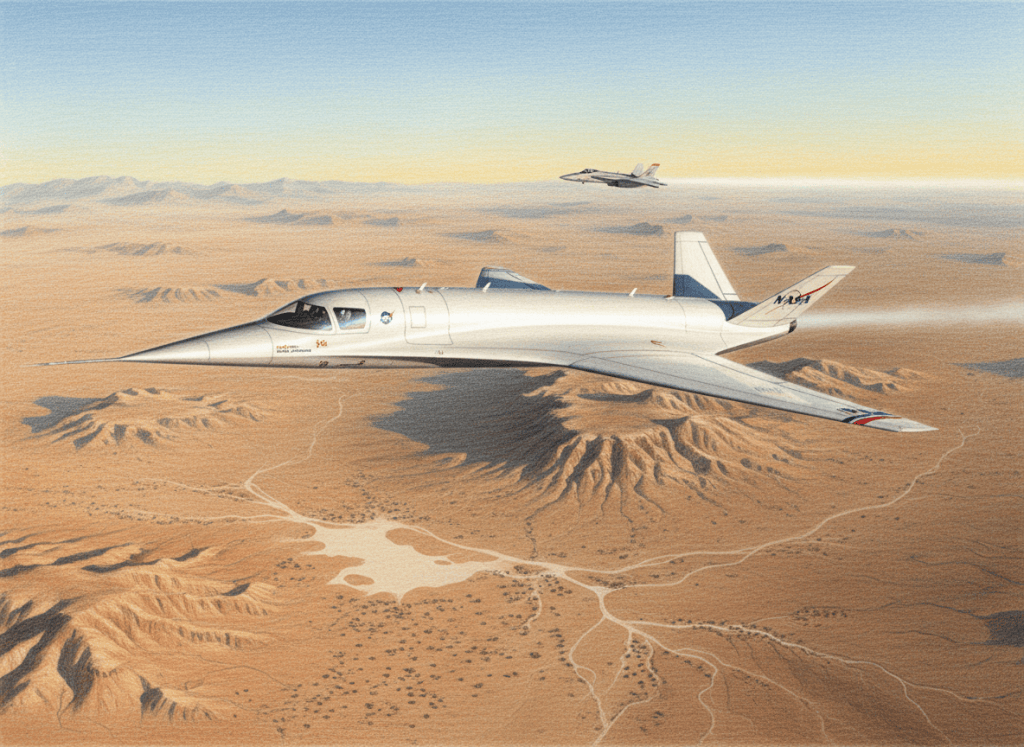
NASA officially accepted its X-59 experimental aircraft from Lockheed Martin Skunk Works on November 18, 2026, according to a November 23 announcement. The transfer closes a major aircraft acceptance milestone for the agency’s Quesst program and shifts attention toward proving whether supersonic flight can produce tolerable noise at ground level.
Lockheed Martin had retained ownership during flight testing at NASA’s Armstrong Flight Research Center in California. The manufacturer will continue providing assistance when needed, while NASA operates the research aircraft. The X-59 first flew on October 28, 2025, and exceeded the speed of sound on June 5, 2026.
NASA footage: the X-59’s first supersonic flight, June 5, 2026. Historical test footage, not the November ownership transfer.
Engineering a quieter shock wave
A conventional supersonic aircraft creates pressure disturbances as it displaces air faster than sound can travel through the surrounding atmosphere. Shock waves can combine into pronounced pressure changes that reach the ground as a sonic boom. Engineers designed the X-59’s elongated nose and carefully shaped fuselage to distribute those disturbances rather than allow them to merge into a stronger signature.
NASA’s June 12 flight report recorded Mach 1.4 at approximately 55,030 feet, close to the intended test conditions. The mission’s nominal speed is about 925 mph at 55,000 feet. The long nose also complicates direct forward visibility, so the aircraft uses an external vision system to provide the pilot with a forward view.
A NASA propagation study identifies a target of 75 perceived-level decibels under standard atmospheric conditions. Perceived level is a specialized psychoacoustic measurement, not a direct substitute for ordinary A-weighted sound readings. A later NASA simulation study estimated a practical range of 72 to 86.7 perceived-level decibels across modeled atmospheric conditions. Neither calculation constitutes a completed community noise trial.
From aircraft acceptance to acoustic validation
The Quesst mission plan separates the research into three stages: construction and initial flight testing, acoustic validation, and community response testing. The second stage examines whether the predicted low-boom signature holds under actual atmospheric conditions. Weather, altitude, trajectory and aircraft configuration can influence how pressure waves propagate.
NASA’s Quesst mission overview, linked from the agency’s official mission page, explains the quiet supersonic research program.
The approach complements NASA’s broader experimental aircraft portfolio, including the X-70 modular flight research platform. The same distinction between simulation and operational validation applies to NASA’s autonomous lunar landing research, future satellite communications relays, and robotic orbital construction experiments. Each requires physical evidence before a prototype can support broader deployment.
What commercial aviation still needs
The final Quesst phase calls for flights over selected American communities and surveys of residents’ responses. Regulators can use the resulting acoustic and human-response data when considering noise-based standards. The X-59 is a single-seat research aircraft, not a passenger airliner, and acceptance does not certify commercial operations or guarantee any regulatory change.
Commercial developers must separately address propulsion efficiency, operating costs, airport noise, maintenance, safety certification and environmental performance. A quieter sonic signature could remove one important obstacle, but an economically competitive passenger aircraft requires much more than a successful acoustic demonstration. The November transfer matters because NASA now owns the instrument designed to gather evidence for the next decision.
We volunteer daily to ensure the credibility of the information on this platform is Verifiably True. If you would like to support to help further secure the integrity of our research initiative, please scan the QR code below.



Leave a Reply