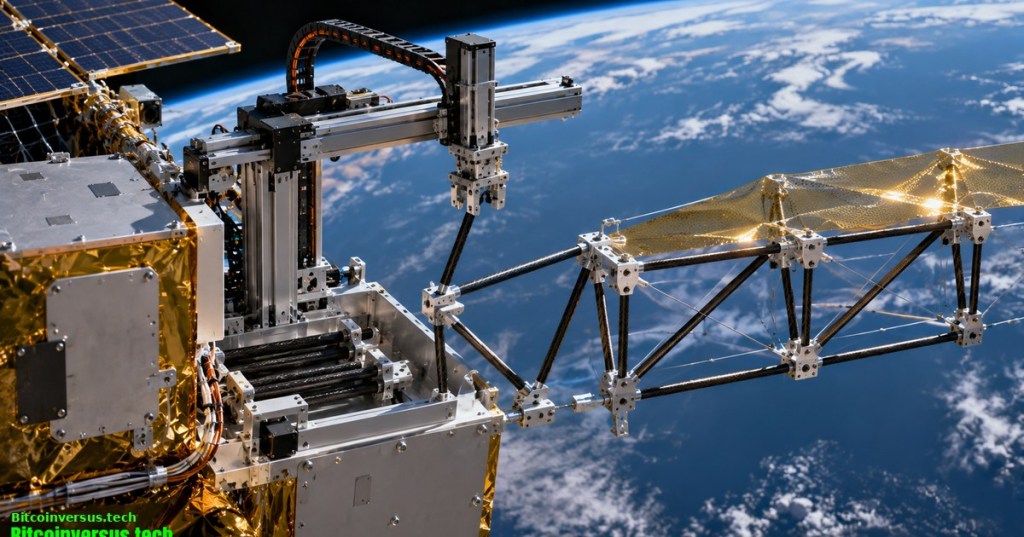
A Caltech-built robot has assembled a new structural section in orbit without astronauts, establishing an important demonstration of how future spacecraft might construct antennas and other structures after launch. The achievement, announced by Caltech and the U.S. Defense Advanced Research Projects Agency (DARPA) on November 5, 2026, comes with a significant qualification: the planned 1.4-meter reflector antenna is unfinished. The experiment built one new truss section in space, not a completed operating satellite dish.
Official demonstration video linked from Caltech’s November 5 announcement. The footage concerns the ASTRA on-orbit assembly project. Video identity is linked by Caltech; independent live playback testing is not confirmed.
A Robotic Constructor Packed Into One Cubic Meter
The machine is called ASTRA, short for Autonomous In-Space Tensioned Reflector Assembly. It flew aboard Momentus’s Vigoride 7 vehicle on the March 30 SpaceX Transporter-16 mission. The roughly one-cubic-meter payload carried a gantry manipulator, motorized parts dispensers and two truss bays assembled on Earth. Once in orbit, engineers commanded deployment of the existing bays, followed by assembly of a third from separate components.
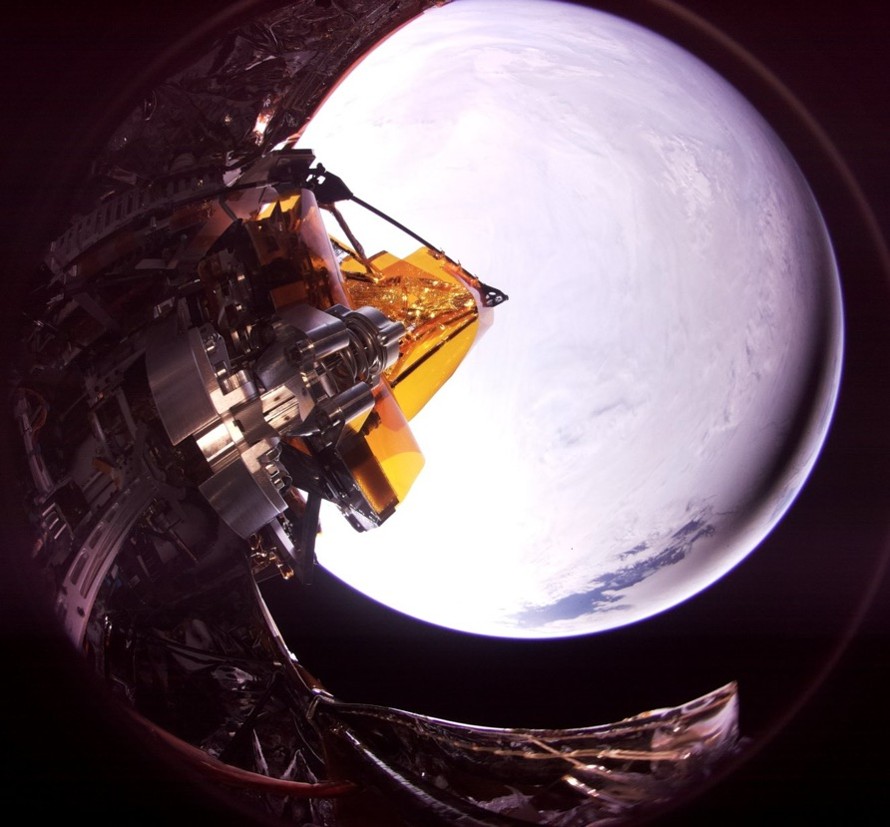
ASTRA’s manipulator travels along three linear axes, retrieves composite-fiber tubes and aluminum joints, and joins them on an assembly plate. Its design also incorporates a thin perforated Kapton film and tensioned reflective nets. DARPA emphasizes straightforward mechanical sequencing rather than sophisticated artificial intelligence. The innovation lies in transporting raw structural elements in a small enclosure and repeatedly assembling them where the finished structure will operate.
One New Bay Completed, Eight Still Missing
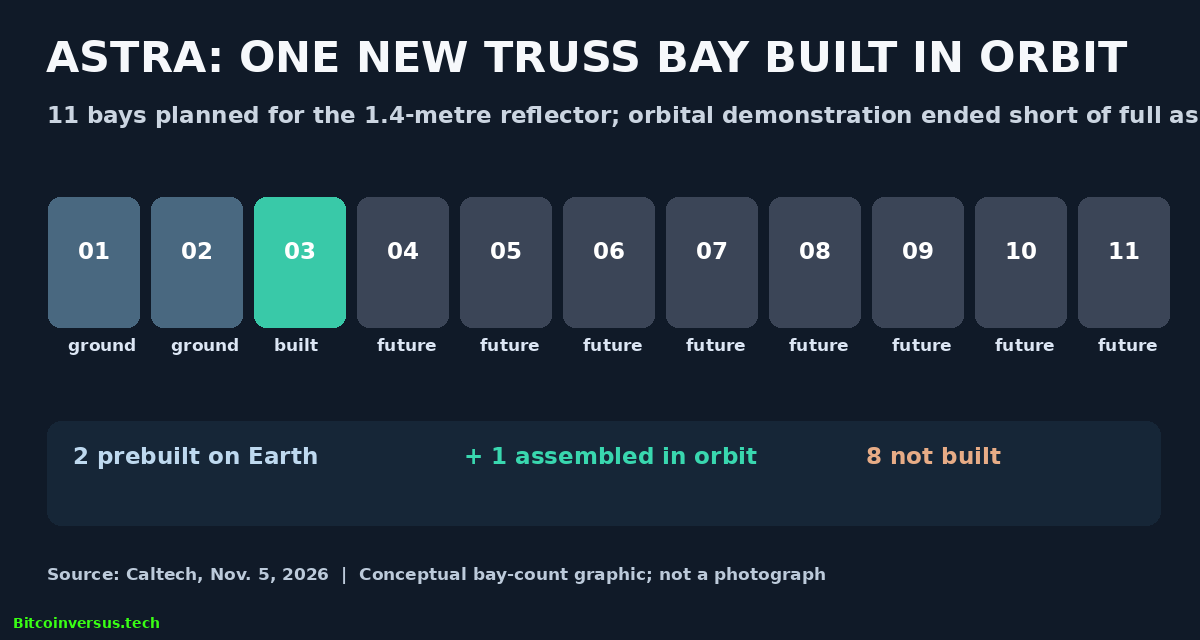
The intended reflector needs 11 truss bays. Two reached space already assembled; ASTRA manufactured one additional bay in orbit, leaving eight unbuilt sections. In engineering terms, the result validates a critical assembly operation but does not prove full-aperture deployment, pointing accuracy or radio performance. Caltech expects its mission to end in December and says completing the entire truss is unlikely.
The distinction matters because many spacecraft use rocket architectures that constrain payload dimensions, mass and launch survivability. Future large antennas or telescopes may exceed the volume a rocket fairing can accommodate. Existing space-telescope programs illustrate the importance of carefully engineered deployable instruments; ASTRA explores construction as an alternative to packing every structural element into a folded assembly.
Ground Control and a Twin Robot Solved Problems
Despite the term autonomous, researchers did not simply press a button and leave ASTRA unattended for six months. Ground operators sent commands, inspected photos and reproduced problems on a spare robot in a Caltech laboratory. Communication occurred during roughly seven or eight windows of 15 minutes daily. Those windows equal approximately 105–120 minutes of potential daily access, before accounting for operational delays or unavailable connections. Repeated troubleshooting helped advance the demonstration but limited overall completion.
Earlier orbital assembly proposals and NASA’s lunar infrastructure plans show why the technology could matter beyond reflector antennas. DARPA envisions eventual structures spanning hundreds of meters or more; those dimensions remain ambitions rather than demonstrated results.
A Step Toward Space Construction, Not a Finished Factory
Scaling the method would require reliable repeated joining, materials handling, calibration, robotic fault recovery and years of environmental durability. Large solar arrays and communication reflectors could benefit, although orbital thermal-management constraints would still apply to powered systems. Caltech and DARPA have demonstrated that a robot can build a new structural element in orbit; proving commercial-scale space manufacturing remains a separate challenge.
Primary sources: Caltech official announcement, November 5, 2026; DARPA NOM4D update and video, November 5, 2026. Independent follow-up: Space.com coverage, November 10, 2026.
BitcoinVersus.Tech Editor’s Note
Published November 10, 2026. Caltech’s ASTRA experiment assembled one new bay in orbit after launching with two prebuilt bays. The eleven-bay reflector antenna was not completed, and no fully operational reflector is claimed. The cover is a conceptual editorial illustration, not an authenticated flight photograph. The in-story orbital photograph is credited to Caltech/Momentus via DARPA. The bay-count graphic is original BitcoinVersus.Tech analysis of published mission status. The official Caltech-linked video was embedded through WordPress; independent playback and mobile-device tests are reported separately.
We volunteer daily to ensure the information on BitcoinVersus.Tech is Verifiably True. Our independent coverage distinguishes experimental hardware, operational achievements, proposals and engineering limitations. Readers may voluntarily support reporting using the original QR below.

Readers may optionally contribute 5,000 satoshis. Scan the QR using a Bitcoin wallet on a second screen, or use a mobile wallet with saved-image QR scanning. Independently verify destination 3C9o19EH5HSiwEPyCTmEKzxhNCbo2X6TTb and amount before paying; Bitcoin payments are irreversible.
BitcoinVersus.Tech is an independent, volunteer-run educational technology publication. Coverage is provided for informational purposes, not financial or investment advice.


Leave a Reply