
MIT researchers are exploring a way to construct buildings with simple, low-cost robots and sophisticated interlocking blocks, shifting the burden of precision from the machine into the material. In a November 18, 2026 research profile, engineer Miana Smith described voxels, lightweight lattice units that correct placement errors as robots assemble them. Her team has built room-scale, load-bearing demonstrations, including a small experimental house. The researchers are investigating how such systems could reduce material consumption in construction, but no commercial, code-approved housing development has been demonstrated. MIT’s latest account details the work.
How blocks compensate for imperfect robots
A voxel is a repeating three-dimensional structural cell, not a conventional solid brick. MIT’s lattice units use geometry and snap-fit features to guide adjacent pieces into alignment. When an inexpensive robot approaches slightly off target, the joint can settle into its intended position rather than passing the error to the next block. The lab reports tolerance for about 10 millimeters of robotic placement error, compared with roughly 100 micrometers typically associated with industrial precision robots. Those are fundamentally different machine requirements, not proof that an entire completed structure stays within 10 millimeters of its design.
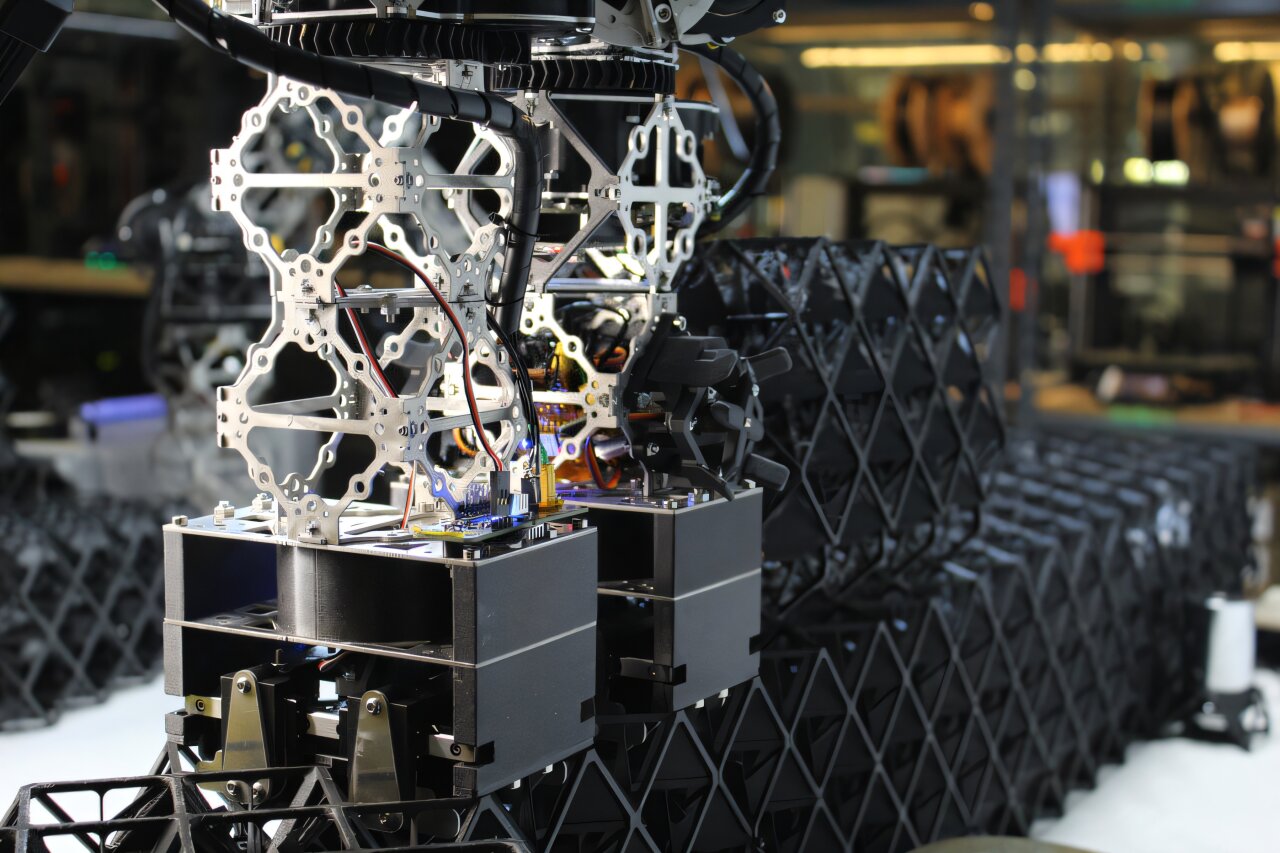
An inchworm that assembles its own route
MIT’s Modular Inchworm Lattice Assemblers, or MILAbots, anchor to an existing lattice, extend their bodies and grip the next unit. As the structure grows, it becomes the robot’s working surface and navigation reference. The team redesigned earlier cells, which could require as many as 24 separate connectors, into larger assemblies with fewer vulnerable joints. Strong, stretch-dominated octet lattices distribute loads through interconnected members rather than relying mainly on bending. Related experiments with architected mechanical metamaterials explain why lattice geometry matters.
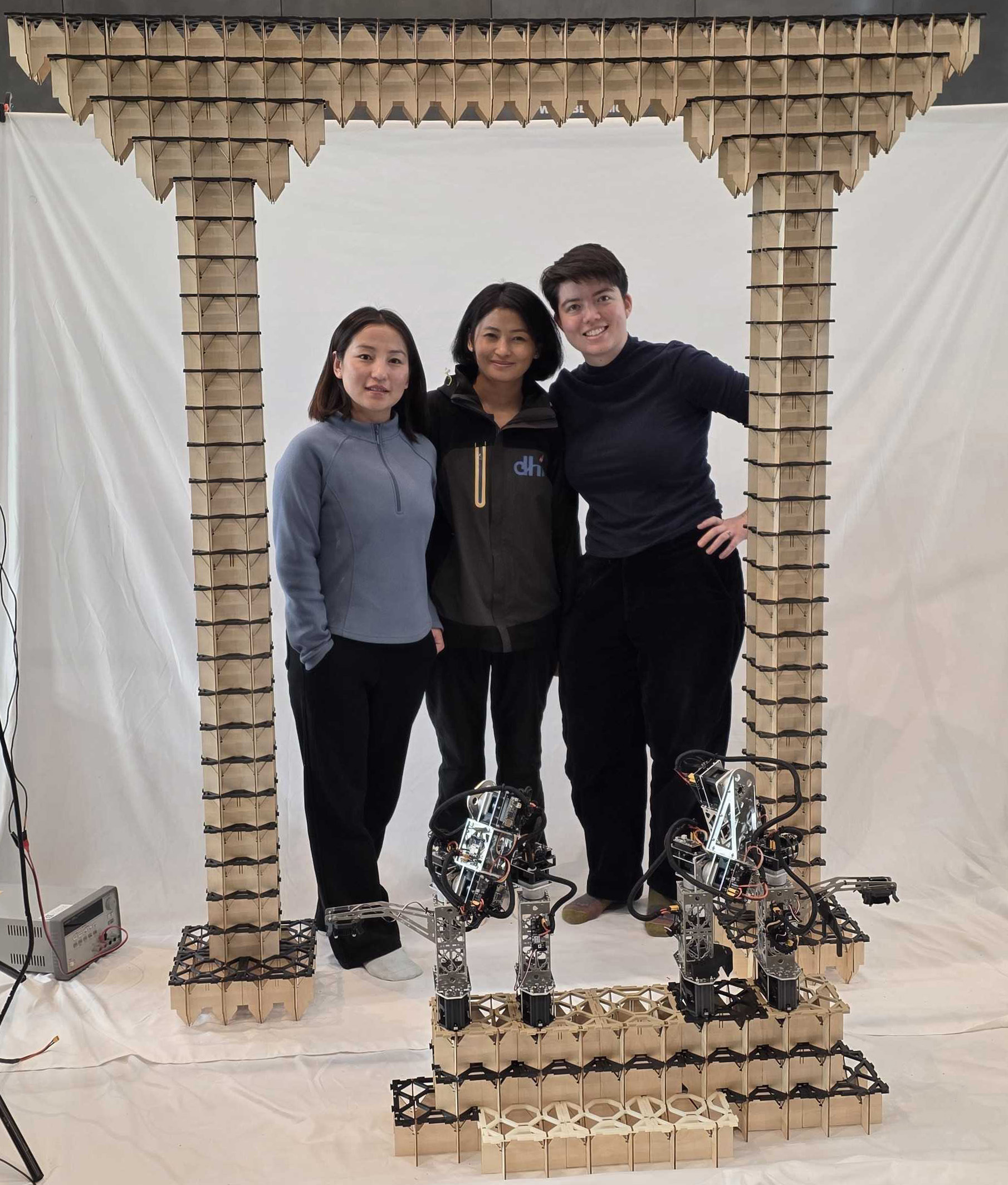
The carbon numbers are modeled, not construction-site measurements
In an April 2026 peer-reviewed engineering study, the researchers compared materials and modeled construction of a simplified one-story building. Their plywood voxel design was estimated to generate approximately 76%–82% less embodied carbon than the examined 3D-printed-concrete alternatives. Steel voxels offered smaller reductions; some plastic designs performed poorly. The study also projected about 99 hours of on-site robotic assembly versus 155 hours for selected conventional methods. Those figures depend on material sourcing, chosen designs and assumptions. They are not measured emissions or construction hours from occupied buildings.
The same research direction appears in MIT’s fabric-formed low-material concrete beams and AI-based structural optimization. Each seeks to place material where loads require it, rather than using uniformly oversized components.
What has actually been built, and what comes next?
Smith’s team has assembled room-scale load-bearing structures, including an experimental house made from plywood voxels. In the November interview, MIT reported a collaboration with Bhutan’s Druk Holding and Investments connected to Gelephu Mindfulness City, with outdoor testing still planned. Further work must establish weather resistance, connections, fire performance, insulation, plumbing and electrical integration, maintenance, code compliance and true construction costs.
An appealing feature is reversibility: components could theoretically be removed, reused and reconfigured instead of discarded during renovation. The idea resembles the modularity in factory-built data centers, but building-scale structural certification imposes additional demands. MIT is also extending the robotic assembly research toward larger geometries; orbital truss-construction research illustrates a distinct environment where lightweight modular structures may help.
The near-term result is a working research method for getting reliable structures from deliberately imprecise robots. Claims of dramatically cheaper, greener cities remain engineering opportunities to validate, not established commercial outcomes.
Sources and visual verification
- MIT News, November 18, 2026: Building blocks for a greener skyline
- MIT News, April 28, 2026: robotic voxel feasibility study
- Automation in Construction, volume 187, DOI 10.1016/j.autcon.2026.106952
- MIT Center for Bits and Atoms: full research manuscript
- MIT Media Lab: Miana Smith doctoral research and laboratory-scale demonstrations
- MIT Center for Bits and Atoms self-assembling modular robots: historical YouTube demonstration, direct link only
Media disclosure: The 1200 × 630 oil-painted cover is conceptual editorial artwork, not an MIT construction-site photograph. The approved BitcoinVersus.tech secondary watermark is pasted once, unmodified, at bottom-left. Both body photographs show actual MIT laboratory work from April 2026 and are labeled accordingly. The historical YouTube source is linked, not embedded: live playback could not be verified.
We volunteer daily to ensure the credibility of the information on this platform is Verifiably True. If you would like to support to help further secure the integrity of our research initiative, please scan the QR code below.



Leave a Reply