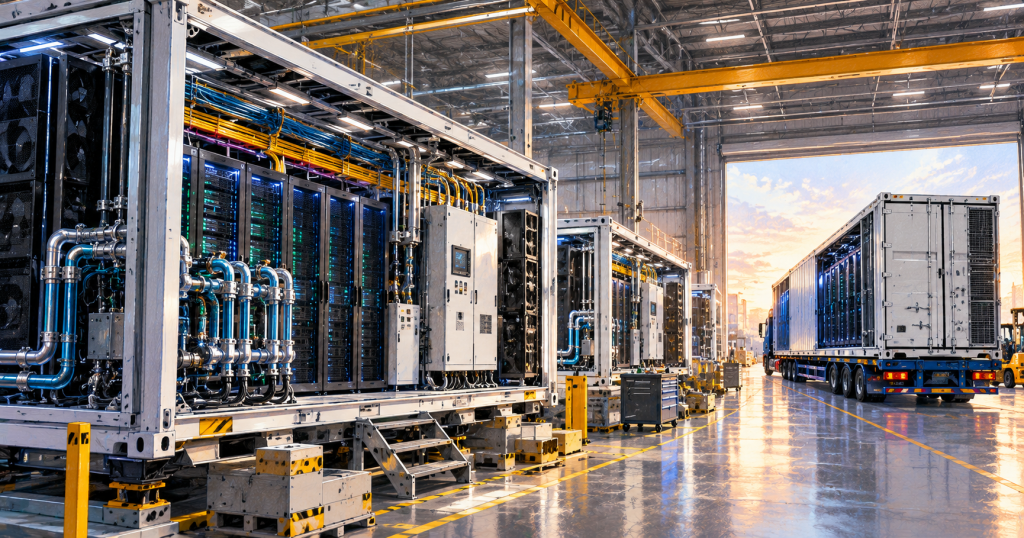
Submer Group is turning modular AI infrastructure into a dedicated business. The company has launched Corenix, a new operation focused on factory-built data center platforms for neoclouds, hyperscalers, and AI operators that want complete power, cooling, networking, and IT systems assembled before they reach the construction site.
Submer said in its launch announcement that Corenix will engineer, integrate, and factory-test complete functional modules before shipment. Installation, utility connection, site acceptance testing, commissioning, and operational readiness then move to the customer site.
The launch was also highlighted by Data Center Dynamics in a September 29 post covering Submer’s move into modular data center infrastructure.
Build the Data Center Before It Reaches the Site
Corenix is built around a simple construction idea: move as much integration work as possible into a controlled factory. Instead of treating the data center as a collection of separate field-installed systems, the company plans to assemble IT racks, electrical distribution, cooling equipment, networking, controls, and structural elements as coordinated modules.
That approach fits a wider shift BitcoinVersus.Tech has been tracking as modular data centers target the AI construction boom. AI clusters are growing faster than conventional construction schedules, making prefabrication attractive when power and GPUs are available before a traditional building can be completed.
Corenix says its platforms will be based on NVIDIA reference designs and customized around each deployment. Factory testing can expose integration problems before modules arrive at a live site, where troubleshooting is more expensive and delays can affect energization schedules.
Power, Cooling, Networking, and Compute Become One Product
The modular model becomes more important as AI racks stop behaving like ordinary server rows. High-density accelerators require tightly coordinated electrical distribution, liquid cooling, network fabrics, controls, and mechanical systems. A change in one layer can affect every other layer.
BitcoinVersus.Tech recently examined the same integration pressure in NVIDIA DSX Ready infrastructure, where power and cooling equipment are increasingly validated around complete AI factory designs rather than isolated components.
Submer brings a liquid-cooling background into Corenix. The parent company has spent years working with immersion and direct-liquid-cooling systems, giving the new unit experience with the thermal side of dense accelerated computing. For readers following the physical layer, BitcoinVersus.Tech’s guide to air, water, and immersion cooling explains why higher rack density increasingly changes the rest of the facility design.
Corenix Targets the Construction Bottleneck
Independent coverage from Data Center Dynamics confirms that Corenix is aimed at neoclouds, hyperscalers, and AI operators, with former Johnson Controls executive Martin Renkis appointed CEO. Renkis previously worked in data center infrastructure services, giving the new operation a leadership team centered on deployment rather than only component manufacturing.
The bottleneck Corenix is targeting is increasingly physical. AI operators can order accelerators and networking equipment faster than many campuses can complete traditional design, procurement, construction, integration, and commissioning. Factory-built modules can compress portions of that schedule by allowing building work and infrastructure assembly to happen in parallel.
Modularity also changes expansion planning. A campus can add standardized blocks as power becomes available instead of waiting for one enormous hall to reach completion. The tradeoff is that interfaces between modules, utility systems, software controls, and site-specific infrastructure have to be engineered carefully enough for repeatable deployment.
AI Factories Are Becoming Literal Factories
The most interesting part of the Corenix launch is how closely data center delivery is beginning to resemble industrial manufacturing. Racks, cooling loops, power distribution, networking, and controls are moving toward pre-engineered assemblies that can be built, tested, shipped, connected, and repeated.
That does not eliminate site engineering. Grid connections, backup power, civil work, water strategy, heat rejection, security, and local regulations remain location-specific. Corenix is instead trying to shrink the portion of the project that has to be invented again in the field.
If the model works at scale, the competitive question for AI infrastructure suppliers may become less about who can design the most impressive data center and more about who can manufacture a repeatable one, test it before shipment, and bring it online with the fewest surprises.
Editor’s Note
We volunteer daily to ensure the credibility of the information on this platform is Verifiably True. If you would like to support our research initiatives, please donate here: 3C9o19EH5HSiwEPyCTmEKzxhNCbo2X6TTb
BitcoinVersus.tech is not a financial advisor. This media platform reports on financial subjects purely for informational purposes.


Leave a Reply