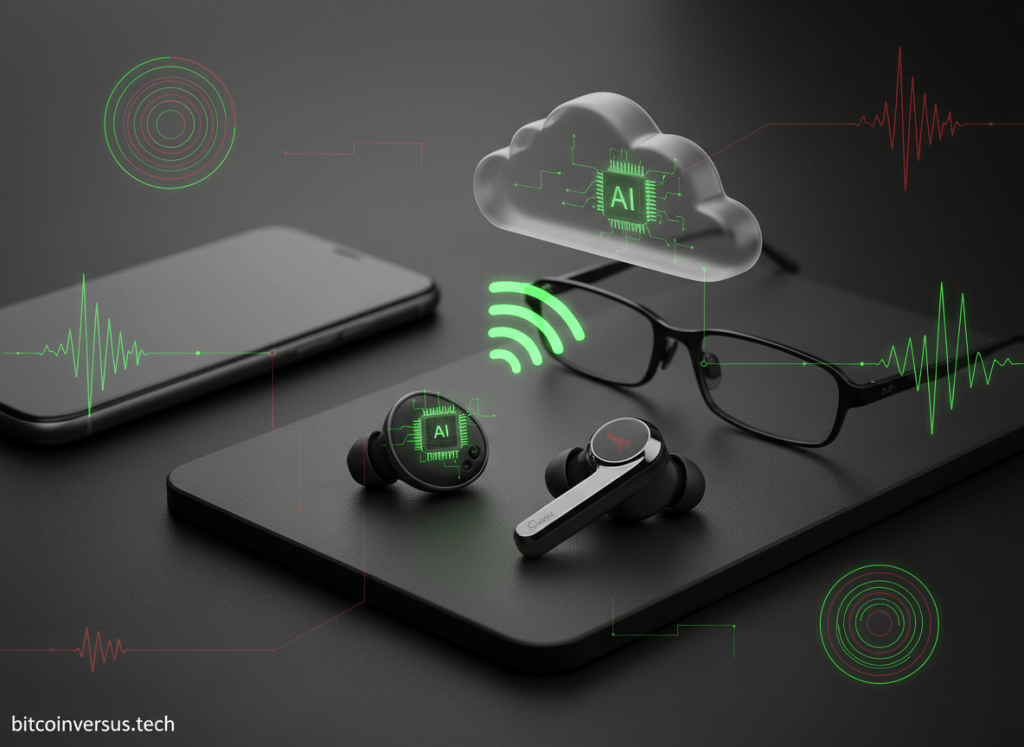
Qualcomm’s Snapdragon Sound Elite Gen 2 is pushing wireless earbuds beyond their traditional role as phone accessories by combining on-device AI, integrated micro-power Wi-Fi 6E and direct cloud connectivity inside the audio platform itself.
Qualcomm introduced the platform at Snapdragon Summit 2026 and described the shift in a September 23 post as a move toward more adaptive, personalized audio experiences built for what the company calls the Personal AI era.
The official launch announcement says Snapdragon Sound Elite Gen 2 combines premium audio processing, on-device intelligence, security-focused cloud connectivity and integrated micro-power Wi-Fi 6E. Qualcomm claims up to twice the AI capability of its predecessor, up to 40% lower power consumption and a footprint up to 30% smaller.
The important change is direct-to-cloud connectivity
Traditional wireless earbuds depend heavily on a nearby phone. Bluetooth carries audio and control data, while applications, cloud services and most complex computation remain on the handset.
Snapdragon Sound Elite Gen 2 changes that architecture by integrating low-power Wi-Fi directly into the audio platform. That gives manufacturers a path to build hearables that can reach cloud services without routing every interaction through a smartphone.
An independent SoundGuys review of the announcement notes that direct Wi-Fi access could support translation, transcription and AI-assistant interactions while reducing dependence on the phone as the central processing gateway.
On-device AI keeps part of the workload local
Direct cloud access does not mean every task has to leave the device. Qualcomm is also increasing local AI capability so multiple audio and intelligence functions can run inside the wearable.
That balance between local and cloud execution mirrors the broader Snapdragon strategy BitcoinVersus.tech recently covered in Qualcomm’s latest mobile processors. Phones increasingly run AI locally for latency, privacy and responsiveness while still reaching cloud models when the job is too large or needs outside information.
In earbuds, local processing is especially valuable because latency is noticeable. Noise cancellation, voice pickup, hearing personalization and environmental adaptation all need to react quickly enough that the user does not perceive the computation happening.
Camera-equipped earbuds blur the line with smart glasses
Qualcomm is not limiting the platform to conventional earbuds. The company explicitly includes audio glasses and camera-equipped hearables among the form factors Snapdragon Sound Elite Gen 2 is intended to support.
A camera changes the type of context an AI agent can receive. Instead of only hearing the user’s voice and surrounding audio, a multimodal device could also interpret what the wearer is looking at and combine vision with speech.
BitcoinVersus.tech recently examined the same trend in local AI smart glasses, where manufacturers are moving more perception and inference closer to the wearable rather than treating glasses as a simple camera connected to a phone.
Power efficiency determines whether Personal AI is practical
Earbuds have one engineering constraint that phones and laptops do not: there is almost no room for battery. Adding AI accelerators, Wi-Fi radios, microphones, sensors and potentially cameras only works if each component consumes very little power.
Qualcomm’s claimed 40% reduction in platform power and 30% smaller footprint therefore matter as much as the headline AI performance increase. A feature that drains an earbud in minutes is not a useful wearable feature, no matter how sophisticated the model behind it is.
The same efficiency problem is shaping the wider wearable market. BitcoinVersus.tech’s coverage of Meta’s Muse Charm personal-AI concept showed how the next generation of assistants is spreading beyond phones into devices designed to stay close to the user all day.
The phone is becoming optional for some interactions
Smartphones will remain the most powerful personal computing hub for many users, but direct-to-cloud hearables introduce a different topology. An earbud could potentially handle local audio processing, connect to specialized cloud agents over Wi-Fi and return spoken results without requiring the user to unlock a phone or open an app.
That does not mean the smartphone disappears. It means the phone may stop being the mandatory middleman for every wearable interaction.
The bigger shift is architectural: wireless audio devices are gaining their own compute, networking and AI layers. Once that stack exists, earbuds can become endpoints for translation, navigation, accessibility, work assistants, contextual search and multimodal services rather than remaining passive speakers with microphones.
The hardware is ready before the product category is proven
Qualcomm has shown the platform and named Bose, HP and Cleer among early partners, but the market still has to prove that people want always-available AI in their ears enough to keep it active throughout the day.
The open questions are practical: battery life in shipping products, privacy controls for camera-equipped devices, how frequently the platform can remain connected to cloud services, and whether users find voice-first AI more convenient than reaching for a phone.
Snapdragon Sound Elite Gen 2 does not answer those questions by itself. What it does is give device makers a more complete hardware foundation for testing them. The earbud is no longer just an output device. It is starting to look like a small networked computer that happens to sit in your ear.
Editor’s Note
We volunteer daily to ensure the credibility of the information on this platform is Verifiably True. If you would like to support our research initiatives, please donate here: 3C9o19EH5HSiwEPyCTmEKzxhNCbo2X6TTb
BitcoinVersus.tech is not a financial advisor. This media platform reports on financial subjects purely for informational purposes.


Leave a Reply