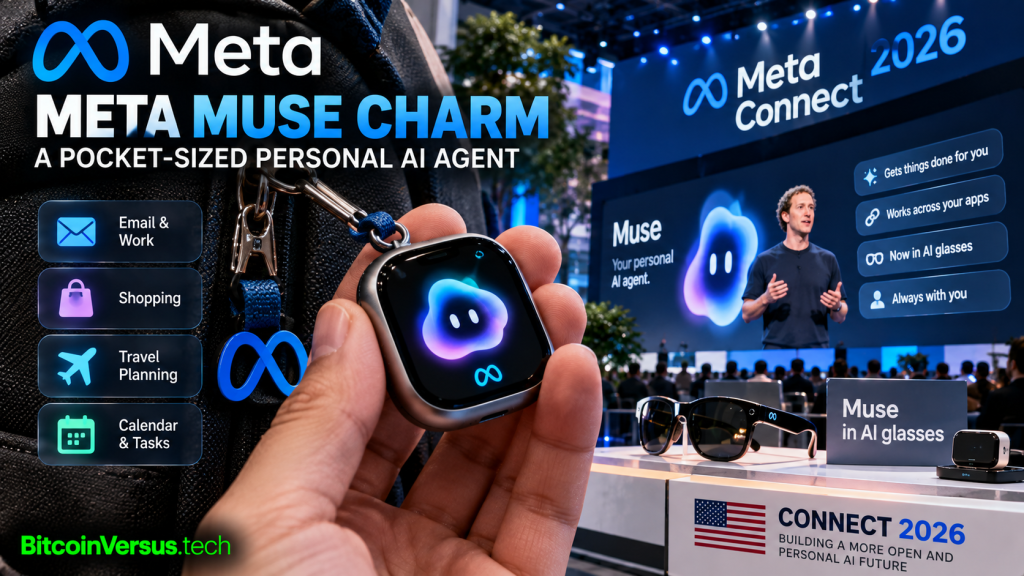
Meta has unveiled Muse Charm, a pocket-sized device built around its new Muse personal AI agent, giving users a dedicated way to talk to an agent that can shop, plan travel, manage tasks and work across connected services without relying on a phone or computer interface.
The surprise hardware reveal came at Meta Connect 2026. A widely shared look at the announcement shows the tiny Charm and summarizes the everyday tasks Meta is positioning Muse to perform.
Meta’s Muse Charm reveal puts its personal AI agent into a dedicated pocket-sized device designed for interaction away from a traditional phone or computer screen.
Muse is supposed to do work, not just answer questions
The company introduced Muse earlier this month as a personal agent that can open a browser, fill out forms, coordinate projects and perform tasks on a user’s behalf. Meta says the agent can continue longer-running work after a person closes the app and return when something changes or approval is needed.
Muse runs in what Meta calls a Secure VM, a dedicated cloud computer containing the agent and connected-service data. Meta says a separate Sentinel agent reviews outbound actions and that Muse asks for permission before sensitive actions such as sending an email or making a purchase.
The architecture makes Muse part of a broader shift from conversational AI toward software that acts. BitcoinVersus.tech has recently covered that transition from several hardware angles, including trillion-parameter local AI across Mac Studios, Samsung bringing Mistral AI into semiconductor manufacturing and Siemens and TSMC using AI agents for chip-design verification.
The Charm gives Muse its own hardware
At Connect, Mark Zuckerberg described Muse Charm as a device for talking and interacting with Muse that fits in a pocket. Meta’s Connect recap says the Charm uses a real-time voice model and that more product details will arrive later this year.
Independent reporting from sources covering the launch describes the device as keychain-sized and reports that Meta is targeting availability by December.
The physical form factor matters because Meta is trying to make the AI agent available without requiring users to continuously pull out a smartphone.
Muse is also moving into AI glasses
Charm is only one endpoint. Meta announced that Muse is coming to its AI glasses, where the agent will be able to respond to what the wearer is looking at. A person could ask Muse about a product on a shelf, text on a flyer or items on a shopping list without first describing the scene.
Meta also announced a voice mode designed for longer conversations while the agent continues working in the background. The company is therefore building the same agent across software, glasses and dedicated pocket hardware instead of tying it to a single device.
That device-plus-agent strategy sits alongside the physical-AI trend BitcoinVersus.tech has followed through Ambarella’s low-power physical-AI processor, QBit’s robot-control silicon and Aeva and LG Innotek’s 4D lidar production push.
Connectors are the real engine
Hardware is the visible part of the story, but Muse’s usefulness depends heavily on what it can access. Meta says it is adding shopping connections including Walmart, Best Buy, American Eagle, DICK’S Sporting Goods, Fanatics, Gap, Michael Kors, Sephora, Ulta and Wayfair, alongside payment options including Shop Pay and PayPal.
Expedia is coming for travel planning, while productivity integrations include Notion, Granola, GitHub and Box. Meta also says Muse will receive its own email address, giving the agent another channel for carrying out work and communicating with users.
The growing connector list turns Muse Charm from a voice gadget into a physical front end for an agent capable of interacting with outside services.
A new attempt at dedicated AI hardware
Dedicated AI devices have had a difficult early market, but Meta enters with an important advantage: an existing social ecosystem, a growing smart-glasses business and an agent that is already available as software.
The Charm does not need to replace the smartphone to matter. Its more immediate test is whether people want an always-near physical shortcut to an agent that can perform multi-step tasks.
That makes Meta Connect 2026 less about another keychain gadget and more about a larger computing question: if AI agents increasingly perform work across apps, how much traditional screen-and-menu interaction will users still need?
Advertisement:
Support BitcoinVersus.tech’s independent technology reporting and research.
BitcoinVersus.Tech Editor’s Note & Disclaimer:
We volunteer daily to ensure the credibility of the information on this platform is Verifiably True. BitcoinVersus.tech provides news, technical analysis and educational information and does not provide financial or investment advice. Verify technical specifications and operational requirements with the manufacturer before making purchasing, deployment or investment decisions. If you would like to support to help further secure the integrity of our research initiatives, please donate here: 3C9o19EH5HSiwEPyCTmEKzxhNCbo2X6TTb


Leave a Reply