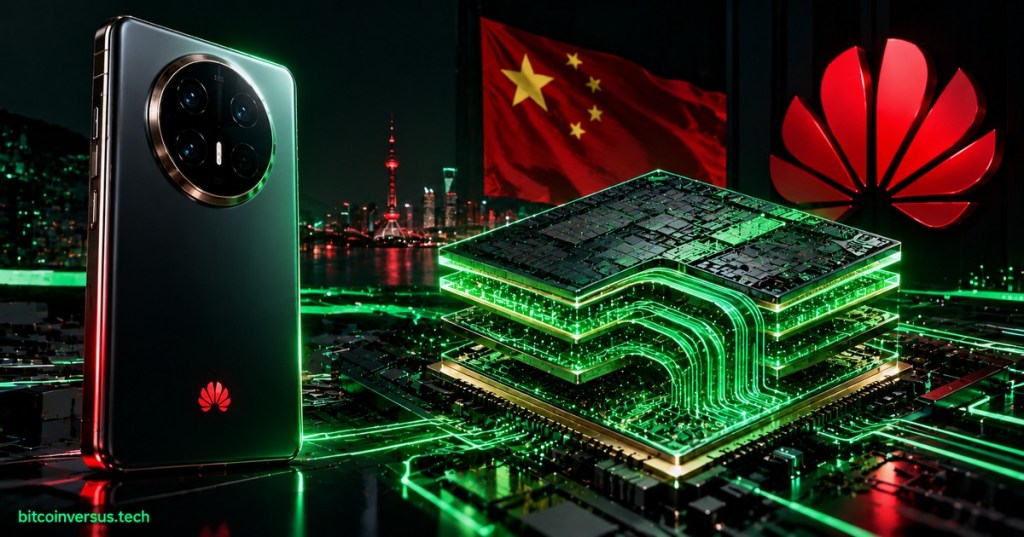
Huawei has turned a semiconductor architecture it introduced earlier this year into shipping consumer hardware. The new Mate 90 family puts the company’s τ-scaling strategy into phones, with the top Kirin 9050 Pro using what Huawei calls LogicFolding.
Huawei’s semiconductor roadmap describes LogicFolding as a circuit-level approach that shortens critical-path wiring and reduces resistive and capacitive loads rather than relying only on smaller transistor geometry. Reuters reported that the Mate 90 launch brings the architecture into Huawei’s newest flagship generation as the company continues developing chips under constrained access to leading-edge manufacturing equipment.
In its main launch post, Huawei called the Kirin 9050 Pro the first chip with LogicFolding architecture and positioned the Mate 90 family around tighter integration between silicon, HarmonyOS 7 and the rest of the device stack.
A Different Route Around the Scaling Wall
The important part is not another smartphone launch by itself. LogicFolding is Huawei’s attempt to extract more performance and density from circuit architecture when conventional process-node scaling is difficult or expensive. The company says its broader τ-scaling framework works across devices, circuits, chips and systems, with LogicFolding specifically attacking interconnect distance and signal delay.
That makes the Mate 90 a useful real-world test of an idea that sits alongside other efforts to get more computing from silicon without depending exclusively on lithography shrink. BitcoinVersus recently covered how CoWoS-L pushes AI packaging beyond reticle limits and how MIPS and Xcelsa are optimizing custom silicon. Huawei’s approach attacks another part of the same physical problem: how to keep improving useful compute when simple geometric scaling delivers less.
From Architecture Paper to a Phone
The top Mate 90 Pro Max configuration launches at roughly ₿0.018 (US$1,491), using the contemporaneous Bitcoin price only as an approximate conversion because BTC moves continuously. Huawei says the Pro Max generation reaches materially higher system performance while adding hardware-level ray tracing and deeper software-hardware integration.
The launch also lands as Chinese technology companies push more of their stack in-house. BitcoinVersus recently examined Huawei and DeepSeek’s open Ascend AI programming stack. LogicFolding extends that vertical-integration story all the way down to physical circuit architecture.
For chip engineers, the bigger question is whether the technique can scale beyond a flagship mobile processor. Huawei has already framed τ scaling as relevant to AI computing as well as smartphones. If the architecture proves repeatable across higher-power silicon, Mate 90 may be remembered less for its cameras or display than for putting an alternative scaling philosophy into mass-produced hardware.
Editor’s Note
Support independent technology reporting with Bitcoin. Donations help BitcoinVersus.Tech continue covering semiconductors, AI infrastructure, Bitcoin mining hardware and open technology.
Bitcoin donation address: 3C9o19EH5HSiwEPyCTmEKzxhNCbo2X6TTb
BitcoinVersus.tech is not a financial advisor. This media platform reports on financial subjects purely for informational purposes.


Leave a Reply