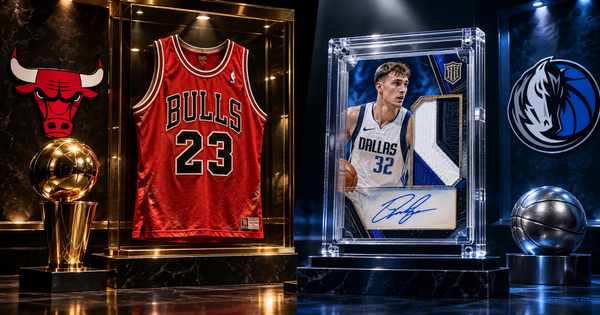
Two basketball collectibles sold within days of each other, and the gap between them is surprisingly small.
Michael Jordan’s Game 3 jersey from the 1998 NBA Finals sold for approximately ₿146.7 ($12.26 million), while Cooper Flagg’s one-of-one NBA Rookie Debut Patch Autograph card sold for approximately ₿96.2 ($8.04 million). Those Bitcoin equivalents use a contemporaneous BTC price near $83,567 and are approximate because Bitcoin moves continuously.
Put another way, the Flagg card sold for about 65.6% of the Jordan jersey’s price. Jordan’s jersey commanded only about a 52.5% premium over a rookie card tied to a player who has completed one NBA season. That does not prove one asset is objectively mispriced, but it creates an unusually sharp valuation question: is the Flagg card carrying a massive future-value premium, is Jordan’s Finals jersey relatively undervalued, or are collectors simply pricing two different kinds of scarcity?
Jordan’s artifact is historical scarcity
JOOPITER lists Jordan’s white Game 3 jersey as a world auction record for an NBA game-worn jersey. The jersey comes from the 1998 Finals, Jordan’s sixth and final championship run with Chicago, and the auction house describes it as the only publicly known white game-winning jersey from that Finals to surface.
BitcoinVersus.tech covered the sale separately in our report on the Last Dance Game 3 jersey. Jordan scored 24 points in Chicago’s 96-54 win over Utah, one of the defining games of a championship run whose cultural importance has only grown with time.
Flagg’s card is future-value scarcity
The Flagg card represents a very different asset. Topps says the one-of-one Rookie Debut Patch Autograph sold through Fanatics Collect for ₿96.2 ($8.04 million), setting a new record for the format. It combines Flagg’s autograph with the patch worn during his NBA debut and exists as a single card.
Fanatics Collect announced the result in a specific public X post, noting that it became the third-most expensive NBA card and sixth-most expensive trading card at the time of sale.
One price is anchored in a finished legacy
The strongest argument for Jordan being relatively undervalued is certainty. His résumé is complete. Six championships, six Finals MVPs, five regular-season MVPs and a global cultural legacy are already part of the historical record. The Game 3 jersey is directly connected to the final championship season of that career.
Flagg’s card is different because a large part of its price depends on what collectors believe his career could become. He has already produced an elite rookie season, but decades of future performance, health, championships, awards and cultural relevance remain unknowable.
That distinction matters. Jordan’s jersey has historical completion risk near zero: the event already happened and the legacy already exists. Flagg’s card has much more career outcome risk, even though its one-of-one scarcity is absolute.
The card may be pricing the future more aggressively than the jersey prices the past
The Flagg card’s price makes more sense when viewed through the mechanics of the modern card market. A one-of-one debut patch autograph is engineered around maximum scarcity, authentication and narrative. There will never be another copy of that exact card, and the object is tied to the first game of a highly anticipated No. 1 pick’s career.
But manufactured one-of-one scarcity is not identical to event scarcity. Jordan wore the jersey in a specific NBA Finals victory during a completed dynasty. No manufacturer had to declare it scarce after the fact; the scarcity came from the historical event itself.
BitcoinVersus.tech has explored this kind of collectibles logic before, including the long-term scarcity argument around LeBron James’ early SLAM feature and the auction market for Shohei Ohtani’s 50/50 home-run ball.
The market gap is only ₿50.5
At the same contemporaneous BTC conversion, the difference between the two sales is only about ₿50.5 ($4.22 million). For collectors who see Jordan’s 1998 Finals run as one of the most important chapters in modern sports history, that gap may look surprisingly narrow.
There are at least three plausible interpretations. First, Flagg’s card may be overvalued because buyers are capitalizing decades of hoped-for greatness into a rookie collectible today. Second, Jordan’s Game 3 jersey may be undervalued relative to comparable historical artifacts. Third, neither may be “wrong” because the card and memorabilia markets reward different forms of rarity, liquidity and collector psychology.
A valuation signal, not a final verdict
The safest conclusion is not that either buyer made a mistake. Auction prices reflect who showed up, how aggressively they bid and what kind of scarcity they wanted to own at that moment.
Still, the comparison is hard to ignore. A one-of-one rookie card for a 19-year-old player reached nearly two-thirds of the price of a verified Michael Jordan jersey from the final championship run of one of the most documented careers in sports history. If that relationship persists, collectors may eventually decide that the Flagg sale was an early peak, that Jordan’s Game 3 jersey was relatively cheap, or both.
Editor’s Note
Collectibles can be volatile and highly subjective. This comparison analyzes relative auction pricing and scarcity; it is not an appraisal or a recommendation to buy or sell memorabilia.
If you value independent reporting and analysis, you can support BitcoinVersus.Tech with a Bitcoin donation: 3C9o19EH5HSiwEPyCTmEKzxhNCbo2X6TTb
BitcoinVersus.tech is not a financial advisor. This media platform reports on financial subjects purely for informational purposes.


Leave a Reply