
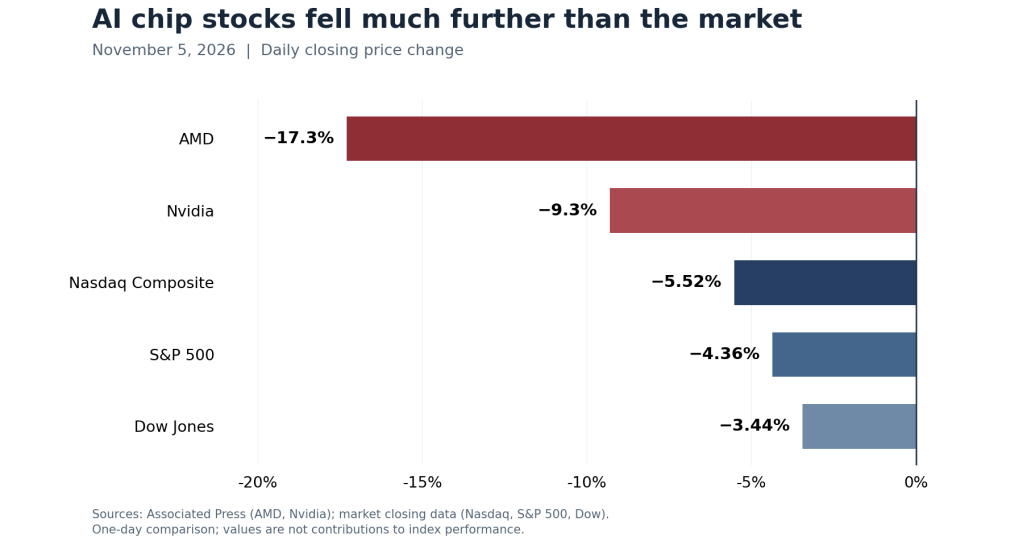
U.S. technology shares suffered a sharp reversal on November 5 as the Nasdaq Composite fell 5.52% to 24,315.00, entering correction territory. The S&P 500 declined 4.36% to 7,353.73, while the Dow Jones Industrial Average lost 3.44%. Semiconductor and data-center companies led the selling as investors reassessed political and financial risks surrounding the artificial-intelligence infrastructure boom.
A stock-market correction generally means an index has fallen at least 10% from a recent peak. The Nasdaq closed more than 10% below its October high. A correction describes a market-price decline, not proof of an equivalent reduction in semiconductor orders, electricity consumption or installed computing capacity.
CNBC Television, Markets Midday: Stocks Plunge On AI Worries, November 5, 2026. Open the original video on YouTube if the embedded player is unavailable.
Semiconductors lead the decline
Nvidia shares dropped approximately 9.3%, while Advanced Micro Devices fell 17.3%, according to Associated Press reporting. The Philadelphia Semiconductor Index lost more than 12%. Those moves reflected a repricing of expected future earnings across companies supplying AI accelerators, memory, servers and supporting equipment.
AI accelerators perform the highly parallel calculations required to train and run machine-learning models. Large clusters also require networking, power conversion, cooling and extensive physical facilities. Consequently, changing expectations for data-center investment can affect businesses far beyond processor designers. BitcoinVersus.Tech previously examined AI financing risks and concerns about debt-funded technology expansion.
Data-center policy becomes a market risk
The sell-off followed Democratic victories in the U.S. midterm elections. Investors questioned whether greater political scrutiny, local opposition and potential restrictions could slow data-center approvals. However, election outcomes do not automatically enact construction bans, and projected policy changes should not be confused with approved legislation or canceled projects.
Data-center developers face additional constraints involving utility interconnections, transformer availability, water supplies and construction costs. Previously announced projects, including Google-backed TeraWulf infrastructure and Riot’s proposed AI data-center lease, illustrate the scale of capital commitments under examination. Their contractual values and development schedules are not the same as realized revenue or operational megawatts.
What the sell-off does and does not establish
The decline indicates reduced investor confidence in near-term valuations, not independently verified evidence of falling AI workload demand. Companies may continue ordering equipment even as their shares fall; conversely, announced spending plans can be postponed before facilities reach commercial operation. Those distinctions matter when evaluating the outlook for power infrastructure and chip manufacturing.
Losses were not universal. Associated Press reported that AppLovin advanced after strong results, demonstrating how company-specific performance could diverge from the broader market. Investors also weighed borrowing costs and the possibility of additional monetary tightening.
For perspective, the broad-market declines were smaller than those of several semiconductor suppliers, underscoring the concentration of losses in AI-linked equities. Percentage changes are closing-market observations rather than forecasts. The next tests include corporate capital-expenditure updates, semiconductor order guidance, data-center permitting decisions and economic data. Verified changes in actual deployments will offer stronger evidence of the AI buildout’s direction than a single trading session.
BitcoinVersus.Tech Editor’s Note: We volunteer daily to ensure the credibility of the information on this platform is Verifiably True. If you would like to support to help further secure the integrity of our research initiatives, please donate using the QR code provided.

For best QR-code scanning results, scan from a desktop or larger screen. Verify the receiving address 3C9o19EH5HSiwEPyCTmEKzxhNCbo2X6TTb before sending.
Disclaimer: BitcoinVersus.Tech is not a financial advisor. This media platform reports on financial subjects purely for informational purposes.


Leave a Reply