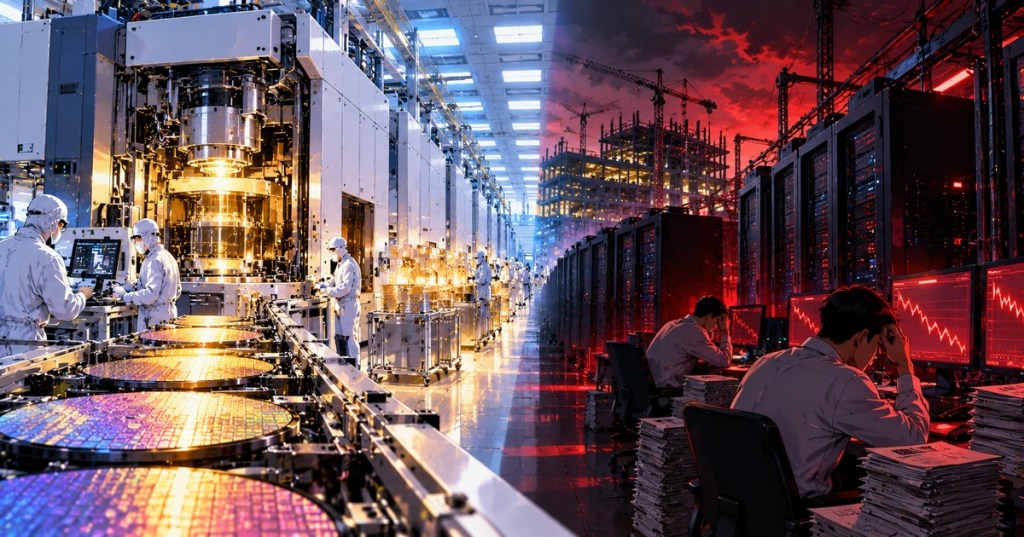
The AI buildout is sending two very different signals at the same time. Physical demand for chips, power and networking still looks strong. But the credit market is starting to question how much debt some AI-infrastructure companies can carry before financing costs become a problem.
The clearest warning is CoreWeave. Its shares fell roughly 16% on October 14 as yields on its unsecured 2032 bonds pushed toward 15%. That does not mean CoreWeave suddenly pays 15% interest on those existing bonds; the coupon was set earlier. It means investors are demanding a much higher return to hold the debt in the secondary market, which is a signal that perceived credit risk has risen sharply.
CoreWeave investors debate what a roughly 15% market yield actually means for the company’s debt and refinancing risk.
The bearish signal is in the financing math
CoreWeave’s own second-quarter results show why the bond move matters. The company generated $2.575 billion in quarterly revenue, but recorded $640 million of net interest expense and a $626 million net loss. Interest expense alone was about 24.9% of quarterly revenue.
At the same time, demand is not the obvious problem. CoreWeave reported approximately $104 billion of revenue backlog as of June 30, plus more than $25 billion of additional customer commitments added early in the third quarter. In other words, the company can have a huge contracted demand pipeline and still face financing pressure because building GPU capacity requires enormous amounts of capital before that backlog becomes revenue and cash flow.
Bloomberg previously examined CoreWeave’s multibillion-dollar AI cloud contracts and the debt-heavy infrastructure model behind them.
Reuters reported that hotter inflation pushed long-term U.S. yields higher while CoreWeave’s bond yield approached 15%. That combination matters because a capital-intensive business becomes harder to finance when the risk-free rate rises at the same time investors demand a larger credit premium.
But the hardware data is still bullish
The bearish credit signal is colliding with strong evidence that the physical AI buildout is still expanding. Earlier today, BitcoinVersus.Tech reported that ASML says customer demand is outrunning its planned 2027 and 2028 equipment supply, with some customers already discussing 2029 and 2030 orders.
ASML investors are weighing record demand against the question of how much growth is already priced into future semiconductor-equipment spending.
Bloomberg’s July report shows how AI demand had already pushed ASML to raise its annual outlook before the latest quarter.
The same physical expansion is visible outside lithography. AEP just committed about $4 billion to a 702 MW fuel-cell power project for a major data-center campus, while Salience Labs raised $125 million to scale optical switching for AI networks.
The signal is divergence, not collapse
The data does not say the AI boom is over. It says the next phase may be more selective. Semiconductor tools, power systems and networking hardware can remain in strong demand even while debt-heavy infrastructure operators face much tougher financing conditions.
That creates a useful market signal to watch: if hardware orders remain strong but bond yields for AI infrastructure companies keep rising, the bottleneck may shift from demand to capital. If credit spreads stabilize while backlog converts into revenue and cash flow, the bearish signal weakens. If they keep widening, the financing layer could become the first place the AI buildout meaningfully slows.
BitcoinVersus.Tech Editor’s Note:
We volunteer daily to ensure the credibility of the information on this platform is Verifiably True. If you would like to support to help further secure the integrity of our research initiatives, please donate using the QR code provided

For best QR-code scanning results, please scan this donation code from a desktop or larger screen. Mobile screens may prevent camera recognition.


Leave a Reply