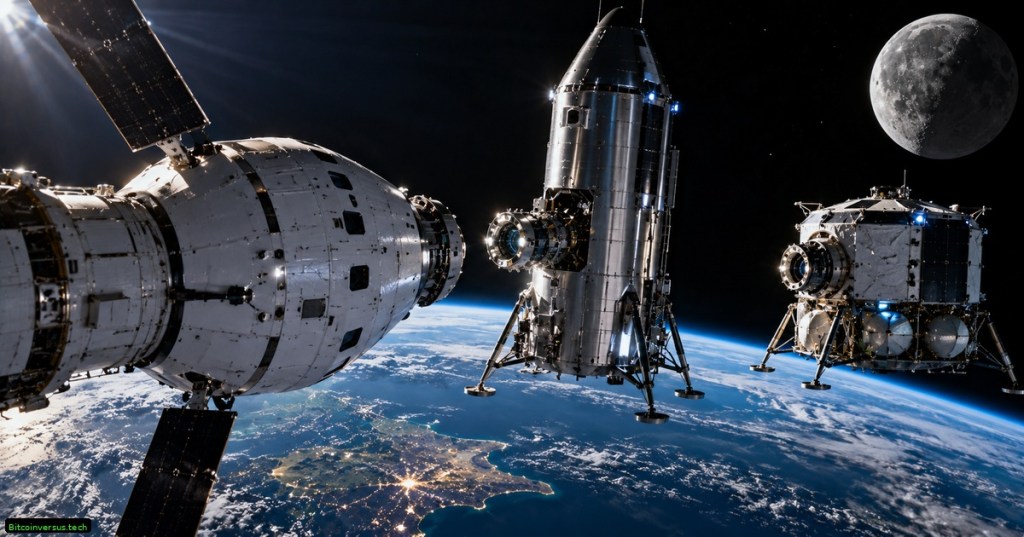
NASA’s next Artemis flight is still targeting a potential June 2027 launch, but the mission is no longer the Moon-landing attempt people originally associated with Artemis III. Instead, NASA has turned Artemis III into a crewed low-Earth-orbit demonstration designed to prove that Orion can rendezvous and dock with the commercial lunar landers that future astronauts will actually use.
Reuters reported on October 5 that NASA still sees June 2027 as a possible launch window, while astronaut Andre Douglas cautioned that major spaceflight schedules remain difficult to guarantee. The mission will carry Douglas, Randy Bresnik, Frank Rubio and European Space Agency astronaut Luca Parmitano aboard Orion.
Artemis III Is Now a Systems Test Before the Landing
NASA’s current architecture makes Artemis III a risk-reduction mission. The SpaceX Starship human-landing-system test article and Blue Origin Blue Moon test article are being developed to meet Orion in Earth orbit rather than at the Moon.
That lets NASA practice the most failure-sensitive interfaces before committing a crew to lunar orbit: rendezvous, proximity operations, docking, communications, life-support integration and the behavior of multiple independently developed spacecraft when they are physically connected.
Starship Version 3 Gets a Docking System on the Nose
NASA says the Starship test article for Artemis III will use a Version 3 vehicle with a docking system added to its nose. That gives NASA and SpaceX a chance to evaluate how the integrated Orion-Starship stack behaves while docked, including controllability and communications.
Astronauts are not currently expected to enter the Starship test article during Artemis III. The point is to prove the spacecraft-to-spacecraft interface and operating procedures before a later mission depends on that connection to move people toward the lunar surface.
Blue Moon Adds a Second Commercial Lander Architecture
Blue Origin’s Blue Moon Mark 2 test article gives NASA a second lander architecture to evaluate. NASA says the vehicle will carry an instrumented spacesuit mass simulator that can collect environmental data inside the cabin, adding another layer of hardware validation beyond the docking event itself.
The broader strategy matters because NASA no longer wants the Artemis program to depend on a single lander design. BitcoinVersus has already covered Blue Origin’s expanding role in NASA launch infrastructure, while Blue Origin is also building communications infrastructure for NASA’s Mars roadmap.
Orion Still Has Its Own Hardware to Prove
Artemis III is not only a lander test. Orion will carry the crew for longer than it did on Artemis II, giving NASA more time to evaluate life-support systems and crew operations. NASA also plans to test an upgraded heat-shield configuration during reentry so future missions have more flexible return profiles.
That is why the revised mission can still be technically valuable even though it no longer lands on the Moon. A lunar campaign is a chain of systems: launch vehicle, crew capsule, docking hardware, lander, communications, suits, propulsion, life support and ground operations. Artemis III is now designed to exercise more of that chain before the landing mission.
The Moon Landing Moves to Artemis IV
NASA’s current plan puts the first crewed Artemis lunar landing on Artemis IV in 2028. That gives the agency and its contractors another full flight to uncover docking, software, communications or vehicle-integration problems before a crew has to depend on those systems near the Moon.
That shift also fits a wider pattern in NASA’s lunar architecture. The agency is already developing 5G and Wi‑Fi 6 communications for the Moon and has selected surface experiments for future lunar exploration. The landing is only one layer of a much larger system.
Why the 2027 Flight Matters
The easiest way to think about Artemis III now is as an integration test with astronauts onboard. Individual spacecraft can pass their own qualification programs and still fail when interfaces, timing, software, communications and human procedures all meet in the same mission.
NASA’s July Artemis III mission update describes the 2027 flight as a way to practice rendezvous and docking between Orion and commercial human-landing systems before astronauts return to the lunar surface. If Artemis III exposes problems in Earth orbit, that is exactly what the revised mission is supposed to do.
BitcoinVersus.Tech
Advertisement
Editor’s Note
Artemis schedules can change as hardware and integrated testing progress. This story reflects NASA’s current 2027 mission architecture and the latest reported June 2027 target window.
We volunteer daily to ensure the credibility of the information on this platform is Verifiably True. If you would like to support to help further secure the integrity of our research initiatives, please donate here: 3C9o19EH5HSiwEPyCTmEKzxhNCbo2X6TTb
BitcoinVersus.tech is not a financial advisor. This media platform reports on financial subjects purely for informational purposes.


Leave a Reply