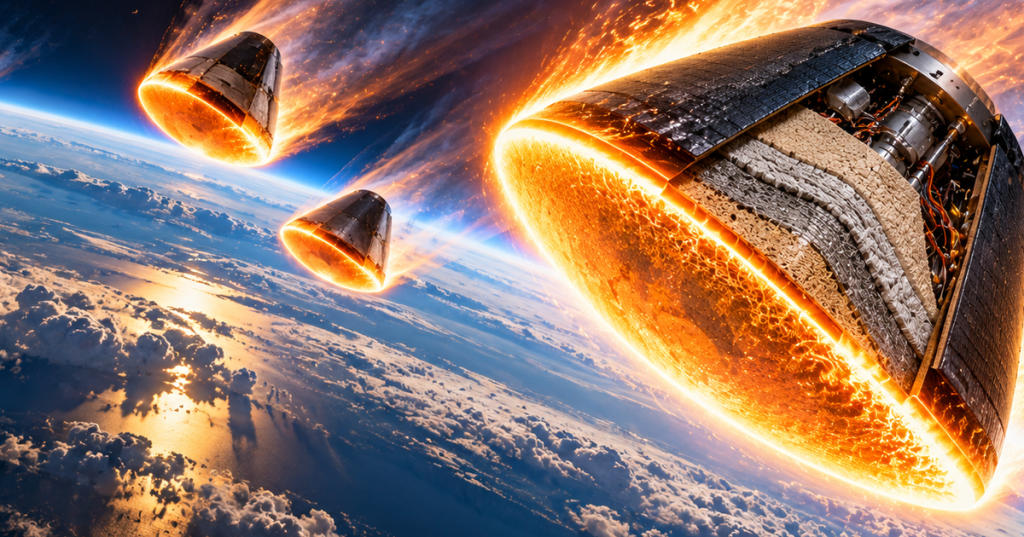
NASA is using a disposable cargo spacecraft’s final plunge through Earth’s atmosphere to test heat shields for future Moon and Mars missions.
The KREPE-3 experiment packed 12 instrumented capsules inside Northrop Grumman’s departing Cygnus XL spacecraft. As Cygnus headed for destructive reentry, the capsules were designed to eject and transmit temperature, pressure, motion, magnetic-field and light data while their thermal-protection systems faced real hypersonic heating.
NASA Administrator Jared Isaacman highlighted Ames heat-shield development and arc-jet testing earlier this year. The post is broader heat-shield context, not a KREPE-3 results announcement.
The hardware mix is unusually diverse. One capsule carries a 3D-printed heat shield developed by NASA Johnson and Oak Ridge National Laboratory. Others test stitched carbon-and-phenolic materials called MERINO, a deployable umbrella-like shield, and a capsule shape based on the aeroshell planned for NASA’s Dragonfly mission to Titan.
BPS.space tours NASA Ames and shows how arc-jet facilities reproduce the extreme heating spacecraft encounter during atmospheric entry.
The University of Kentucky hosted a reentry data watch party on October 12. As of October 13, NASA’s public KREPE-3 article has not yet reported which experimental shield performed best.
The flight connects directly to BitcoinVersus.Tech’s explainers on 3D printing, NASA’s next Moon missions, and the engineering challenge of eventually sending humans to Mars.
BitcoinVersus.Tech Editor’s Note:
We volunteer daily to ensure the credibility of the information on this platform is Verifiably True. If you would like to support to help further secure the integrity of our research initiatives, please donate using the QR code provided

For best QR-code scanning results, please scan this donation code from a desktop or larger screen. Mobile screens may prevent camera recognition.


Leave a Reply