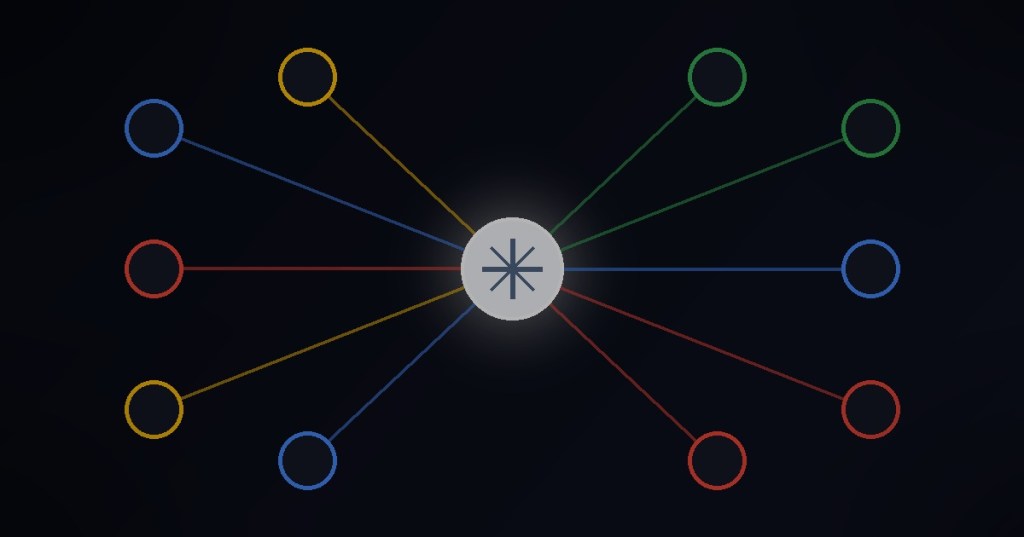
Google Cloud has launched Gemini agent, a new universal AI agent for work that is designed to move beyond answering questions and actually carry work through to completion.
Announced October 8 at Gemini at Work 2026, the new agent is built to handle knowledge work, create documents and media, write and execute code, use enterprise tools, and coordinate specialized agents from one interface. Google says it carries an organization’s business context with it and can work inside the software employees already use rather than forcing every task into a standalone chatbot.
The launch pushes Google deeper into the same agentic AI production stack BitcoinVersus has been tracking across coding, infrastructure, robotics and enterprise software. The important shift is not another larger language model. It is the attempt to turn an AI system into a persistent worker with memory, permissions, tools and responsibility for completing a task.
One Prompt Box, but a Much Bigger Job
Google describes Gemini as a single universal agent for work. In its Gemini at Work announcement, the company says the agent can answer questions, complete knowledge work, create media, write and run code, and connect to business systems while retaining enterprise controls.
That makes the product closer to an AI operating layer than a normal chat assistant. Instead of asking for a summary and manually carrying that summary into five other programs, a user can assign an objective and let the agent decide which tools, skills and models are needed to finish it.
The idea connects directly to model routing. Google says Gemini can choose the most appropriate model for each part of a job rather than forcing everything through one model. That includes Google’s own model families and, for enterprise customers, support for third-party models including Anthropic’s Claude.
Gemini Can Become an Actual Coworker Account
One of the stranger—and potentially more important—parts of the announcement is Google’s concept of a coworker agent. A company can describe the role it wants, and Gemini can create an agent with its own Workspace identity, including an email address, calendar, Drive and directory presence.
That means an agent can be added to a team chat, mentioned in a document, assigned work and appear under its own identity in version history instead of silently acting through a human employee’s account. Google says the coworker agent only sees information shared with it, with permissions following the organization’s normal access controls.
This is a much more literal version of the shared AI office idea. An AI system is no longer just sitting beside the team. The enterprise directory can treat it as a governed participant.
It Can Work Inside Gmail, Drive, Docs, Sheets and Calendar
Google is bringing the agent directly into Gmail, Drive, Docs, Slides, Sheets, Chat and Calendar. The goal is for the same context, memory, skills and permissions to follow the worker across those applications instead of resetting every time they open another tab.
Google also says the agent can connect to third-party business systems and channels, which puts it in competition with the broader enterprise-agent ecosystem rather than just other Gemini models. Reuters described the announcement as another escalation in the race among major AI companies to build autonomous agents that can operate across applications rather than simply answer prompts.
Reuters reports that the new Gemini agent arrives as OpenAI, Meta and other major AI companies are also pushing persistent agents that can carry out real tasks for users. The competitive question is quickly moving from “which chatbot gives the best answer?” to “which agent can safely finish the most useful work?”
Google Is Giving the Agent Skills, Not Just Prompts
The new system can use domain-specific skills. For data engineering, Google says Gemini can generate PySpark code, build notebooks, train models and troubleshoot pipelines. Business users can ask plain-language questions that turn into operational reports through BigQuery and Google’s Knowledge Catalog.
Google is also adding specialized versions for financial services and legal work. Those areas matter because enterprise agents cannot simply improvise their way through regulated workflows. They need source lineage, permissions, auditability and predictable access to company data.
The specialization trend mirrors what BitcoinVersus has already seen in agentic engineering tools and AI assistants connected to live technical documentation. General intelligence is useful, but production work usually requires very specific tools and trusted context.
The Security Model Treats Agents More Like Employees
The hard part of autonomous enterprise AI is not making the agent capable. It is limiting what a capable agent can touch.
Google says every enterprise agent can receive its own cryptographically attested identity, least-privilege permissions and audit trail. When the agent connects to another system, its identity and permissions travel with it. Code execution happens inside an Agent Sandbox, while an Agent Gateway applies network and policy controls to traffic moving in, out and between agents.
That governance layer is central to the pitch. The same autonomy that makes an AI agent useful also makes a poorly controlled agent dangerous. BitcoinVersus has already covered the security side of the shift in AI-powered cyber defense and the growing need to treat AI systems as active infrastructure rather than passive software.
The Agent Can Route Work Across Different Models
Google is separating the agent from the model. Gemini is the orchestration layer, while the underlying model can change depending on the task. A difficult reasoning job may go to a frontier model; a repetitive high-volume job can use a cheaper, faster model.
That is important economically. Enterprise AI does not fail only because models are inaccurate. It can also fail because the cost of sending every trivial task through the most expensive model becomes impossible at scale. Google is pairing model routing with project-level spend caps and cost controls so a company can stop an agent project automatically when it hits a budget limit.
Google Is Already Showing Large-Scale Deployments
The announcement is packed with customer examples. Google says Qatar University has deployed more than 2,000 custom agents, Tata Steel created more than 300 specialized agents in nine months, and DBS Bank is using deterministic chains of 70 to 80 specialized agents for complex financial research.
Google also says the U.S. Chief Digital and Artificial Intelligence Office has put Gemini Enterprise in the hands of 3 million uniformed and non-uniformed personnel, where users have built more than 100,000 custom agents. Those figures are company-reported, but they show what Google wants enterprises to imagine: not one assistant per company, but thousands of task-specific agents operating inside the same governed system.
The Real Competition Is Becoming the AI Operating Layer
For years, the AI race was framed around model benchmarks. The Gemini agent announcement shows why that framing is becoming incomplete.
The next battle is over the layer that remembers the user, understands company context, chooses the right model, connects to tools, manages permissions, executes code, delegates to sub-agents and returns completed work. That layer may matter more to most companies than whichever model wins a benchmark on a particular Tuesday.
Google has an obvious advantage because Workspace, Cloud, Gmail, Drive, Docs, Calendar and BigQuery already sit inside millions of workdays. The challenge is proving that a universal agent can be trusted with enough access to become genuinely useful without becoming another complicated enterprise system employees have to supervise.
If Google gets that balance right, the Gemini agent could turn the company’s productivity suite from a collection of applications into a single AI-managed work surface. That is a much bigger ambition than adding another chatbot sidebar.


Leave a comment