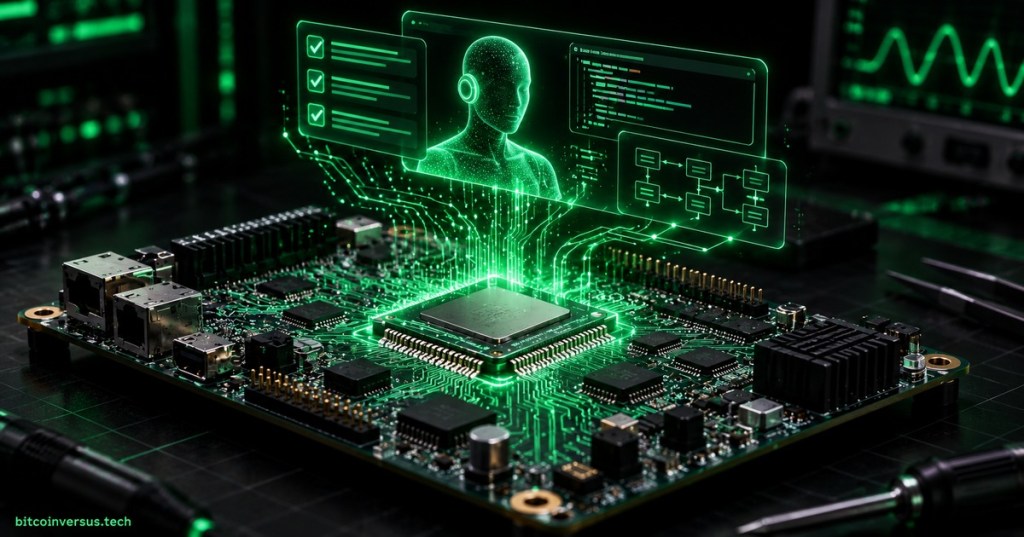
AMD is pushing AI agents deeper into semiconductor engineering with Ross, a new assistant designed to work across FPGA, adaptive-SoC and embedded-system development rather than stopping at generic code generation.
According to AMD’s Ross product documentation, the assistant can connect a developer’s preferred AI client to AMD tools through Model Context Protocol servers, search AMD technical knowledge, execute supported tool actions and follow reusable expert-authored workflows from design through debug and deployment.
The launch matters because the engineering bottleneck around programmable silicon is rarely just writing HDL. Teams also have to interpret timing reports, investigate implementation failures, inspect utilization, optimize high-level synthesis, debug hardware, manage tool settings and repeatedly translate documentation into a working design flow.
Ross connects the AI agent directly to engineering tools
The key architectural change is tool access. Ross is designed around MCP servers that expose supported AMD development environments to an AI client. Instead of an assistant merely suggesting a command, the agent can work with a live tool session, inspect project information and run supported actions through structured interfaces.
AMD’s September 30 announcement describes Ross as an agentic AI assistant for embedded developers that automates repetitive workflows and moves from design intent toward execution through natural-language interaction.
That tool-level integration is especially relevant for FPGA engineers because implementation is iterative. A design can be functionally correct while still failing timing, consuming too many resources or creating power and routing problems. Ross is positioned as a layer that can help move between those reports, documentation and corrective workflows without forcing engineers to manually reconstruct the same diagnostic process each time.
For readers new to programmable logic, BitcoinVersus.Tech’s Field-Programmable Gate Array overview explains why FPGAs occupy a middle ground between fixed-function silicon and general-purpose processors.
The first release targets Vivado and Vitis HLS workflows
Ross launches with support centered on Vivado and Vitis HLS. AMD says Vivado support spans all versions, while Vitis HLS support begins with version 2025.2 and later. The assistant can be used from clients such as VS Code, Cursor, Claude Code, Codex CLI, Devin and GitHub Copilot CLI, provided the client can work with the required interfaces.
The initial release also separates the agent layer from the underlying engineering software. Ross does not replace Vivado, Vitis or the engineer reviewing the result. Instead, it adds a natural-language control and workflow layer over established tools and reference material.
StorageReview’s technical breakdown notes that the launch includes open agent skills, MCP-based tool access and a monthly update cadence, giving AMD a faster software delivery path than traditional major tool-suite releases.
Agent skills turn engineering procedures into reusable files
One of Ross’s most consequential ideas is the use of structured agent skills. These files encode step-by-step workflows, interpretation guidance and fix patterns that an AI agent can follow for specific engineering tasks.
That model creates a path for teams to preserve engineering knowledge as executable procedures rather than leaving it only in internal notes or individual experience. A timing-closure process, debug sequence or HLS optimization routine can be turned into a reusable skill that guides the agent through the same methodology each time.
The approach lines up with a broader move toward programmable control planes in hardware infrastructure. BitcoinVersus.Tech recently covered Lattice’s open control-plane push for AI data-center racks, another example of programmable logic being used as a flexible systems layer rather than as isolated silicon.
Local knowledge makes the design assistant usable in restricted environments
AMD also provides a local-knowledge option for teams that do not want documentation retrieval to depend on an external service. The downloadable knowledge base can be deployed with a local embedding model, while the answer-generation model can be selected separately by the user.
That architecture matters for semiconductor and embedded teams working with proprietary RTL, unreleased boards or restricted networks. A design assistant becomes significantly more practical when documentation search, workflow execution and project data can remain inside the engineering environment.
The same shift toward specialized compute is visible at the opposite end of the design spectrum. BitcoinVersus.Tech’s coverage of Dnotitia’s dedicated vector-search ASIC reaching first silicon shows what happens after workloads become mature enough to justify purpose-built hardware. Ross targets the earlier engineering stage: making the process of building and optimizing that hardware more agentic.
AI is moving from writing code to operating the chip-design workflow
The important distinction is that Ross is not simply an AI chatbot trained on FPGA documentation. AMD is exposing engineering tools, knowledge and reusable procedures in a form that agents can act on.
That does not eliminate the need for simulation, timing analysis, hardware validation or engineering judgment. AI-generated workflows remain non-deterministic and must still be checked against the actual reports and hardware. But the interface between engineer and toolchain is changing quickly: more of the repetitive navigation, lookup and first-pass diagnosis can now be delegated to an agent that understands the structure of the development flow.
For FPGA and embedded teams, that may be the more significant AI transition. The agent is no longer outside the semiconductor workflow explaining what an engineer should do next. It is beginning to sit inside the workflow with access to the same tools.
BitcoinVersus.Tech
Advertisement
Editor’s Note
We volunteer daily to ensure the credibility of the information on this platform is Verifiably True. If you would like to support to help further secure the integrity of our research initiatives, please donate here: 3C9o19EH5HSiwEPyCTmEKzxhNCbo2X6TTb
BitcoinVersus.tech is not a financial advisor. This media platform reports on financial subjects purely for informational purposes.


Leave a Reply