
Google Cloud Tech’s AI Harness Crash Course, published October 22, 2026, is receiving renewed attention after social-media accounts described a new two-hour Google course. The verified official video runs approximately nine minutes and links to hands-on codelabs for AI-agent memory, tools, secure execution and testing. A separate longer workshop has circulated under Google’s name, but its precise source and duration have not been independently confirmed as a standalone corporate release.
Qingyue “Annie” Wang, a Google Cloud engineer, presents the official lesson. After a widely shared October 24 post listed a five-part, roughly two-hour syllabus, Wang publicly thanked readers for sharing her video. Her acknowledgment supports attribution to her work, not every claim made about a distinct official Google course.
The harness supplies everything around the model
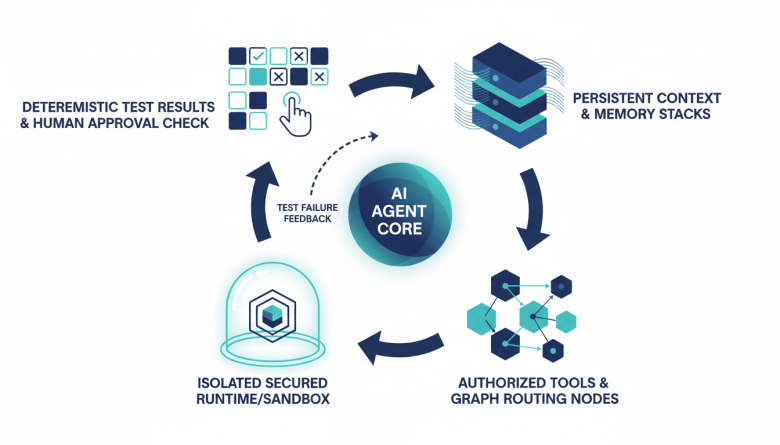
An AI agent is more than a language model with instructions. Its harness supplies tool permissions, session state, memory, file access, execution rules and evaluations that turn model proposals into controlled operations. Google’s demonstration asks a coding agent to add a CSV export button, then tests whether the exported file contains the correct customer data. A plausible answer is not treated as evidence that the implementation works.
The interactive learning page divides the system into four parts: context and memory; tools and execution flow; runtime, security and privacy; and evaluation. It separates chat transcripts from scratchpad state and long-term memory. A Python function or Model Context Protocol server can carry out a tool call; a graph defines the order of operations and paths after a failed check.
Where the viral two-hour outline comes from
The longer circulating schedule cites harness fundamentals at 0:29, a first agent at 11:08, Chief of Staff evaluation at 28:08, loop engineering at 1:00:13 and a self-improving graph at 1:23:19. Those timings are reported social-media chapter markers, not chapters in Google’s nine-minute official video. The full original recording corresponding to the five timestamps was not independently identified in the verified Google Cloud channel materials.
The subject matter has genuine technical foundations. Google’s ADK 2 orchestration codelab teaches graph, collaborative and dynamic workflows using Python code. Earlier BitcoinVersus.Tech coverage differentiates harness engineering, feedback loops and graph engineering. The disciplines complement one another but describe different layers of a system.
Self-improvement depends on reliable tests
Google’s self-evolving-loop and evaluation codelab combines deterministic checks, model-as-judge grading and human approval. An agent can revise its instructions after a failed assessment, yet a higher score on one rubric does not guarantee better performance on every task. Weak metrics may reward shortcuts rather than correctness.
Engineers must impose retry limits, budgets and sandbox boundaries. Untrusted documents cannot become governing instructions merely because a tool retrieved them. The official learning site uses software-enforced permissions and manual approval for sensitive operations, rather than promises of an endlessly running agent. Related BitcoinVersus.Tech reporting on agent-evaluation failures and scheduled coding agents shows why unattended operation needs controls.
Google’s course and labs give developers an actionable introduction to context persistence, bounded tool use and testing. Coverage of developer tooling for AI applications adds a cross-platform perspective. Readers can use the verified short video and linked codelabs immediately while treating the viral two-hour release claim as an unresolved attribution question.
We volunteer daily to ensure the credibility of the information on this platform is Verifiably True. If you would like to support our work and help further secure the integrity of our research initiatives, please scan the QR code below to donate 5,000 sats.

For mobile scanning, open the article on another screen and scan the original QR code with a compatible Bitcoin wallet. Verify the address 3C9o19EH5HSiwEPyCTmEKzxhNCbo2X6TTb before sending 5,000 sats.
Editor’s Note: Sources include Google Cloud Tech’s verified short video, Annie Wang’s companion educational site, Google’s graph-workflow codelab and the October 24 viral post. The two-hour chapter list is reproduced only as an attributed social-media description, not an independently verified official Google Cloud release. The cover and in-story diagram are original conceptual illustrations. BitcoinVersus.tech is not a financial advisor. This media platform reports on financial subjects purely for informational purposes.


Leave a Reply