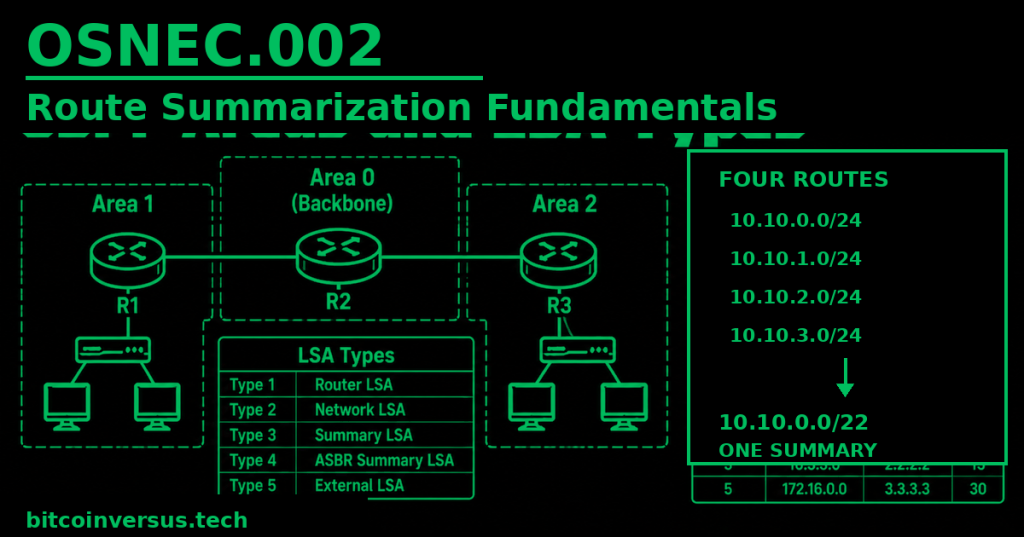
Large networks can learn hundreds or thousands of routes. Route summarization lets a router advertise one broader route that represents several smaller, contiguous networks. The result can be a smaller routing table and a cleaner routing design.
This engineering lesson builds on OSNEC.001: OSPF Fundamentals. Here, the focus is the underlying summarization calculation before applying it to a particular routing protocol.
Four Routes, One Summary
Suppose a router has these four contiguous networks:
10.10.0.0/24
10.10.1.0/24
10.10.2.0/24
10.10.3.0/24
These can be represented by the single summary route 10.10.0.0/22. A /22 spans the address range from 10.10.0.0 through 10.10.3.255.
Why Engineers Summarize Routes
- Reduce the number of route entries advertised upstream.
- Make routing tables easier to read and reason about.
- Reduce the amount of detailed topology information carried beyond the point where it is needed.
- Help contain some routing changes behind a stable aggregate route when the protocol and design support it.
Video: Route Summarization Explanation + Calculation
This networking lesson demonstrates the logic and calculation used to combine multiple routes into a summary.
Find the Common Prefix
The reliable method is to compare the network addresses in binary. Starting from the left, count the bits that are identical in every network. The number of common leading bits becomes the prefix length of the summary.
For 10.10.0.0 through 10.10.3.0, the first 22 bits are common, producing 10.10.0.0/22.
Alignment Matters
A valid summary is not simply any larger subnet that happens to include the listed routes. The summary boundary must align with the prefix length. Engineers should verify the complete address range represented by the proposed aggregate.
Watch for Unintended Addresses
A summary may cover addresses that are not actually present behind the summarizing router. That can create a black-hole risk if traffic is attracted to the summary but no more-specific route exists for the destination. Always calculate the full range and understand where the aggregate is being advertised.
Data Center Example
Imagine four server VLANs using 10.20.0.0/24 through 10.20.3.0/24 in one data-center block. At an appropriate routing boundary, an engineer might advertise 10.20.0.0/22 instead of four separate /24 routes, provided the topology and routing protocol support that design.
Bitcoin Mining Facility Example
A large mining campus could have several adjacent infrastructure networks assigned from one contiguous block. Summarization at the correct upstream boundary can keep the rest of the network from carrying every individual campus subnet.
Troubleshooting Checklist
- List every network that should be included.
- Convert the changing octet or octets to binary.
- Find the common leading bits.
- Build the summary prefix.
- Calculate the entire range represented by that summary.
- Confirm that advertising the aggregate will not attract traffic to unintended destinations.
- Verify the actual routing table after configuration.
Practice
Find one summary route for 192.168.8.0/24, 192.168.9.0/24, 192.168.10.0/24, and 192.168.11.0/24. Then write the complete address range represented by your answer.
Key Takeaway
Route summarization replaces multiple contiguous, appropriately aligned routes with a broader prefix. The engineering skill is not merely making the table smaller—it is proving exactly which addresses the aggregate represents and placing the summary at the correct routing boundary.


Leave a Reply