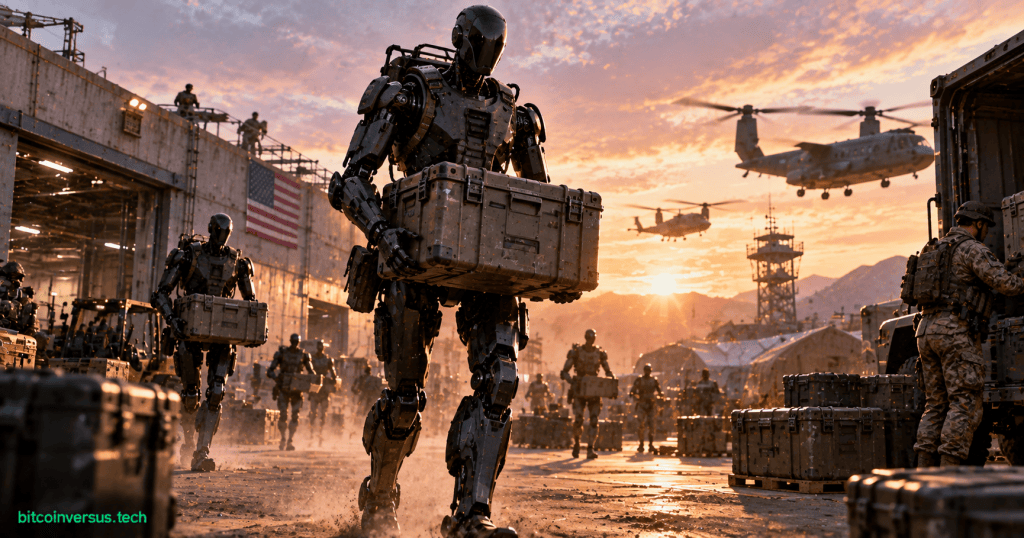
A six-foot humanoid built for factories is now being pitched for one of the most unforgiving workplaces on Earth: the battlefield.
Foundation Future Industries’ Phantom MK-1 is a roughly human-sized black humanoid the company is developing for defense and industrial work. NBC News put the machine in the national spotlight this week, showing Phantom walking, handling objects and discussing the company’s ambition to move humanoids into military logistics, reconnaissance and eventually more direct battlefield roles.
The robot soldier is not here yet
The important distinction is between what Phantom can demonstrate today and what Foundation says future versions may do. In NBC’s latest report, CEO Sankaet Pathak describes a future in which humanoids can perform dangerous defense work that would otherwise put people at risk.
But Phantom MK-1 should not be confused with an autonomous mechanical infantryman. Independent reporting has described limitations in the current machine and uncertainty around some widely repeated claims about military testing. WIRED’s reporting on Foundation noted that the company is exploring future weapons-related capabilities while robotics experts cautioned about the gap between controlled demonstrations and reliable deployment.
That gap is exactly why a recent public X post from manufacturing executive Mike Kalil is relevant to the story: it highlights disputed reporting around Phantom’s claimed Ukraine testing and links to a longer discussion of those questions. Those claims remain contested rather than independently established facts.
Why build a humanoid for war?
A battlefield is already designed around the human body. Doors, stairs, ladders, tools, vehicles, ammunition containers and control panels assume roughly human reach and proportions. A humanoid can theoretically enter that environment without forcing the military to redesign every object around a wheeled or tracked machine.
The near-term jobs are also less cinematic than science fiction. Carrying supplies, inspecting hazardous areas, moving equipment, reconnaissance and casualty recovery all expose humans to danger without necessarily requiring a robot to make decisions about lethal force.
That is a different branch of the same physical-AI transition BitcoinVersus has been following in industry. Eni is evaluating humanoids for industrial field work, where machines face environments built for people rather than robots.
The autonomy problem gets much harder
A warehouse robot can stop when its confidence drops. A defense robot may operate with damaged communications, changing terrain, civilians nearby and adversaries deliberately trying to confuse its sensors. Reliability therefore becomes more than a productivity metric.
That connects directly to NVIDIA’s work on hardware-backed safeguards for autonomous agents. If software agents need enforceable boundaries while controlling ordinary enterprise systems, the requirement becomes even more consequential when the agent has a physical body.
Humanoid hardware is moving faster than deployment proof
Across the industry, walking, manipulation and dexterity are improving quickly. Boston Dynamics, Figure, Agility, Unitree and dozens of younger companies are turning humanoids from laboratory demonstrations into increasingly capable machines.
But capability demonstrations are not the same thing as sustained autonomous operation. BitcoinVersus recently covered Boston Dynamics’ new Atlas hand, where even something as apparently simple as a robotic hand represents a dense combination of sensing, actuation, durability and control.
Phantom’s real test is reliability
The most interesting question is not whether a humanoid can carry military equipment for a camera. It is whether it can repeat useful work for hours in dust, rain, damaged buildings and unpredictable terrain while remaining controllable when communications fail.
Foundation’s defense ambitions make Phantom one of the more provocative humanoids in the industry. They also create a higher evidence bar. A robot intended for a factory can tolerate downtime. A robot intended to keep a human out of danger has to work when the environment is at its worst.
BitcoinVersus.Tech
Advertisement
Editor’s Note
The featured artwork is a conceptual illustration and is not a photograph of Phantom in a combat deployment. Company statements about future defense capabilities are identified as plans or claims; disputed deployment claims are not presented as established fact.
Support independent BitcoinVersus.Tech reporting with Bitcoin donations at: 3C9o19EH5HSiwEPyCTmEKzxhNCbo2X6TTb
BitcoinVersus.tech is not a financial advisor. This media platform reports on financial subjects purely for informational purposes.


Leave a Reply