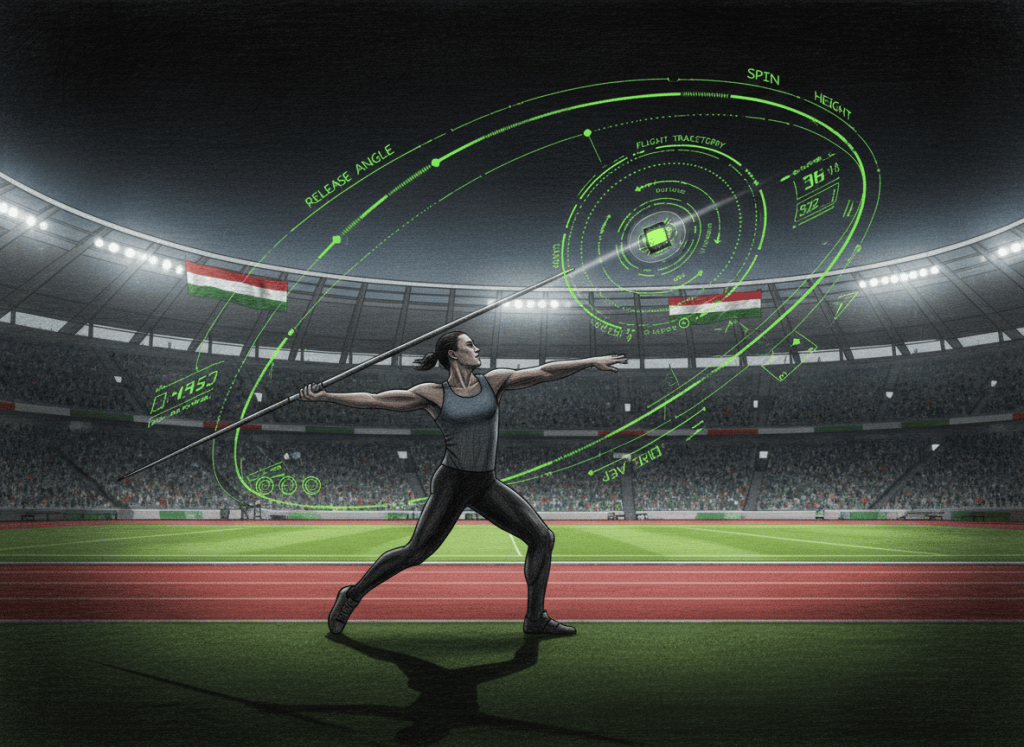
A javelin normally gives spectators one headline number: distance. TDK and World Athletics are trying to turn the throw itself into a live data stream.
At the 2026 World Athletics Ultimate Championship in Budapest, athletes tested a sensor-equipped “Smart Javelin” designed to capture the mechanics of a throw in real time. World Athletics said the system can measure release angle, rotation, speed, height and flight trajectory, then turn those readings into visualizations at the venue.
The project moved beyond a conventional result board. Euronews highlighted the Smart Javelin rollout before the Budapest demonstration, framing it as a new way to expose physics that normally remains invisible during competition.
The javelin becomes its own telemetry platform
The technical idea is straightforward but powerful: put the sensor inside the object being measured. Instead of relying only on external cameras to infer what happened after release, the javelin can carry instrumentation through the flight itself.
That means the throw can be described as a time-varying physical event. Release velocity affects the initial energy of the flight. Release angle shapes the ballistic arc. Rotation affects stability. Height and trajectory determine how the javelin moves through the air before impact.
Why real-time analysis matters
According to Euronews’ report, TDK upgraded both the sensor module and its software after earlier work with World Athletics, allowing the system to analyze and visualize movement immediately rather than waiting for post-session processing.
For athletes and coaches, that short feedback loop can matter as much as sensor accuracy. A thrower can make an attempt, review how angle, speed and rotation changed, then adjust technique while the movement is still fresh.
That is the same broader shift BitcoinVersus.tech has been tracking in markerless motion capture in elite football: sports science becomes more useful when measurement fits directly inside normal training instead of requiring a separate laboratory workflow.
A sensor can explain why two 85-meter throws are different
Distance alone can hide important differences. Two throws can land near the same mark while arriving there through different combinations of release speed, angle and rotation. One may be technically efficient; another may rely on exceptional power while leaving performance on the table.
That is where telemetry can become coaching information. Rather than telling an athlete only that a throw was shorter, the data can help identify which part of the launch changed.
Sports equipment is becoming instrumented
The Smart Javelin fits a larger pattern: sports equipment is increasingly becoming a measurement device. BitcoinVersus.tech recently examined sensor-equipped football shoulder pads that quantified accumulated collision exposure, while baseball’s tracking stack can now measure increasingly specific events such as difficult first-base scoops.
In all three cases, the important change is the same: the sport produces richer data without fundamentally changing the athlete’s task. The running back still runs. The first baseman still fields. The javelin thrower still throws. The difference is that previously invisible details can now be recorded and compared.
The fan experience may change too
TDK and World Athletics are also aiming at spectators. A live broadcast could eventually show release speed, angle and rotation next to the distance result, giving viewers a more technical explanation for why one throw carried farther than another.
That could make javelin resemble other data-rich sports, where audiences increasingly expect telemetry alongside the action. The measurement does not replace the competition; it adds a second layer of understanding.
The Smart Javelin is still a demonstration rather than a new scoring system. But it shows where elite sports instrumentation is heading: smaller sensors, faster processing and real-time analytics embedded directly into the object or environment being measured.
BitcoinVersus.Tech
Editor’s Note
We volunteer daily to ensure the credibility of the information on this platform is Verifiably True. If you would like to support to help further secure the integrity of our research initiatives, please donate here: 3C9o19EH5HSiwEPyCTmEKzxhNCbo2X6TTb
BitcoinVersus.tech is not a financial advisor. This media platform reports on financial subjects purely for informational purposes.


Leave a Reply