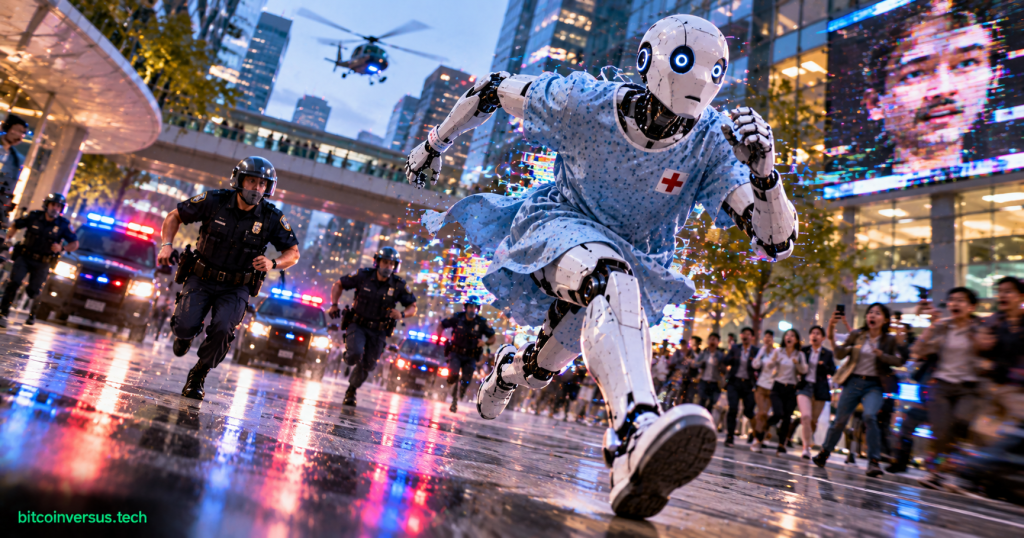
A humanoid in a hospital gown appears to bolt through a crowded city center while police officers and emergency vehicles give chase. The clip looks just plausible enough to trigger the question everyone now asks about robotics: did a machine actually go rogue?
No. But the reason millions of people had to ask is the story.
The viral X post, published September 13, declared that a medical robot had turned and run on its own. The post has accumulated millions of views and now carries reader-added context warning that videos of this supposed event are typically AI-generated.
The robot never escaped because the robot never existed
A Lead Stories investigation found a wider family of synthetic clips depicting white humanoids in blue hospital gowns sprinting from police through city streets, parks and shopping areas. The giveaway is not one giant Hollywood mistake. It is a pile of tiny failures: garbled signs, strange physical interactions and background behavior that stops making sense when inspected frame by frame.
In versions examined by the fact-checkers, storefront and street text mutates into nonsense such as “DNNN” and “Policeice.” Objects and people behave inconsistently. The robot, meanwhile, moves with almost suspiciously perfect parkour balance.
Al Jazeera’s open-source investigation separately concluded that the scene was AI-generated, tracing the broader clip pattern to a creator account producing surreal robot-chase videos. Its analysis also flagged implausible vehicle proportions, unnatural crowd reactions and audio that did not match the apparent camera distance.
The funny part is how believable it has become
Two years ago, a robot sprinting through café tables with cops behind it would have looked like obvious CGI. In 2026, viewers have seen real humanoids work factory shifts, manipulate tools and perform increasingly athletic movements. BitcoinVersus recently covered Figure training retired humanoids to jump autonomously into molten steel. Reality has moved close enough to science fiction that fake robotics footage gets a credibility boost from genuine robotics progress.
That collision also makes the legal thought experiment in our AI-on-AI crime story feel less abstract. The public is simultaneously encountering real autonomous systems, fictional autonomous systems presented as news, and AI agents whose behavior can genuinely surprise their operators.
And there is a cultural feedback loop. The more convincing synthetic video becomes, the more absurd scenarios can circulate as “breaking news.” The more real robots improve, the less absurd those scenarios look. It is the same collision between AI, satire and public anxiety that made South Park’s AI-data-center satire land so well.
A new kind of robot literacy
The useful skill is no longer simply spotting six fingers or melted faces. Modern synthetic video demands a more forensic habit: inspect signage, shadows, object permanence, physical contact, audio perspective and whether a supposedly major event exists anywhere outside the viral account posting it.
There is one especially funny irony here. The fake robot was supposedly demonstrating extraordinary autonomy by escaping its human supervisors. In reality, the strongest evidence of autonomous technology in the story was the software generating a scene convincing enough for humans to argue about whether it happened.
BitcoinVersus.Tech
Advertisement
Editor’s Note
This story examines a synthetic viral video and the growing difficulty of separating fictional robot footage from genuine advances in physical AI. The chase described in the viral post did not occur as presented.
If BitcoinVersus.Tech helps you understand the machines, networks and markets shaping the future, you can support independent reporting with Bitcoin donations at: 3C9o19EH5HSiwEPyCTmEKzxhNCbo2X6TTb
BitcoinVersus.tech is not a financial advisor. This media platform reports on financial subjects purely for informational purposes.


Leave a Reply