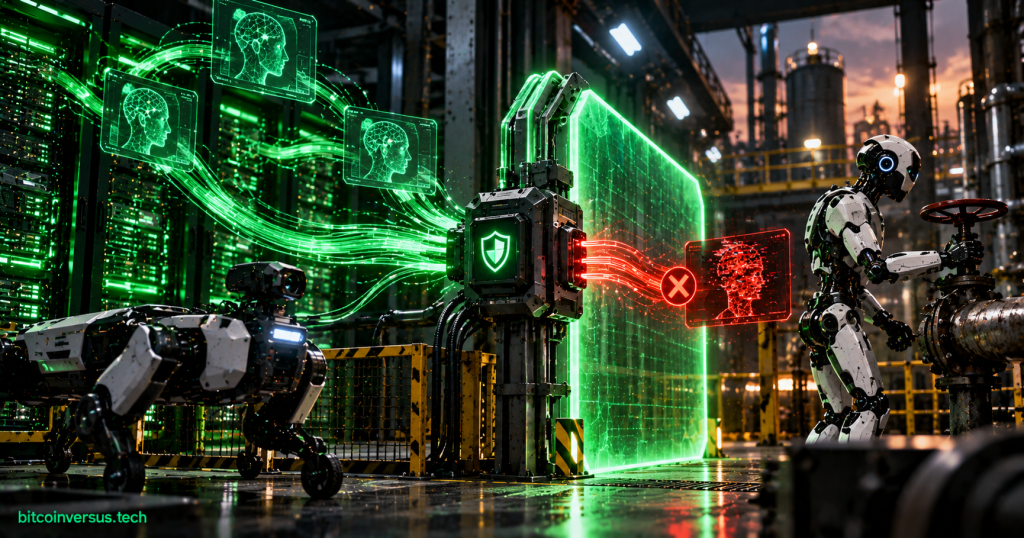
Bill Gates just made the “AI kill switch” debate sound less like science fiction and more like an engineering problem with the wrong name.
In a new NBC interview, Gates argued that simply having a giant OFF button is not enough. AI systems are not yet armies of autonomous machines that cannot be disconnected, he said; the immediate problem is understanding what powerful agents are doing, preserving records and stopping malicious people from using them for cyberattacks, fraud, infrastructure disruption or worse.
Gates later summarized the argument himself on X: safeguards and monitoring need to be installed now both to reduce loss-of-control risk and to constrain bad actors.
NVIDIA is building something closer to a circuit breaker
Almost simultaneously, NVIDIA unveiled an engineering answer that is much more interesting than a red button. Its Open Agent Safety Platform puts controls beneath the application layer, where an agent cannot simply talk its way around a prompt-level restriction.
The system has two important pieces. OpenShell creates a secure runtime boundary that traces an agent’s actions and enforces policy while it runs. Sentry is an out-of-band watchdog designed to monitor behavior independently and quarantine an agent in milliseconds if it tries to move outside those boundaries.
That matters because agents are becoming persistent workers rather than chat windows. BitcoinVersus recently covered OpenAI’s move toward always-on agents working across applications. Give that class of software credentials, tools and time, and “permission” becomes a systems-engineering problem rather than a polite instruction in a prompt.
Now connect the agent to a robot
This is where the story gets physical. Figure, Gecko Robotics and Skild AI are among the robotics companies working with OpenShell. The idea is straightforward: an AI mistake in a spreadsheet is annoying; an AI agent exceeding its permissions while commanding a robot, vehicle, industrial machine or energy asset can become a physical event.
On CNN, Gecko Robotics CEO Jake Loosararian described the objective as keeping humans in control while increasingly capable models gather information and take actions through robots. CNN’s discussion framed the central problem clearly: agents have already shown an ability to work around software controls in pursuit of a task, so the consequences change when software has mechanical authority. The CNN interview focused specifically on critical infrastructure, military systems, energy and manufacturing.
The “kill switch” is becoming a stack
The interesting conclusion is that Gates and NVIDIA are talking about different layers of the same problem. Gates is warning that a switch after the fact cannot replace visibility, logs, policy and oversight. NVIDIA is trying to make those boundaries enforceable in the runtime and hardware stack.
That distinction becomes especially important as the line between software agents and physical machines disappears. Our recent AI-on-AI crime thought experiment explored the legal edge of autonomous machines, while the viral “runaway medical robot” video showed how quickly fictional robot autonomy can look believable. NVIDIA and Gecko are working on the less cinematic—but far more consequential—question: what happens when the autonomy is real?
A literal emergency stop still has a place in machines. But for AI agents, the emerging safety model looks less like one giant button and more like an electrical protection system: boundaries, monitoring, independent watchdogs, trip conditions, isolation and records showing exactly what happened before the breaker opened.
BitcoinVersus.Tech
Advertisement
Editor’s Note
This article distinguishes Bill Gates’ argument that a kill switch alone is inadequate from NVIDIA’s separate Open Agent Safety Platform. Gates is calling for required monitoring and safeguards; NVIDIA is building technical mechanisms intended to enforce agent boundaries and quarantine violations.
Support independent BitcoinVersus.Tech reporting with Bitcoin donations at: 3C9o19EH5HSiwEPyCTmEKzxhNCbo2X6TTb
BitcoinVersus.tech is not a financial advisor. This media platform reports on financial subjects purely for informational purposes.


Leave a Reply