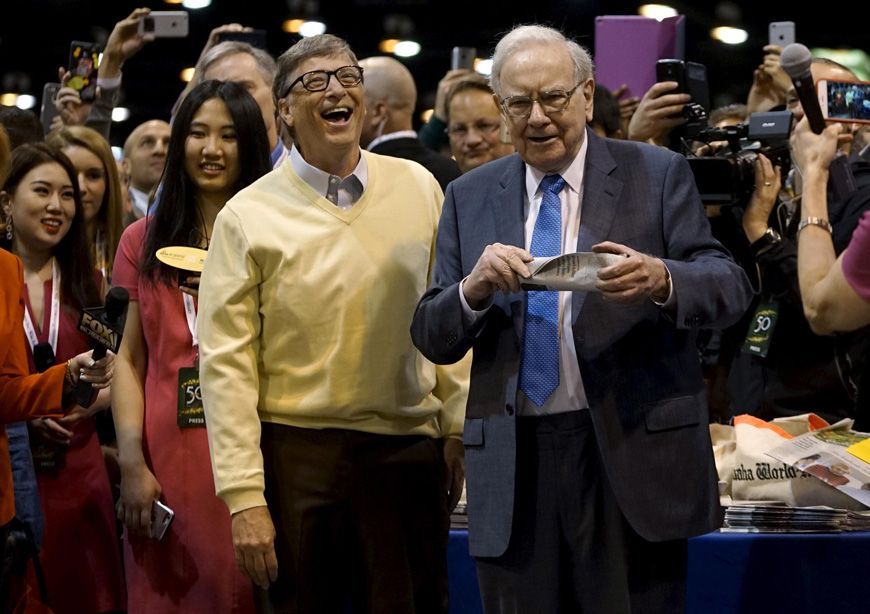
A viral X post argues that Bill Gates would be worth roughly $1.33 trillion today if he had never diversified away from Microsoft after becoming friends with Warren Buffett. The counterfactual is directionally interesting, but both the number and the implied Buffett causation need an update.
The $1.33 Trillion Figure Is Already Dated
The first thing to fix is the timing. The exact claim that Gates was worth $138 billion and would have been worth $1.33 trillion without diversification was circulating in market commentary by early 2024. In 2026, neither figure is a clean current snapshot.
Forbes’ 2026 billionaires list estimated Gates at about $108 billion. That is still an extraordinary fortune, but it is below the $138 billion figure in the viral graphic because Gates has spent decades selling, transferring and donating Microsoft shares while building a much broader portfolio and philanthropic structure.
The more interesting update is the Microsoft side of the equation. Microsoft’s own IPO history says Gates retained 11,142,000 shares after the company went public in March 1986. Microsoft also confirms that one original share became 288 shares after nine stock splits.
That means a literal never-sell counterfactual starts with about 3.209 billion split-adjusted shares. Microsoft closed at about $529.76 on October 7, 2026, according to Reuters. Multiply those two numbers and the stock alone comes to roughly $1.70 trillion.
That calculation is intentionally simple: 11,142,000 original post-IPO shares × 288 split factor × $529.76 per share ≈ $1.70 trillion. It does not include decades of dividends, including Microsoft’s special dividend, so the gross hold-forever value could be even higher before taxes and other assumptions.
Gates Really Did Diversify Out of Microsoft
The underlying diversification story is real. Reuters reported in 1999 that Gates had sold more than 7 million Microsoft shares for more than $600 million and planned to sell another 3 million. A Microsoft spokesman explicitly said the sales were part of Gates’ normal program of selling shares to diversify his portfolio.
Over time, Gates’ wealth moved into a much wider group of assets through Cascade Investment and related structures. The result is a fortune that is no longer simply a leveraged bet on one software company. That approach reduced single-company risk, but it also meant surrendering a massive amount of upside as Microsoft became one of the defining companies of the cloud and AI infrastructure era.
But Did Buffett Tell Gates to Diversify?
This is where the viral post gets too neat. Gates and Buffett did become friends in 1991. Gates has written that they immediately connected during their first meeting on July 5 of that year, and that Buffett’s friendship and guidance later influenced his life and philanthropy.
But there is no strong public evidence that Buffett told Gates to sell Microsoft and diversify his personal fortune. In fact, Buffett’s own public comments are almost the opposite of the meme’s implied lesson. At Berkshire Hathaway’s 2008 annual meeting, Buffett said diversification is appropriate for investors who do not know enough to concentrate intelligently, while skilled investors can rationally put far more capital into their best ideas.
Buffett also avoided buying Microsoft himself for a different reason: he repeatedly said his friendship with Gates created the appearance of a potential information advantage. That is very different from telling Gates to sell his own company.
The Steve Ballmer Comparison Shows the Other Path
Former Microsoft CEO Steve Ballmer provides a useful real-world contrast. Ballmer kept the overwhelming majority of his wealth concentrated in Microsoft stock for decades. That concentration exposed him to far more company-specific risk, but Microsoft’s enormous rise turned the strategy into one of the most successful passive founder-holding stories in modern finance.
Gates chose something different. He sold shares, diversified, funded philanthropy and ultimately committed to giving away nearly all of his fortune. Measuring that decision only by the dollars he did not make misses the purpose of the decision itself.
The Real Lesson Is Concentration Versus Optionality
The viral calculation is useful because it puts the opportunity cost of diversification in unusually dramatic terms. Holding a world-class compounder can create staggering wealth. Selling too much of one can look painful in hindsight.
But concentration works only if the company survives, keeps compounding and the investor can tolerate decades of volatility without selling. Diversification sacrifices some upside in exchange for resilience, liquidity and freedom to fund other goals. For Gates, those goals included a global investment portfolio and one of the largest philanthropic efforts in history.
So the better 2026 takeaway is not “Warren Buffett cost Bill Gates a trillion dollars.” It is that Microsoft became such an extreme long-term winner that even a sensible diversification program carried a gigantic opportunity cost. Using current Microsoft pricing, the thought experiment is no longer roughly $1.33 trillion. It is closer to $1.70 trillion in Microsoft stock alone.
Editor’s Note
We volunteer daily to help keep the information on this platform verifiably accurate. If you would like to support our independent research, please donate here: 3C9o19EH5HSiwEPyCTmEKzxhNCbo2X6TTb
BitcoinVersus.Tech is not a financial advisor. Content is provided for informational purposes.


Leave a comment