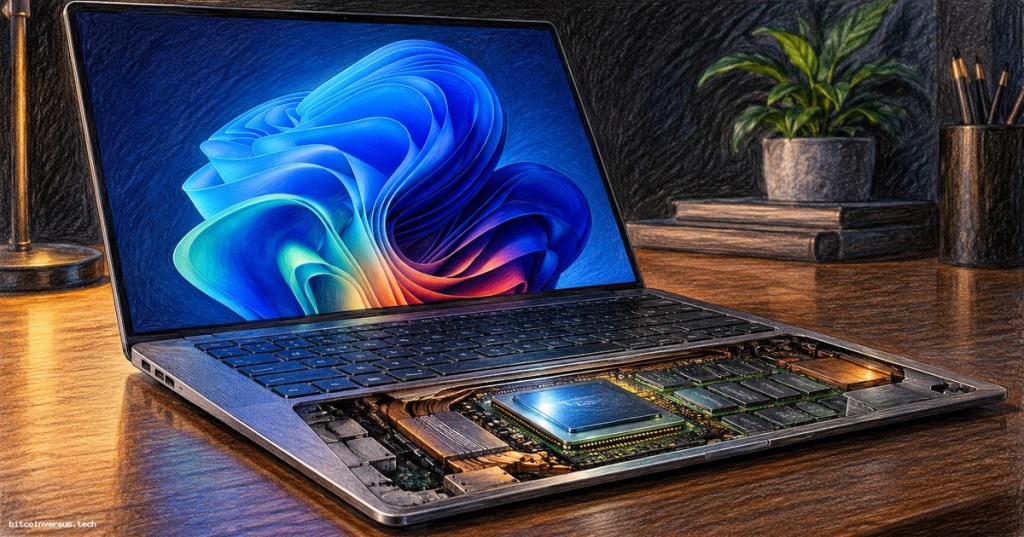
Microsoft and NVIDIA used their October 7 Windows and Surface event to push a different idea of the AI PC: instead of treating the laptop mainly as a terminal for cloud models, the new Surface Laptop Ultra is designed to run much larger AI workloads directly on the machine.
The hardware is built around NVIDIA RTX Spark, the Grace-Blackwell platform BitcoinVersus.Tech covered earlier this month. Microsoft says the Surface Laptop Ultra can be configured with up to 128 GB of unified memory, delivers up to 1 petaflop of AI performance, and can run AI models exceeding 120 billion parameters locally.
Local AI Is Becoming a Memory Problem
The most important specification may not be raw compute. Large local models need enough memory to keep model weights, context and working data close to the processor. That makes the Surface Laptop Ultra’s unified-memory design especially relevant at a time when GPU memory and memory bandwidth are becoming major limits for AI, rendering and other accelerated workloads.
Microsoft’s own Surface announcement says the system combines an NVIDIA Blackwell RTX GPU with up to 6,144 cores, an NVIDIA Grace CPU with up to 20 cores and up to 128 GB of unified memory. The company says the machine is aimed at creators, developers and AI builders rather than the mainstream notebook market.
The Price Makes the Target Audience Clear
Surface Laptop Ultra starts at $2,599 and becomes available October 16. Microsoft is also selling a Surface RTX Spark Dev Box for $5,999, with U.S. shipments planned for November. Reuters reports that higher-end Laptop Ultra configurations reach $5,899, placing the machine far above ordinary consumer laptops.
That price changes the comparison. This is less about replacing a basic office PC and more about deciding whether developers should buy local compute rather than continuously rent cloud GPU time. BitcoinVersus.Tech has tracked the opposite end of that equation in the rapid buildout of AI data-center infrastructure, where enormous centralized facilities are being built to serve remote workloads.
Microsoft Calls It Hybrid Intelligence
Microsoft is not arguing that cloud AI disappears. Its new Windows strategy is explicitly hybrid: choose between local and remote models depending on the task, privacy requirements, performance and cost. In its Windows hybrid-intelligence announcement, Microsoft says RTX Spark systems are intended to let builders perform inference, image generation, video generation and agent work locally while still using cloud services when larger resources are required.
That requires more than silicon. The operating system, device drivers, AI runtimes and application frameworks all have to expose the accelerator correctly. Microsoft is also pairing the hardware push with Microsoft Execution Containers, a Windows security feature designed to isolate AI agents and restrict access to data they have not been authorized to use.
Windows Is Trying to Make AI Compute Personal Again
The broader shift is architectural. For several years, the most capable AI systems lived almost entirely in large GPU clusters. RTX Spark-class machines create a middle layer: far more local compute than a normal laptop, but still dramatically smaller than a data center.
That could matter for coding agents, private datasets, creative workflows and model experimentation. A developer may be able to keep sensitive source code or files on the local machine, run repeated inference without paying for every cloud token, and send only the jobs that genuinely need larger-scale compute to a remote service.
The challenge is cost. A $2,599 starting point means Microsoft still has to prove that local AI creates enough practical value to justify premium hardware. It also arrives as Windows 11 continues changing underneath the hardware, adding new servicing and platform capabilities that Microsoft increasingly treats as the software half of its AI-PC strategy.
The Real Test Starts October 16
Specifications can show what is possible, but shipping systems will determine whether RTX Spark can sustain those workloads within a laptop thermal envelope, whether software support is broad enough, and whether developers actually prefer local inference over cheaper or more flexible cloud options.
What Microsoft and NVIDIA are attempting is bigger than a faster Surface. They are trying to move serious AI compute back onto the personal computer—and make the PC itself part of the modern AI infrastructure stack.
BitcoinVersus.Tech
Editor’s Note
BitcoinVersus.Tech independently covers semiconductors, artificial intelligence, computing hardware, data centers and the infrastructure connecting them.
If you would like to support our research and technical publishing, donations are welcome: 3C9o19EH5HSiwEPyCTmEKzxhNCbo2X6TTb
BitcoinVersus.Tech is not a financial advisor. This media platform reports on financial and technology subjects purely for informational purposes.


Leave a Reply