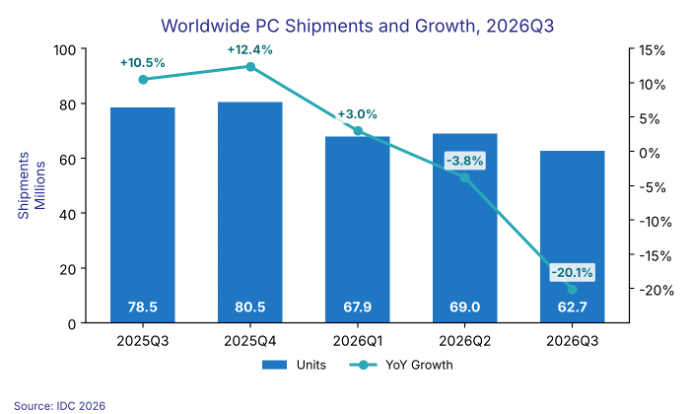
The global PC market just posted one of its sharpest recent contractions. IDC says worldwide PC shipments fell 20.1% year over year in Q3 2026, dropping from 78.5 million units a year earlier to 62.7 million.
The decline is especially notable because the third quarter normally gets a seasonal lift. Instead, shipments were also down 9.1% from Q2. IDC says the market is being squeezed by supply constraints, elevated prices, a large inventory pull-in earlier in the year, and higher component costs tied in part to the AI data-center buildout.
The Usual Q3 PC Bump Disappeared
PC vendors and distributors stocked up earlier in 2026 to get ahead of expected memory-driven price increases. That moved purchases forward into the first half and left less demand for the third quarter. The result was the opposite of normal seasonality: Q3 came in below Q2 instead of above it.
A separate Omdia estimate points in the same direction. Ars Technica reports Omdia measured a 21.2% year-over-year decline to 58.1 million PCs, including a 23.5% drop in desktop shipments and a 20.6% decline in laptops. The exact totals differ because research firms use different methodologies, but both show a market that weakened dramatically during the quarter.
AI Memory Demand Is Colliding With Consumer Hardware
The PC downturn is not simply a story about people suddenly losing interest in computers. Memory and storage have become a much larger portion of system cost, while the most valuable production capacity is being pulled toward AI accelerators, HBM, server DRAM, and data-center infrastructure. BitcoinVersus recently examined how the AI HBM boom is making ordinary RAM more expensive.
That matters because a PC maker cannot simply remove memory from a modern machine without changing the product. Windows laptops, gaming PCs, workstations, and local-AI systems are all moving toward larger memory footprints at the same time that memory prices are under pressure. The market is therefore being hit from both sides: buyers face higher prices while manufacturers face higher bills of materials.
HP, Dell, and Lenovo Took the Biggest Hits
The decline was broad, but it was not evenly distributed. IDC estimates Lenovo remained the largest vendor with 14.9 million units and 23.8% market share, while its shipments fell 22.6% year over year. HP fell 30.9% to 10.3 million units, and Dell dropped 25% to 7.6 million.
Apple and ASUS also shipped fewer PCs, but they fell more slowly than the overall market. Apple declined 11.3% to 5.9 million units, while ASUS fell 8.6% to 5.5 million. That allowed both companies to gain market share even while their unit volumes declined.
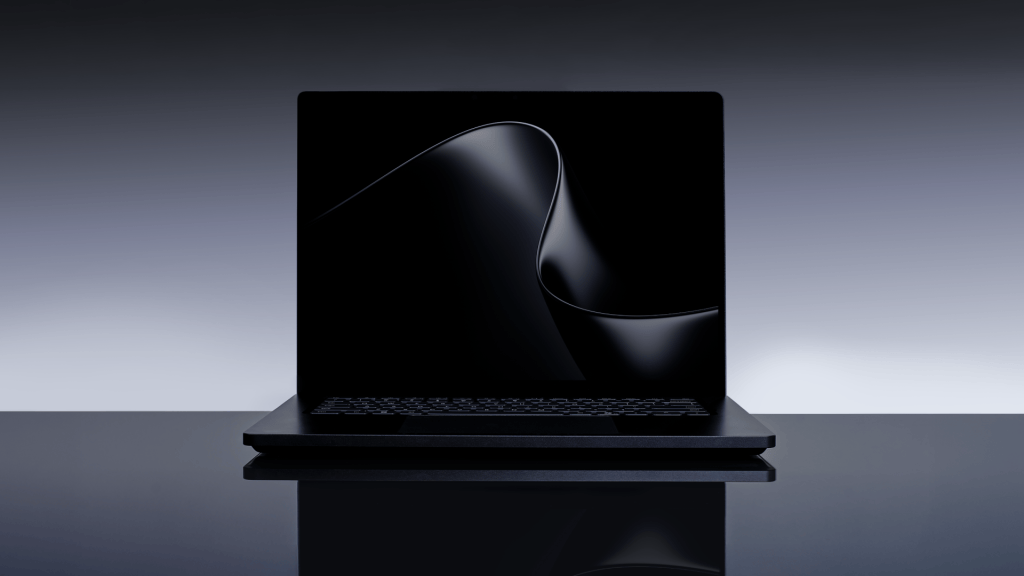
At the premium end, manufacturers are still pushing much more capable systems. Microsoft’s new $2,599 Surface Laptop Ultra targets large local AI models with up to 128 GB of unified memory. Hardware like that shows why the PC market is not simply shrinking into cheaper machines: some of the industry’s most ambitious new computers are becoming more memory-intensive and more expensive at the same time.
A Shipment Crash Does Not Automatically Mean Cheap PCs
Ordinarily, weak demand and excess inventory would create aggressive discounts. IDC does expect promotions and some short-term relief as channels work through inventory, but it does not expect pricing to return anywhere close to year-ago levels. That is the important distinction: fewer PCs are shipping, yet the cost structure behind those PCs remains elevated.
The memory industry has powerful reasons to prioritize high-value AI products. BitcoinVersus has already tracked how surging AI memory demand is reshaping Micron’s business. That same capital-allocation logic can leave consumer hardware competing for manufacturing resources against faster-growing and higher-margin data-center products.
What Happens Next
The next few quarters will show whether Q3 was mainly an inventory correction or the beginning of a longer replacement-cycle slowdown. The key signals will be memory pricing, component availability, channel inventory, corporate refresh budgets, and whether consumers continue stretching the life of existing PCs.
The bigger tension is now clear. AI infrastructure is creating extraordinary demand for advanced memory and compute, while the consumer PC market is being asked to absorb higher costs at the same time. If supply remains tight and prices stay elevated, the 20.1% Q3 decline may look less like a one-quarter anomaly and more like the point where the AI infrastructure boom became impossible for the PC market to ignore.
BitcoinVersus.Tech Editor’s Note: IDC’s Q3 2026 figures are preliminary shipment estimates. Shipment data measures units sent into distribution channels or to end users and is not identical to final retail sales.
Support independent BitcoinVersus.Tech reporting with Bitcoin: 3C9o19EH5HSiwEPyCTmEKzxhNCbo2X6TTb
BitcoinVersus.Tech is not a financial advisor. This article is for informational and educational purposes.


Leave a Reply