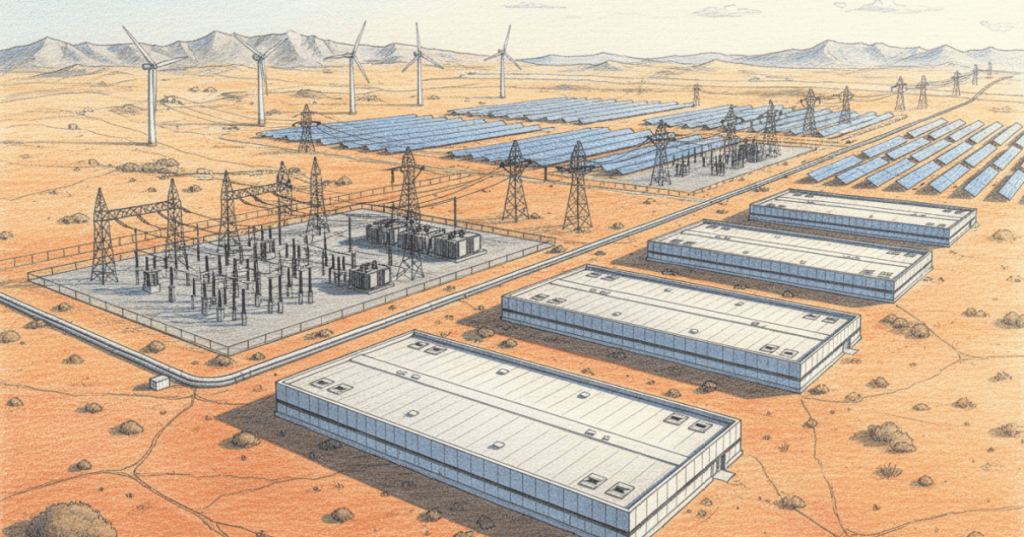
Aragón has become one of Europe’s biggest data-center construction zones, with more than €60 billion ($67.6 billion) of expected investment over the next decade. The story is not only about AI demand: it is also about how quickly a region can turn land, grid connections, water, fiber and permits into operating digital infrastructure.
Reuters reported on October 6 that the northeastern Spanish region is attracting Amazon, Microsoft and other developers through a fast-track planning framework known as PIGA, or a Project of General Interest of Aragón. The model can compress approvals that might otherwise take years, but its speed is also intensifying debate over environmental review, water and electricity demand.
Why Aragón Became a Data-Center Magnet
Data centers need more than cheap land. Hyperscale campuses need large blocks of reliable electricity, high-capacity fiber, buildable sites, cooling resources and a permitting path that lets billions of dollars of equipment move from plan to production on a predictable schedule.
Aragón has combined those ingredients with an unusually aggressive infrastructure pipeline. Amazon says its planned Spanish investment has risen to €33.7 billion through 2035, centered on the AWS Europe (Spain) Region in Aragón. The company estimates the investment could support an average of 29,900 full-time-equivalent jobs annually across Spain and contribute €31.7 billion to Spanish GDP through 2035.
Microsoft Is Building Three Interconnected Campuses
The regional government’s current Microsoft plan describes three data-center campuses at La Muela, Villamayor de Gállego and Zaragoza. The sites are designed to be interconnected by fiber and require access roads, high-voltage electricity, potable and non-potable water, wastewater handling and stormwater infrastructure.
That list is a useful reminder that a “data center” is really an infrastructure system. The servers are only the visible computing layer; underneath them are substations, switchgear, cooling systems, water systems, generators or storage, and the network plant that connects the campus to the rest of the internet. Our guide to electrical substations explains one of the most important pieces of that physical chain.
Fast Permitting Is The Competitive Advantage
Reuters identifies Aragón’s PIGA framework as a major reason projects can advance quickly. Instead of treating a giant campus as an ordinary local development, the regional government can designate strategically important projects and coordinate the territorial and urban-planning procedures needed to build them.
Speed matters because AI infrastructure is moving through unusually short hardware cycles. A campus that waits years for land, transmission or planning approvals risks opening after the compute generation it was designed around has already been replaced.
The Trade-Off Is Scrutiny
Faster approval does not make the physical constraints disappear. Reuters reports that critics and environmental groups are challenging aspects of the process, arguing that compressed consultation can weaken scrutiny of electricity and water impacts. Spain’s national government is also considering tighter requirements around data-center resource use.
That debate is especially important in a dry region hosting facilities that can require substantial cooling infrastructure. Cooling design varies widely—some systems consume far more water than others—and our data-center cooling guide explains the trade-offs among air, water-assisted and liquid approaches.
Europe Is Starting To Measure The Resource Cost
The European policy direction is also moving toward more disclosure. BitcoinVersus.Tech previously covered the EU push for data-center energy and water labels, which would make it easier to compare facilities using consistent resource metrics rather than relying only on company sustainability claims.
For Aragón, that means the region’s competitive advantage may eventually depend on more than how quickly it can approve a campus. Developers will increasingly have to show how efficiently the campus converts grid capacity, water and land into useful computing output.
The Bigger Lesson For The AI Buildout
Aragón illustrates a new phase of the AI race: the bottleneck is moving beyond GPUs. Regions that can coordinate power generation, transmission, substations, fiber, cooling, construction labor and permitting can become strategic compute hubs even if they were not previously major technology centers.
But the same concentration creates a harder public-policy question. Fast permitting can accelerate investment and jobs, while electricity, water and land remain shared regional resources. Aragón is effectively testing how far Europe can accelerate AI infrastructure without allowing the permitting shortcut to become an accountability shortcut.
Sources
Primary and reporting sources: Reuters and the Government of Aragón’s Microsoft PIGA documentation.
BitcoinVersus.Tech
Advertisement
Editor’s Note
We volunteer daily to help keep the information on this platform verifiably accurate. If you would like to support our independent research, please donate here: 3C9o19EH5HSiwEPyCTmEKzxhNCbo2X6TTb
BitcoinVersus.tech is not a financial advisor. Content is provided for informational purposes.


Leave a Reply