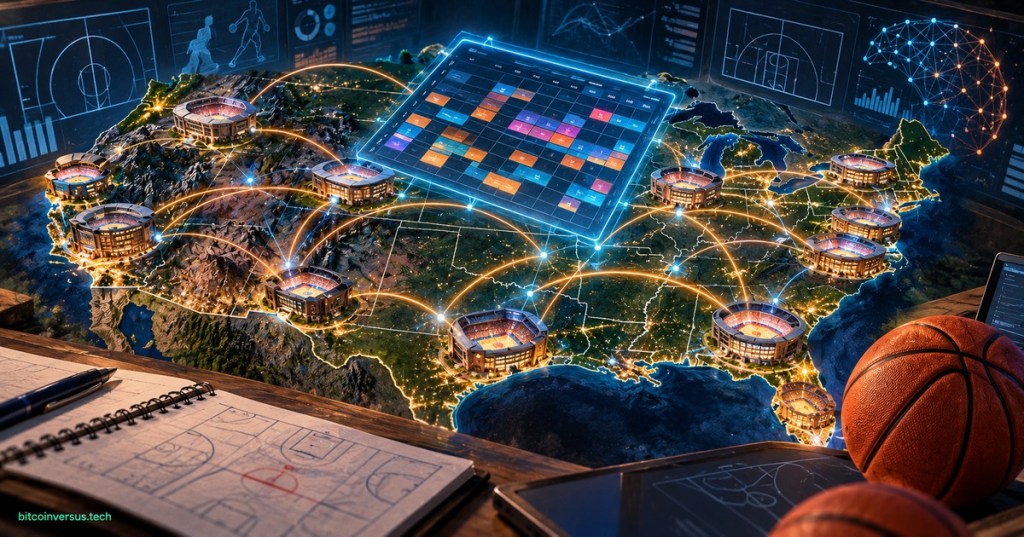
The Big Ten is using artificial intelligence to tackle one of college sports’ least visible but most complicated jobs: building schedules that keep 18 schools, multiple time zones, arena conflicts, travel, rest, television windows and competitive balance from colliding with each other.
Fastbreak AI announced a multi-year agreement with the conference in September, and the technology was already used to help construct the Big Ten’s football schedule plus its 2026–27 men’s and women’s basketball schedules.
Hundreds of full schedules can be tested before one is chosen
In its partnership announcement, Fastbreak said the conference worked through hundreds of complete basketball schedule iterations before settling on the final versions. Each pass could change priorities around travel, rest, arena availability, competitive equity and broadcast needs, then regenerate an entire calendar for review.
That is a much different problem from simply filling dates on a spreadsheet. With 18 institutions spread across the country, every decision can create downstream effects for another team, another venue or another television partner.
Fastbreak summarized the challenge in a specific X post, noting that the Big Ten basketball calendar has to account for three time zones, four broadcast partners, coast-to-coast travel, rest requirements and arena conflicts.
The Big Ten’s 180-game men’s slate is the finished output
The conference’s official men’s schedule release confirms the AI-generated workflow behind its 180 conference matchups for 2026–27. Each school plays a 20-game league schedule, facing three opponents twice and 14 opponents once.
The important part is not that AI “picked the games” by itself. The value is in optimization: administrators can set the constraints and priorities, generate a complete candidate schedule, inspect the tradeoffs, then change the rules and run another version without rebuilding everything manually.
Sports technology is moving deeper into operations
Most sports-tech headlines focus on what happens on the field or court. BitcoinVersus.Tech recently covered Sony rebuilding sprint finishes as 3D broadcast replays and YOLO and OpenCV turning football video into live tracking data. Scheduling AI attacks a different layer of the same industry: the operational machinery required before a game can even happen.
The problem scales quickly because modern conferences have national footprints. A schedule can affect athlete recovery, flight time, arena staffing, television inventory, rivalry placement and competitive fairness all at once. Optimization software can evaluate far more combinations than a human committee could reasonably test one by one.
The software is useful because humans can keep changing the constraints
A good sports schedule is not one with a single mathematical answer. One version may minimize travel but create poor television windows. Another may improve rest patterns while creating arena conflicts. The real advantage of Fastbreak’s approach is the ability to repeatedly solve the entire system under different priorities and compare the outcomes.
That iterative model resembles other computer-vision and performance systems entering sports. BitcoinVersus.Tech also reported on a Premier League club using markerless motion capture for rapid player testing. In both cases, technology is valuable less because it replaces staff than because it gives staff more usable versions of reality to compare.
College scheduling is becoming an optimization problem at national scale
The Big Ten’s expansion made scheduling substantially more complex. Teams that once operated inside a largely Midwestern footprint now have regular conference obligations stretching from the East Coast to Southern California and the Pacific Northwest.
That makes travel and rest more than administrative details. They can influence preparation time, athlete recovery and competitive balance. Broadcast requirements add another layer because the conference’s games also have to fit into national television windows.
Fastbreak’s deployment shows where AI may be most practical in sports: not necessarily making the final decision, but generating and testing enough realistic alternatives that humans can make a better one.
BitcoinVersus.Tech
Advertisement
Editor’s Note
We volunteer daily to ensure the credibility of the information on this platform is Verifiably True. If you would like to support to help further secure the integrity of our research initiatives, please donate here: 3C9o19EH5HSiwEPyCTmEKzxhNCbo2X6TTb
BitcoinVersus.tech is not a financial advisor. This media platform reports on financial subjects purely for informational purposes.


Leave a Reply