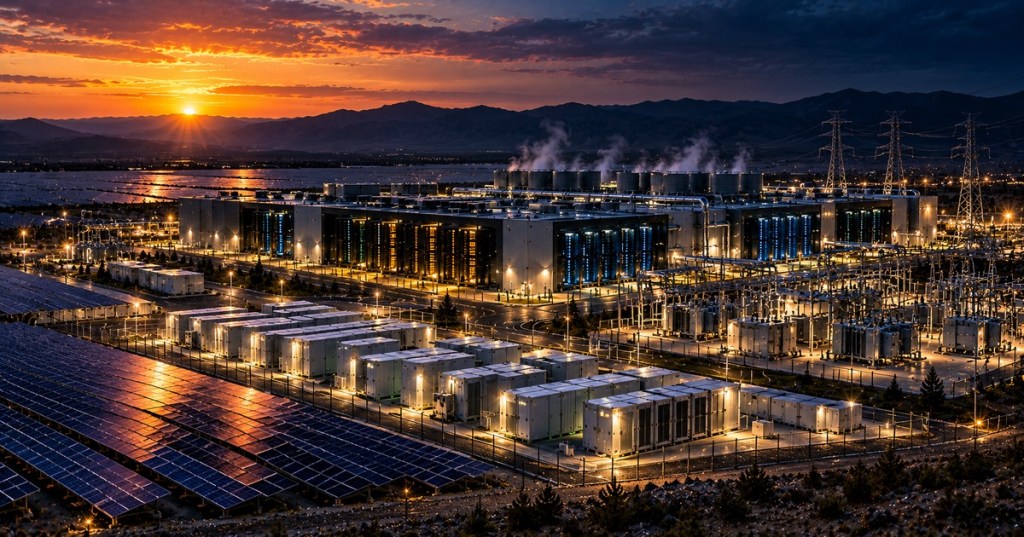
Yes—solar can power a data center. But running one continuously is harder because servers need electricity at night, during storms, and during periods when solar production is weak.
The answer is therefore: solar can supply a large share of the energy, but 24/7 operation requires storage, overbuilt generation, demand flexibility, another firm source, a grid connection, or some combination of them.
The Short Verdict
| Question | Verdict |
|---|---|
| Can solar generate enough annual energy for a data center? | Yes. |
| Can solar panels alone provide power at midnight? | Nah. |
| Can solar plus batteries support continuous operation? | Yes, technically. |
| Is that always the cheapest reliability strategy? | Nah. |
Megawatts Are Not Megawatt-Hours
A 100 MW data center running continuously consumes 2,400 MWh every day. A 100 MW solar farm cannot provide 2,400 MWh every day because it only reaches strong output when sunlight is available.
That is why BitcoinVersus.Tech separates nameplate power from real energy production in our capacity-factor guide.
Solar Capacity Factor Changes The Math
The National Renewable Energy Laboratory models utility-scale U.S. solar capacity factors at roughly 21% to 34%, depending on location and solar resource.
Using a simple 30% example, a 100 MW solar plant averages about 30 MW over time. To match the annual energy of a constant 100 MW load, roughly 333 MW of solar would be needed before storage losses, reserve margin, curtailment, downtime, and seasonal variation.
Annual Energy Still Does Not Solve Midnight
Even if a solar farm produces enough energy over a year, a data center still needs power after sunset. Matching annual generation and annual consumption is not the same as matching supply and load every second.
If a 100 MW facility had to survive a 12-hour night entirely from batteries, the idealized minimum would already be 1,200 MWh. A real system needs more because charging and discharging lose energy and operators need reserve capacity.
Several Cloudy Days Are The Real Test
Short-duration batteries are excellent at moving solar energy from afternoon into evening. The difficult and expensive part is carrying a large facility through extended low-solar periods.
Every additional hour of backup requires more stored energy. That is why designs that look straightforward with four hours of storage become much larger when they must cover a day or more.
Firm Power Changes Everything
The U.S. Department of Energy notes that data centers often require firm power because they operate continuously. DOE also identifies solar and battery storage as rapidly scalable resources while pointing to technologies such as geothermal and nuclear for clean firm power.
That is why many real systems are hybrids. Solar handles daytime consumption, batteries shift some energy into later hours, and another source supplies long-duration reliability.
Flexibility Helps
Some computing workloads can be shifted toward periods when electricity is abundant. Training jobs, batch processing, rendering, backups, and some Bitcoin mining workloads do not always need to run at the same exact moment.
A flexible data center therefore needs less storage than a rigid one because software can move some demand toward the solar production curve.
Off-Grid Solar Gets Complicated Fast
BitcoinVersus.Tech recently asked whether a data center can run entirely off-grid. Solar is one of the strongest resources for that kind of microgrid, but it still needs storage and redundancy for periods when sunlight is unavailable.
The more uptime the operator demands, the more redundancy the power system needs.
Behind-The-Meter Solar Is Easier
A practical alternative is solar behind the meter while keeping other power sources available. BitcoinVersus.Tech’s behind-the-meter guide explains how onsite generation can reduce imports without forcing a campus to disconnect from the grid.
That lets solar do what it is best at: produce large quantities of daytime energy while the rest of the system provides reliability.
So: 24/7 Solar Data Centers, Or Nah?
Can solar power a data center? Absolutely. Can solar panels alone guarantee 24/7 operation? Nah.
With enough solar, storage, and redundancy, solar can become the primary energy source for an around-the-clock facility. But the strongest practical architecture is usually solar plus batteries plus firm power or a grid connection.
BitcoinVersus.Tech
Advertisement
Editor’s Note
We volunteer daily to ensure the credibility of the information on this platform is Verifiably True.
If you would like to support our research and publishing work, please donate here: 3C9o19EH5HSiwEPyCTmEKzxhNCbo2X6TTb
BitcoinVersus.tech is not a financial advisor. This media platform reports on financial and technology subjects purely for informational purposes.


Leave a Reply