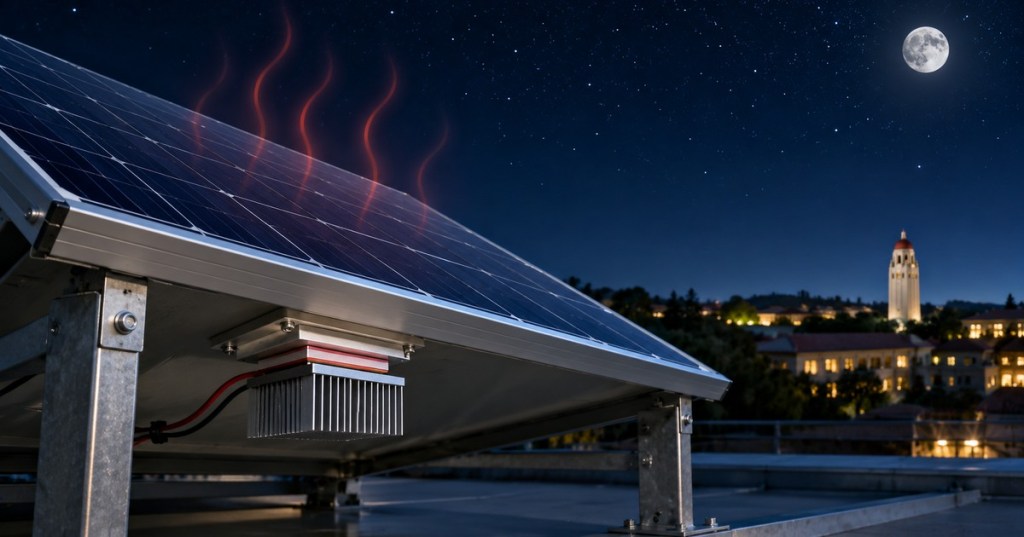
A solar panel can generate electricity after the sun sets—without relying on moonlight. Stanford University researchers demonstrated a modified photovoltaic cell that produces power from heat moving toward the cooler night sky. The April 2022 study in Applied Physics Letters reported approximately 50 milliwatts per square meter (0.05 W/m²) on a clear night, a tiny output with potential applications in remote sensors and other low-power equipment.
Engineers Sid Assawaworrarit, Zunaid Omair and Shanhui Fan added a thermoelectric generator beneath a conventional solar cell, supported by a heat sink and conducting materials. Unlike a normal photovoltaic panel, whose electricity comes from absorbed light, the additional generator harvests a small temperature difference. The experiment predates the newest research; the figure was not announced as a new breakthrough in November 2026.
Video: Rajamanickam Antonimuthu, “Stanford Engineers Invent a Solar Panel That Generates Electricity At Night,” April 2022. The demonstration explains the original Stanford result, not an operating commercial plant.
Radiative cooling becomes a second power source
Exposed surfaces naturally emit infrared radiation. On clear, dry nights, part of that radiation escapes through the atmosphere, allowing a solar cell to become cooler than the air around it. Heat passing through a thermoelectric module from the warmer surroundings toward the cooler cell produces electrical voltage through the Seebeck effect. The research publisher explained that strong thermal contact between the hot and cold surfaces is essential.
The process does not convert moonlight into useful power and does not keep the photovoltaic cells operating as if daylight continued. Clouds, humidity and thermal design affect the cooling gradient. The ability to produce electricity without sunlight comes from the added thermoelectric circuit, not an improvement in ordinary photovoltaic conversion at night.
How much power can the prototype deliver?
A one-square-meter panel delivering 0.05 W steadily for a hypothetical 12-hour night would produce 0.6 watt-hours. Ten square meters would produce 6 Wh under the same assumption. Those figures are arithmetic illustrations, not measured overnight yields. By comparison, a typical photovoltaic panel might deliver around 200 W/m² under favorable daylight conditions—roughly 4,000 times the Stanford nighttime power density.
The modest output might help low-energy lighting, sensors or standby devices, but cannot replace household batteries or supply normal grid demand. The scale difference is important in BitcoinVersus.Tech’s 24-hour solar data-center analysis. Solar power already contributes substantial daytime electricity, as shown by recent U.S. solar-generation data; nighttime production remains a separate engineering problem.
Separate studies report higher nighttime output
A January 2025 Cell Reports Physical Science study measured 0.35 W/m² from an optimized radiative-cooling system. Researchers publishing in Energy Conversion and Management: X in January 2026 reported 1.2 W/m² using concentrated photothermal storage with thermoelectric conversion, and demonstrated an autonomous sensing application. The three results come from different devices and experimental conditions; the later results are not evidence that the original 2022 panel was upgraded to those outputs.
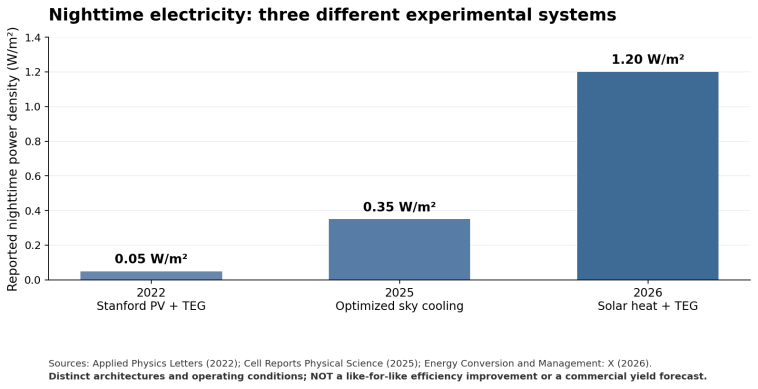
The work also builds on a 2019 Stanford radiative-cooling prototype that generated 25 mW/m² and powered a small LED without incorporating a photovoltaic cell. The broader principle had been investigated years before the 2022 panel retrofit.
Video: Stanford ENERGY, Shanhui Fan’s 2015 lecture, “Nighttime radiative cooling: Harvesting darkness of the universe.” The lecture covers the foundational physics and predates the Stanford solar-cell demonstration.
A sensor-scale technology, not overnight household solar
Commercial potential depends on thermoelectric module cost, durable thermal interfaces, weather resilience and measured annual energy delivery. Adding equipment to existing panels must also avoid degrading daytime output. The technology belongs among emerging energy sources, but lab power-density figures should never be mistaken for continuous electrical generation or the capacity factor of a finished plant.
Stanford proved that a solar-panel assembly can extract a small amount of electricity after sunset. Continued research is improving thermal conversion, but reliable, economically competitive round-the-clock rooftop generation remains an unsolved objective.
BitcoinVersus.Tech
BitcoinVersus.Tech Editor’s Note: We volunteer daily to ensure the credibility of the information on this platform is Verifiably True. If you would like to support our work and help further secure the integrity of our research initiatives, please scan the QR code below to donate 5,000 sats. For best results, scan the QR code from a laptop or larger screen.

Bitcoin address: 3C9o19EH5HSiwEPyCTmEKzxhNCbo2X6TTb. On a phone, open the QR image on another screen or copy and verify the address in your wallet before sending.
BitcoinVersus.tech is not a financial advisor. This media platform reports on financial subjects purely for informational purposes.


Leave a Reply