A laboratory generator has converted about 8% of incoming heat into electricity using a comparatively inexpensive semiconductor. Researchers at Japan’s National Institute for Materials Science (NIMS) reported the result on November 16, 2026, in Nature Sustainability. The device uses zinc antimonide, or ZnSb, and achieved its peak measured efficiency with a 400-kelvin temperature difference between the hot and cold sides. It is a laboratory module, not a commercial waste-heat power plant.
Official AIST Japan demonstration of an air-cooled thermoelectric generator. The video illustrates the underlying technology; it does not show the new ZnSb experiment. View the original YouTube video.
How a solid material makes electricity from heat
A thermoelectric generator exploits the Seebeck effect: a temperature difference across a conductor or semiconductor creates an electrical potential. Arrays of p-type and n-type elements carry charge in complementary ways, letting a module generate useful voltage without rotating machinery. Heat must enter one side and leave the other, so the temperature gradient and cooling arrangement matter as much as the material itself.
NIMS combined a p-type zinc-antimonide leg with an n-type magnesium-antimony-bismuth material, Mg₃Sb₁.₅Bi₀.₅. The experimental module used two p–n pairs. Researchers also introduced an antimony contact layer to reduce electrical losses where ZnSb joins an electrode. They reported an interface resistivity of approximately 10 micro-ohm square-centimeters.
Why $37.86 per kilogram matters
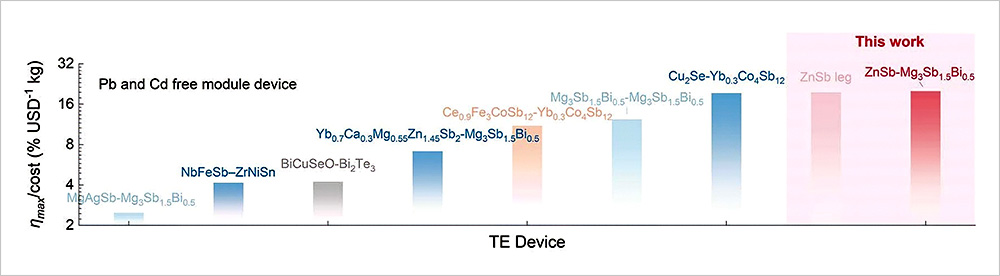
The researchers estimated the constituent raw-material cost of doped ZnSb at $37.86/kg, compared with $1,582.79/kg for germanium telluride and $546.06/kg for magnesium silver antimonide under their comparison assumptions. Those are nominal elemental costs, not procurement prices for assembled generators. Contacts, substrates, processing, packaging, yield, cooling equipment and installation remain outside the figures.
In materials testing, the adjusted ZnSb reached a peak zT of about 1.3 at 673 K, with an average zT near 0.8 across the evaluated temperatures. The dimensionless zT metric reflects electrical conductivity, thermopower and thermal conductivity; a strong peak value does not automatically guarantee a high-efficiency, affordable module over every operating temperature. NIMS therefore compared output efficiency against raw-material costs as well as conventional material performance.
What the measured 8% proves and what it does not
Across a 400 K temperature gradient, the two-pair module delivered a measured maximum conversion efficiency of approximately 8%. The number means about eight units of electrical energy for every hundred units of heat energy supplied under the reported test condition. It does not mean the generator could recover 8% of all waste heat at a typical data center, where available temperature differences can be much smaller.
Grand Illusions demonstrates the Seebeck effect with a small hot-water/cold-water generator. The older educational demonstration is unrelated to the 2026 ZnSb device test. View the original YouTube video.
Where waste-heat recovery could fit
Factories, engines and industrial exhaust systems may offer larger thermal gradients than warm cooling water. Such applications still need real-world measurements of heat-transfer losses, service life, corrosion and economic return. Our earlier report on printable materials for turning data-center heat into electricity discusses a different research path; U.S. rejected-energy estimates illustrate why recovering otherwise unused heat attracts attention.
Thermoelectric conversion should also be distinguished from the nighttime solar-panel thermal experiment and Zeno Power’s seabed Stirling-engine demonstration. Both involve heat and electricity, but they use different devices and operating conditions.
NIMS has not established mass-production yields, long-term reliability or whole-system electricity costs for the ZnSb technology. The researchers identify manufacturing optimization, material supply risk, recycling and lifecycle performance as work still required.
Bottom line: The breakthrough is not record-breaking efficiency. It is evidence that a lower-cost semiconductor can deliver useful, measured heat-to-electricity conversion in a built module, moving the discussion beyond material-only laboratory scores.
Primary sources: NIMS announcement, November 16, 2026; Nature Sustainability research paper; Japan Science and Technology Agency joint release.
Editor’s note: The featured oil painting is an original conceptual illustration, not an image of the tested module. The graph is original NIMS research media; both video embeds are independently labeled historical technical demonstrations.
We volunteer daily to ensure the credibility of the information on this platform is Verifiably True. If you would like to support to help further secure the integrity of our research initiative, please scan the QR code below.



Leave a Reply