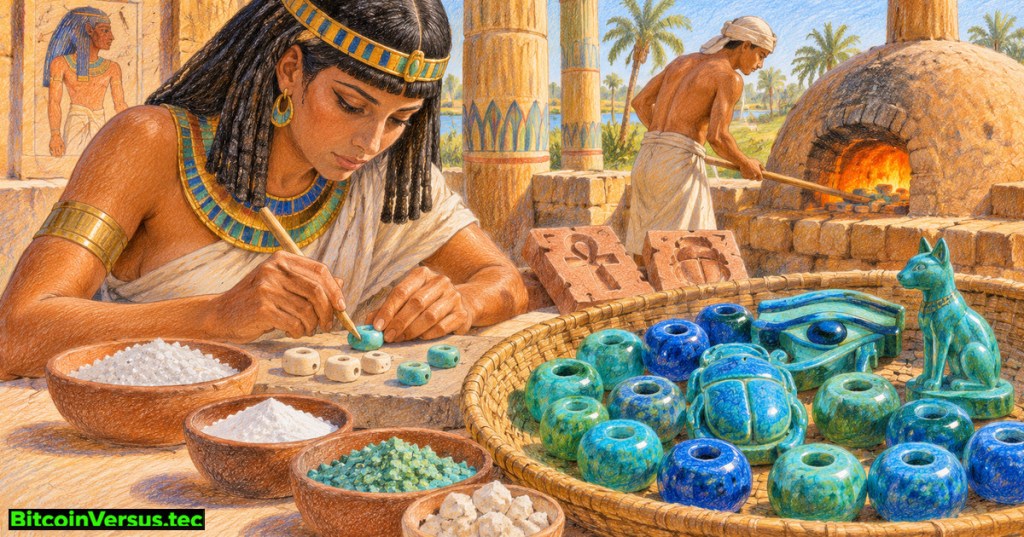
OSHMS.006 explores Egyptian faience, a luminous blue-green engineered material made from crushed quartz, alkaline ingredients, lime, and colorants. Unlike ordinary clay pottery, its body is primarily quartz particles joined by small quantities of glass. The process connects early ceramic vessels, lime-based pyrotechnology, and the mineral processing taught in OSHMS.003.
Key Learning Objectives
- Identify the quartz-rich core, alkali flux, lime, and copper colorant, and explain their functions.
- Explain how firing produces glass between quartz grains and a colored outer glaze.
- Distinguish efflorescence, application, and cementation glazing by their material pathways.
- Interpret cross-section evidence and a worked glaze-thickness calculation without claiming certainty about ancient methods.
Why quartz can become blue-green ceramic
Silica provides the quartz core. An alkali flux, from sources including natron or plant ash, encourages glass formation at temperatures below the melting point of pure quartz. Lime helps stabilize the glass and copper compounds commonly generate blue or turquoise color. During firing, a soda-lime-silicate glass bonds some quartz grains together and can coat the exterior. The resulting object retains a granular core and an outer glassy layer. The Metropolitan Museum of Art explains the core–glaze microstructure and why Egyptian faience differs from European tin-glazed earthenware.
Three glazing routes, three different signatures
Efflorescence: artisans combine soluble alkali ingredients with wet, quartz-rich paste. As the shaped object dries, dissolved salts migrate toward its surface. Firing creates glaze where suitable reactants accumulate and also generates interparticle glass. Application: workers coat a shaped body with glaze-bearing slurry before firing, sometimes leaving runs or uneven thickness. Cementation: an unglazed object is surrounded by reactive glazing powder; kiln heat generates a coating where the powder contacts the body. The Australian Museum describes all three methods and notes that artisans sometimes combined techniques.
Read evidence, not just surface color
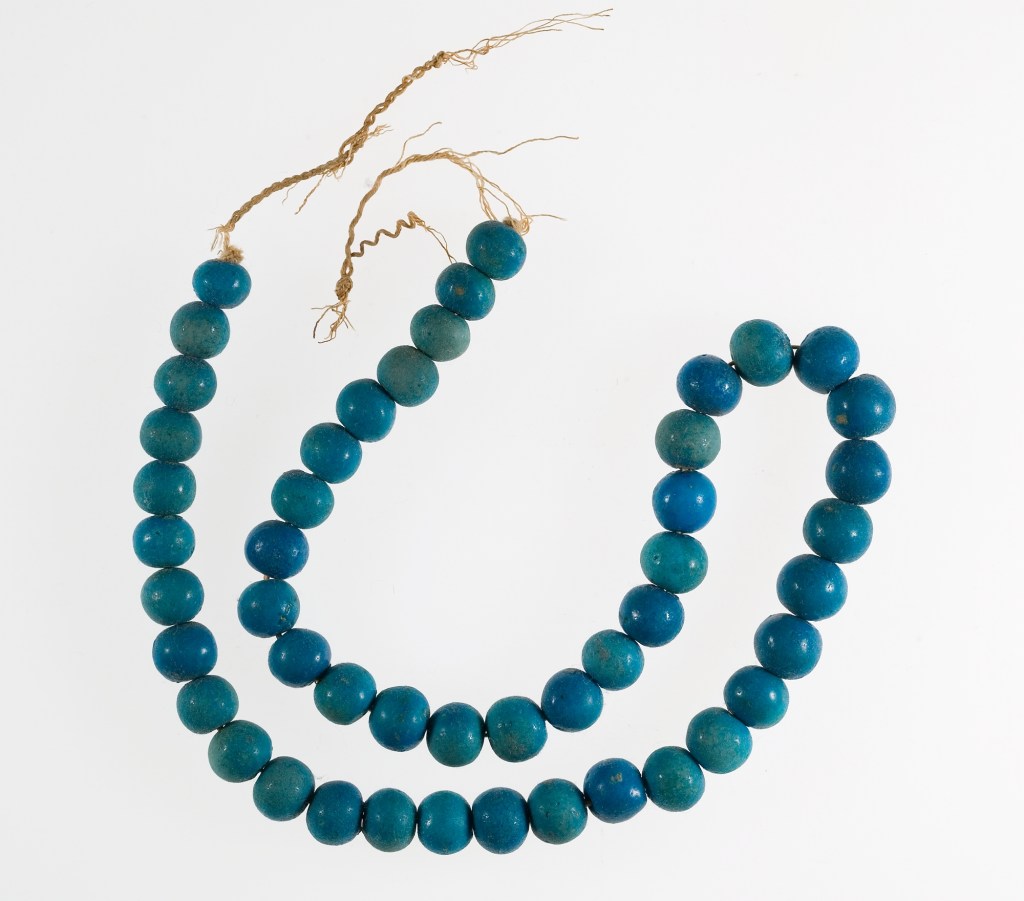
An archaeologist cannot reliably identify a glazing route by blue color alone. Under microscopy, researchers compare glaze thickness, an interaction layer below the surface, and interparticle glass inside the quartz core. Chemical gradients, pores, and surface defects can strengthen an interpretation. Replication studies show method-dependent differences, yet weathering and overlapping recipes may prevent a confident identification. See Cardiff University’s archaeological materials research. The copper-mineral context links to OSHMS.004 on early alloys and OSHMS.005 on furnace chemistry.
Worked example: measuring a coated bead
Suppose an illustrative spherical bead measures 12.0 mm across with a uniform 0.2 mm glaze layer on all sides. The core diameter is approximately 12.0 − 2 × 0.2 = 11.6 mm. Real museum pieces can be irregular, unevenly glazed, or worn; thickness should be checked with multiple measurements. The calculation represents geometry, not a measured ancient manufacturing specification.
Practice questions and answers
Why does copper matter? Copper compounds supply a common blue-green colorant. Which route moves soluble salts toward the exterior during drying? Efflorescence. Which route surrounds the object with glazing powder? Cementation. Can visible sheen prove a recipe? No. Examine the core, interaction region, glaze, and chemistry before drawing a qualified conclusion.
Lesson takeaway: Egyptian faience shows how familiar minerals became lustrous engineered objects through shaping, chemical reaction, and heating. The exact choices used for individual artifacts require evidence and remain open to research. The cover artwork is a historical reconstruction.
We volunteer daily to ensure the credibility of the information on the platform is Verifiably True. If you would like to support to help further secure the integrity of our research initiative, please scan the QR code below.



Leave a Reply