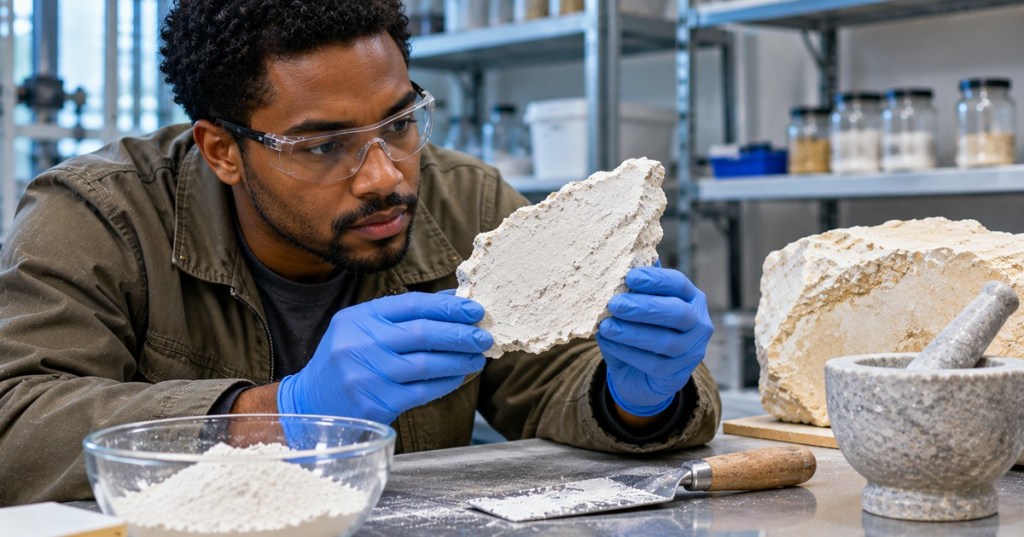
OSHMS.002 examines the development of lime plaster, one of the earliest artificially transformed stone-derived construction materials. The material requires more than grinding a rock: heating calcium carbonate can release carbon dioxide and produce calcium oxide, which becomes a workable binder through controlled reaction with water and later hardens by carbonation. Archaeological evidence from the southern Levant shows sophisticated plaster production before and during the transition to settled Neolithic communities. The chemistry explains the material’s versatility, while site analysis establishes which ancient examples were actually made through burning rather than simply collecting naturally soft limestone.
Learning Objectives and Prerequisites
- Distinguish limestone, quicklime, hydrated lime, hardened lime plaster, gypsum and fired clay.
- Explain calcination, slaking and carbonation with balanced chemical equations and correct units.
- Locate early lime technology in late Epipalaeolithic/Natufian and Neolithic archaeology without assuming a single undisputed invention date.
- Analyze the ideal mass balance of the calcination reaction.
- Identify the evidence needed to distinguish deliberately burned lime from natural carbonate sediment.
- Recognize why real plaster floors, figures and modeled skulls are related material uses but separate archaeological discoveries.
- Outline safe, non-experimental documentation and museum-object analysis exercises.
Prerequisites include elementary chemical formulas, conservation of mass, and an introduction to archaeological context dating. The earlier OSHMS.000 introduced shaped stone and deliberately fired materials. OSHMS.001 studied ceramic containers in East Asia, including contested contexts that may be roughly 20,000 years old. The present chapter follows the curriculum, not a claim that the first lime plaster predates every pottery tradition.
Early Evidence at Nahal Ein Gev II
A research team led by David Friesem and colleagues examined a Natufian cemetery at Nahal Ein Gev II in the southern Levant, where a plaster covering associated with burials was dated to around 12,000 years ago. The peer-reviewed 2019 study used infrared spectroscopy and soil micromorphology to investigate whether the material had undergone purposeful thermal transformation. The researchers describe a high-quality lime plaster and argue for greater technical sophistication among late Palaeolithic foragers than had generally been associated with the production of such binders.
Read the open-access primary research paper and its indexed abstract. The observation concerns an excavated burial-related plaster deposit. It is not evidence that a modern cement kiln or a later Neolithic village floor existed at the site. The team also reviews possible earlier burnt-lime traces, including materials associated with hafting; identifying small calcium-carbonate residues as manufactured lime remains a demanding archaeological problem.
Later Neolithic communities used plaster more extensively. Materials scholar Denise Schmandt-Besserat’s open University of Texas educational chapter on ‘Ain Ghazal describes substantial white-coated walls, floors and re-plastering episodes. The sequence from a small number of early applications to large architectural surfaces and modeled figures demonstrates how knowledge of heat-treated mineral binders could support new construction and artistic practices. It does not establish that every white Neolithic floor was made from burned lime: gypsum and unburned calcareous materials were also used in some regions.
The Lime Cycle as a Material Transformation
Pure limestone consists primarily of calcium carbonate, CaCO₃. When sufficiently heated under suitable conditions, calcium carbonate decomposes by calcination: CaCO₃ → CaO + CO₂. The resulting calcium oxide, called quicklime, is chemically different from the original carbonate and may react strongly with moisture. Temperatures for practical calcination depend on partial pressure of carbon dioxide, rock properties, particle size, heating time and furnace conditions; the archaeological literature describes heating above roughly 700 °C, not one universal historic kiln setpoint.
Quicklime reacts with water in an exothermic slaking or hydration reaction: CaO + H₂O → Ca(OH)₂. Calcium hydroxide may form the binder in a workable plaster. Exposed to carbon dioxide and suitable moisture, it can harden through carbonation: Ca(OH)₂ + CO₂ → CaCO₃ + H₂O. The final calcium-carbonate phase resembles the starting rock chemically, but the formed binder has a new manufactured structure and history. Aggregates, admixtures and environmental exposure can change practical behavior.
Materials terminology matters. Gypsum plaster relies principally on calcium sulfate compounds, not the carbonate-to-oxide lime cycle. Clay ceramics harden through distinct heat-driven transformations, and conventional unfired mud plaster differs again. Hydraulic lime can contain reactive silicate or aluminate phases and does not harden solely by atmospheric carbonation. Avoid describing all ancient white coatings as the same binder without microscopic or chemical analysis.
Worked Calculation: One Mole of Limestone
Assume a theoretical feed of exactly one mole of chemically pure calcium carbonate, with a molar mass of approximately 100.09 g/mol. The calcination reaction yields one mole of CaO at approximately 56.08 g/mol and one mole of CO₂ at approximately 44.01 g/mol. The chemical mass balance is therefore 100.09 g CaCO₃ → 56.08 g CaO + 44.01 g CO₂. In the real world, carbon dioxide leaves the reaction vessel as a gas, but mass is conserved when it is included in the system boundary.
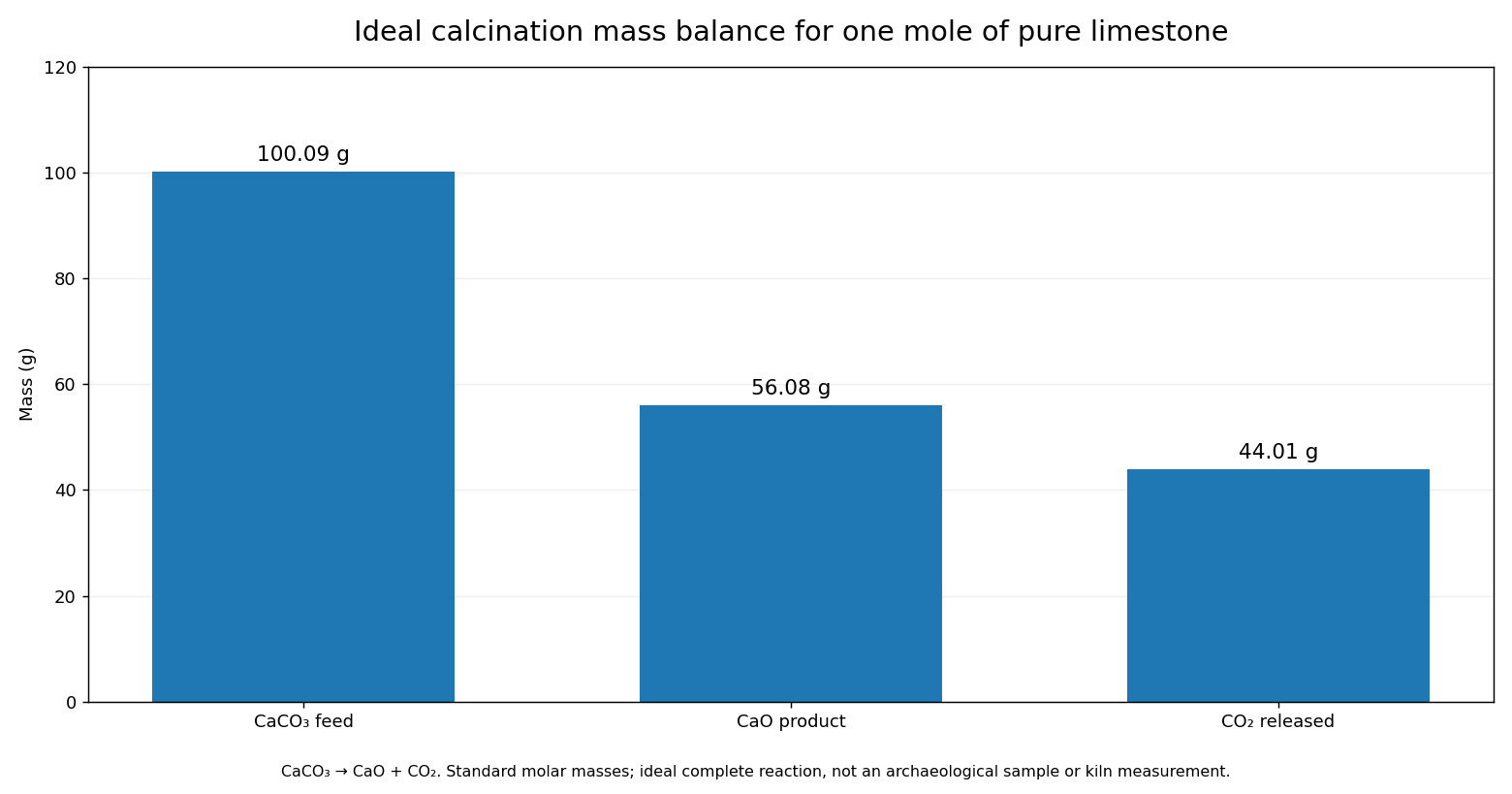
The ideal mass yield of quicklime is 56.08 / 100.09 × 100 ≈ 56.0%, while the theoretical mass of released CO₂ is about 44.0%. If a hypothetical pure 1,000 g sample were fully converted, the ideal products would be roughly 560 g CaO and 440 g CO₂. Natural stone contains impurities and real historical heating is not guaranteed to drive the entire reaction, so the example cannot be used to calculate the mass of lime a specific Natufian workshop actually produced.
Slaking also changes mass: one mole of CaO combines with approximately 18.02 g of water to form about 74.09 g of Ca(OH)₂. Carbonation later involves uptake of CO₂ and release of water. The simplified reactions illustrate why binders can harden through a chemical pathway, but they do not establish a field curing rate, strength or service lifetime. Historic plaster composition and weathering are assessed with material-specific analytical evidence.
What Neolithic Plaster Objects Reveal
At ‘Ain Ghazal near modern Amman, Jordan, archaeologists recovered plaster figures produced during the Pre-Pottery Neolithic. Research on their construction indicates plaster was shaped over reed-and-cord supports and assembled in stages. Such objects required control of a workable paste, material placement and drying. Their preservation is also a conservation achievement, not evidence that ancient makers had modern analytical instruments.
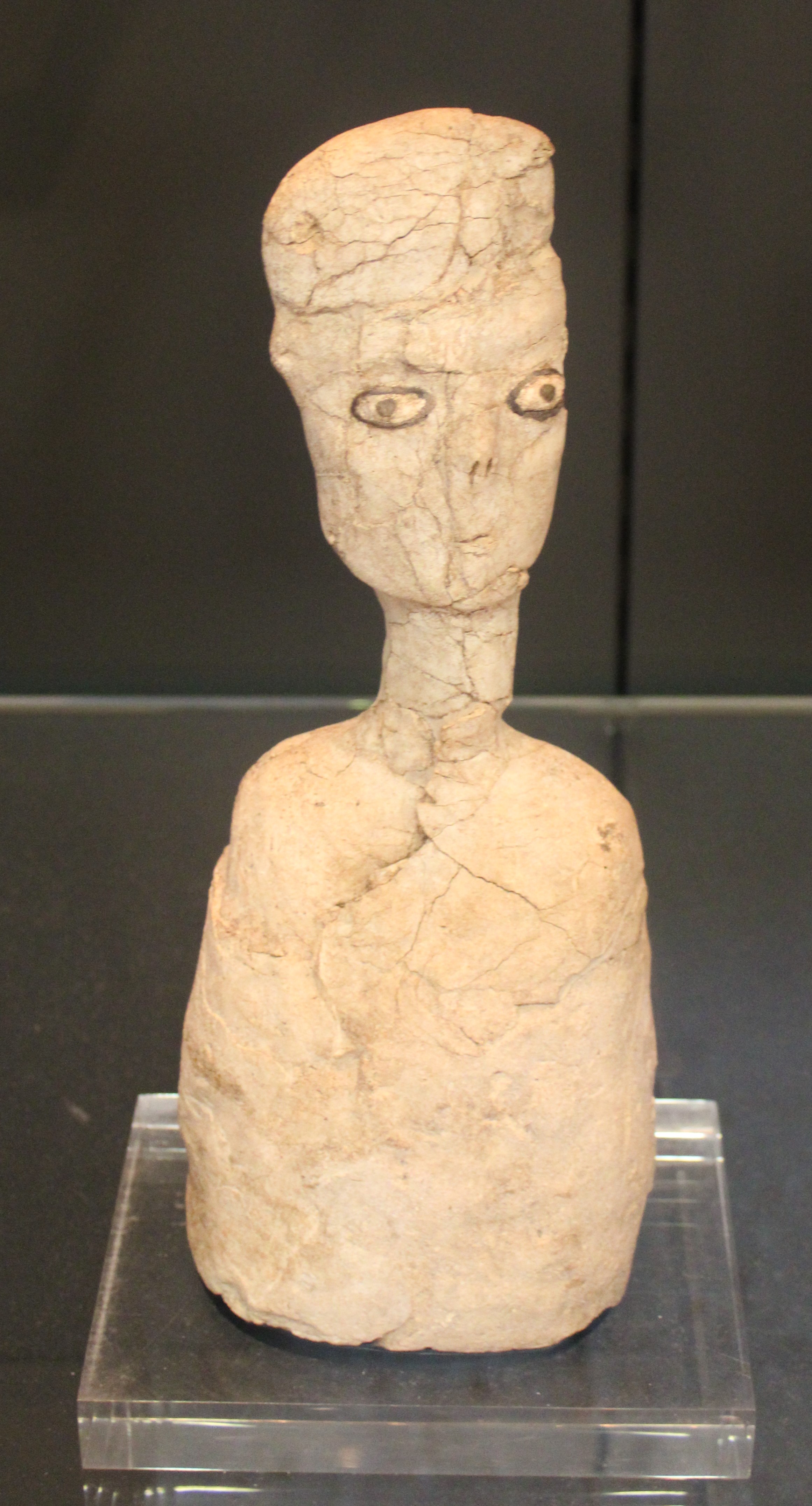
The American Journal of Archaeology study by Carol A. Grissom describes the construction of large ‘Ain Ghazal statues using plaster, reed bundles and cordage. Their forms and recovered construction stages provide a valuable opportunity to examine a manufactured material through the archaeological object itself. Museum conservation and scholarly reconstructions may clarify methods, but the surviving statues cannot reveal every workshop temperature or original batch recipe.
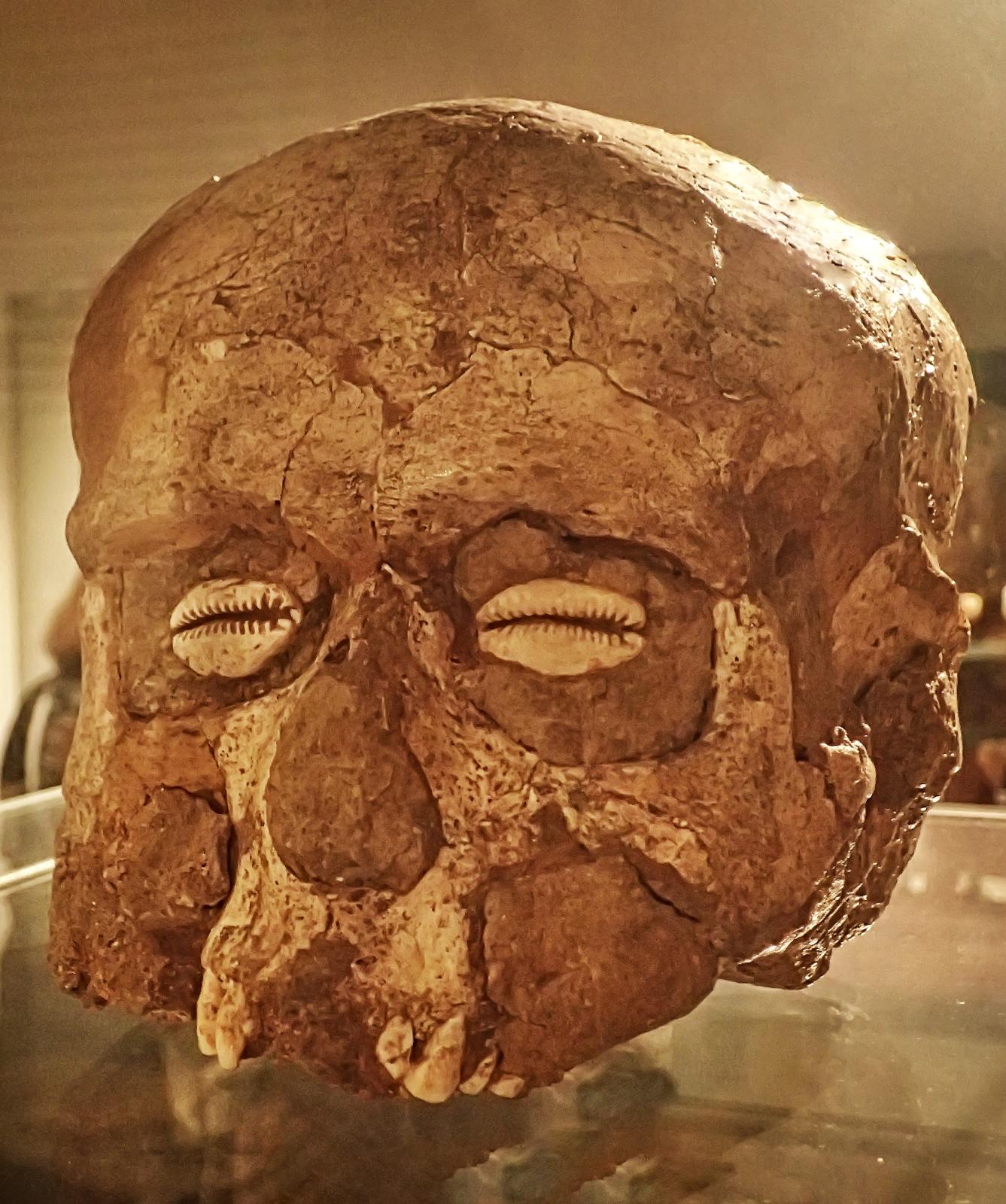
At Jericho, some ancient skulls were remodeled with plaster to create stylized faces and shell eyes. The Ashmolean Museum describes one excavated example, its display history, and uncertainty about the exact original social meaning. The technique illustrates another application of workable mineral paste, but it does not mean the Jericho object and ‘Ain Ghazal figures were made by the same craftworker, recipe or community.
How Researchers Distinguish Manufactured Lime
A white mineral coating does not automatically prove that limestone was burned. Calcium carbonate can occur naturally as soft sediment, chalk or deposits precipitated from water. After lime plaster has carbonated and aged for millennia, its principal carbonate mineral may resemble unburned stone. Researchers must use context, microstructure, stratigraphy, chemical/mineralogical analysis and experimental comparisons rather than rely on color alone.
Methods can include Fourier-transform infrared spectroscopy (FTIR) to distinguish spectral characteristics of minerals, micromorphology of intact sediment blocks to investigate formation and layering, scanning electron microscopy and petrography to examine textures and aggregates. The 2007 Karkanas experimental and archaeological review warns that recarbonated lime may be difficult to distinguish from some naturally occurring calcareous materials. Modern analytical uncertainty is important even when a visually appealing specimen survives.
Archaeological dating is equally important. Dates often come from an associated stratigraphic context or datable organic remains rather than from the plaster mineral itself. Disturbance, later rebuilding and incorrect sample association may produce misleading ages. The Natufian and Neolithic examples in the chapter represent different centuries, uses and archaeological contexts. Their sequence should be read as a development of knowledge, not a claim that every artifact used identical raw material or firing technology.
Materials Engineering Implications
- Thermal transformation: controlled heating can change a common rock into a more reactive material with new processing properties.
- Process control: the quality of limestone, fuel, heating duration, air conditions and particle size can alter final reaction products.
- Workability: suitable water content allows slaked-lime paste to coat surfaces or be shaped around a framework.
- Hardening: carbonation produces renewed calcium carbonate, although the time required varies with thickness and environmental access to CO₂ and moisture.
- Durability: pores, aggregates, wetting cycles, salts, substrate compatibility and environmental exposure influence long-term performance.
- Evidence limitations: neither a photograph nor theoretical chemistry establishes the binder’s actual historic furnace temperature, composition or mechanical strength.
Compare the lime story with OSHE.003 on mudbrick engineering, where geometry, unfired materials and masonry construction raise different problems. Later OSHE.005 on the Bent Pyramid illustrates the scale of limestone construction, without implying that Neolithic plaster chemistry directly explains the massive Fourth-Dynasty structural design.
Safe Documentation-Only Practical Exercise
- Rewrite and balance the three lime-cycle reactions. State which stage releases CO₂ and which stage consumes it.
- Use the chart to calculate what fraction of an ideal 100.09 g CaCO₃ feed becomes CaO and what fraction leaves as carbon dioxide.
- Repeat the ideal mass-balance calculation for 500 g of pure CaCO₃, preserving grams and significant figures. Do not interpret the result as a measured yield.
- Compare the authentic ‘Ain Ghazal statue and Jericho skull photographs. Identify the materials and construction claims that come from museum or scholarly records rather than visible color.
- Write a short note on why a naturally deposited calcium-carbonate floor cannot be reliably identified as burned-lime plaster by appearance alone.
- Describe what extra analytical evidence would be required to establish a particular ancient plaster recipe or an independently supported date.
Safety: the exercise requires no heating or reactive chemicals. Quicklime and wet slaking reactions can cause severe alkaline or thermal burns and present eye and respiratory hazards; do not recreate prehistoric firing or slaking outside a properly controlled, trained and equipped laboratory. Museum artifacts must never be sampled, cleaned, heated or handled without conservation authorization.
Knowledge Check and Answer Key
- What is calcination? Thermal decomposition of CaCO₃ to CaO and CO₂ under suitable conditions.
- What is slaking? Hydration of quicklime, CaO + H₂O → Ca(OH)₂, with heat release.
- What is carbonation? Reaction of calcium hydroxide with CO₂ to form calcium carbonate and water.
- What is the ideal CaO yield from 100.09 g pure CaCO₃? Approximately 56.08 g, about 56.0% by mass.
- What is the ideal CO₂ output? Approximately 44.01 g per mole CaCO₃.
- How old is the Nahal Ein Gev II plaster investigated by Friesem and colleagues? Approximately 12,000 years old according to the studied Natufian context.
- Are the photographed ‘Ain Ghazal statue and Jericho skull specimens from the Natufian burial? No. They are different, later archaeological objects.
- Why is an apparently white prehistoric floor not automatically lime plaster? Natural carbonates, gypsum and other coatings may look similar; microstructural and chemical study is needed.
- Did the calculations measure a Neolithic kiln? No. They are modern theoretical stoichiometry.
- Should learners heat quicklime or conduct slaking as a home project? No. Use the provided mathematical and documentation exercises only.
Open Educational and Primary References
Friesem et al., Lime plaster cover of the dead 12,000 years ago (2019, open access); University of Texas, Denise Schmandt-Besserat, ‘Ain Ghazal lime-plaster floors and painting; Ashmolean Museum, Jericho Skull; Grissom, Ain Ghazal statue construction (American Journal of Archaeology); Karkanas, identification of prehistoric lime plaster; World History Encyclopedia for additional museum-object context. The image credits and open-license terms are provided with the photographs. No unverified institutional video was included.
Conclusion
Lime plaster demonstrates how prehistoric materials engineering combined heat, mineral feedstock, chemical reaction and skilled shaping. The Natufian evidence shows a substantial command of artificial binders, while later Neolithic floors, statues and modeled objects reveal diverse applications. The historical engineering lesson is to distinguish the demonstrable transformation of material from the methods and dates that archaeology can establish—and to avoid confusing a modern calculation with an ancient measurement.
Editor’s Note: OSHMS.002 follows the verified OSHMS.001 pottery lesson. The Natufian burial-related lime plaster at Nahal Ein Gev II is grounded in an open-access 2019 peer-reviewed study; the ‘Ain Ghazal statue and Jericho modeled skull are separate, later Neolithic objects. The cover is original AI-generated editorial art depicting a younger male materials researcher, rotating the subject from OSHE.005’s mature female field engineer, and does not depict a real ancient artifact experiment. The two in-story artifact photographs are genuine, independently credited and openly licensed. The mass-balance chart uses modern ideal molar masses and is not an excavated sample or experimentally measured prehistoric furnace yield. No chemical reaction was performed and no unverified educational video was embedded.

To scan with a mobile wallet, display the QR on a second screen or use the supported saved-image scanner in your wallet. Verify the recipient and 5,000-satoshi amount before confirming any voluntary donation.
We volunteer daily to ensure the information on this platform is Verifiably True. If you would like to support the research, please scan the QR code.
BitcoinVersus.Tech publishes educational engineering and historical material. Follow laboratory safety requirements and seek professional conservation authority before attempting any physical materials investigation.


Leave a Reply