
OSHMS.000 — Open-Source History of Materials Science | Foundational Lesson
Materials engineering began when ancient toolmakers learned that the choice and treatment of a substance could change what it could do. Long before a written science of atoms, minerals, strength or fracture, early hominins selected stone, struck it, tested the result and eventually learned to control heat, crush minerals and blend mixtures. This first lesson traces the strongest archaeological evidence and carefully separates established findings from interpretations.
Elementary Overview
Imagine choosing a rock to make a sharp cutting edge. One rock breaks into useful flakes, while another crumbles. The difference is not only the size of the rock: it is how the material behaves. Choosing the right rock and shaping it for a job is an early example of working with material properties.
Much later, people learned that heating some stones made them easier to shape, and that grinding and mixing colored minerals could produce useful compounds. These small steps eventually led toward ceramics, metalworking, glass, plastics and electronic materials. Materials science studies the link between what something is made of, how it is processed and how it performs.
Smithsonian National Museum of Natural History: How to Tell a Rock from a Stone Tool. This brief demonstration helps learners distinguish intentional toolmaking from naturally broken stone.
Learning Objectives
- Define a material, a property, processing and performance in simple technical language.
- Identify the role of stone fracture in the earliest preserved toolmaking.
- Distinguish stone shaping from deliberate thermal modification and material blending.
- Locate Lomekwi, Pinnacle Point and Blombos Cave in the history of materials technology.
- Explain why artifacts and laboratory analyses provide different types of evidence from written accounts.
- Recognize why the title “first materials scientist” cannot be assigned to an identifiable prehistoric person.
What Counts as an Engineered Material?
A material is matter used to make an object or perform a task: stone, clay, wood, bone, mineral pigment, metal or a modern semiconductor. A material property is a measurable or observable quality such as hardness, toughness, fracture behavior, color, or response to heat. Processing means selecting or changing a substance; performance means how well the finished object serves its purpose.
For an early stoneworker, the question was practical: which stone produces a usable edge, which blow removes the required flake, and which treatment makes that operation more reliable? In the language of modern materials science, the core relationship is processing → structure → properties → performance. This is a modern teaching framework applied retrospectively, not a claim that prehistoric communities used those terms.
Around 3.3 Million Years Ago: Lomekwi and Deliberately Shaped Stone
The published Lomekwi 3 assemblage from West Turkana, Kenya, has been dated to approximately 3.3 million years ago. Researchers described stone artifacts showing battering and intentional flake removal. They named the proposed technological tradition Lomekwian. See the 2015 original research in Nature. The makers have not been identified to a single species or person, and the evidence does not establish the moment toolmaking was invented.
Stoneworking itself is materials processing. A toolmaker applies controlled force to a core, taking advantage of how brittle stone fractures. The remaining edge and removed flake can perform different jobs. Toolmaking creates an engineered geometry even when the chemistry of the rock stays largely the same. This distinction is important: manufacturing a new shape does not necessarily mean synthesizing a new substance.
Smithsonian National Museum of Natural History: The Origins of Stone Tool Technology (2025). Archaeologist Emma Finestone discusses the earliest stoneworking record and uncertainty about the toolmakers.
By 2.6 Million Years Ago: The Oldowan Toolkit
By at least roughly 2.6 million years ago, the Oldowan toolkit included hammerstones, cores, and sharp stone flakes. Older Lomekwian tools and the later Oldowan tradition should not be collapsed into the same category. Their different scales and patterns of manufacture tell archaeologists that technology changed through time.
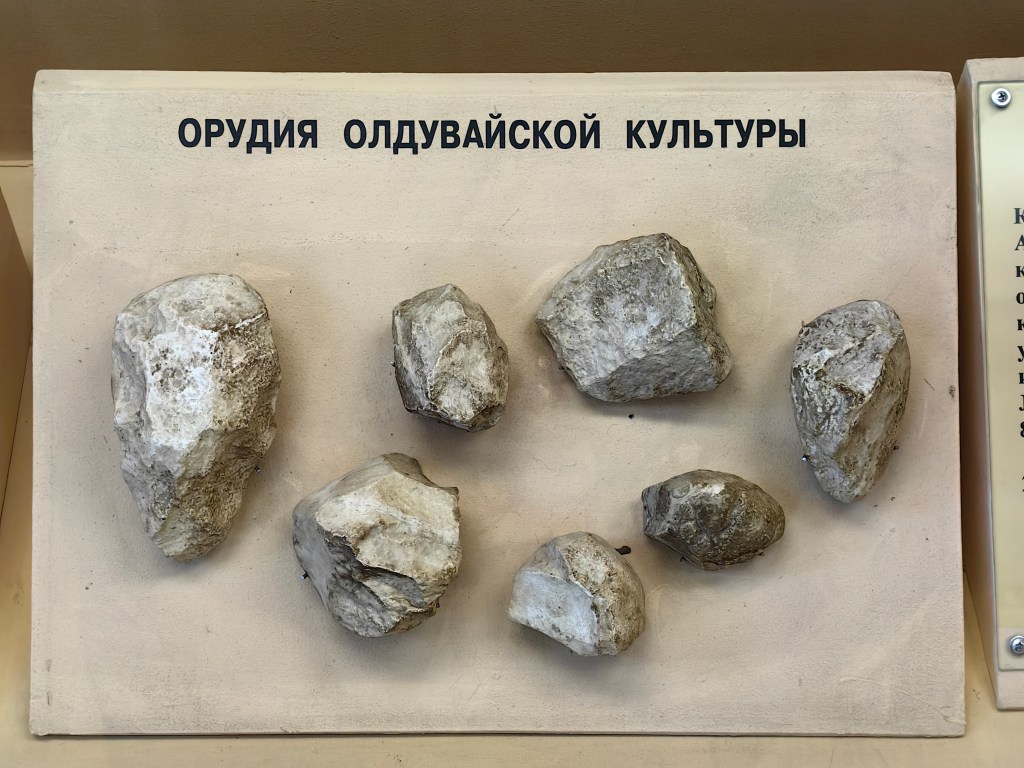
Even a basic stone flake demonstrates selection and control: the maker must choose workable raw material, orient the core and manage the direction of force. The archaeological record preserves discarded flakes as well as successful products. In many cases the debris is exactly how researchers reconstruct a manufacturing sequence.
Cleveland Museum of Natural History: Flintknapping Demonstration (2011). A practical demonstration of stone-tool production, not footage of prehistoric people.
Approximately 164,000 Years Ago: Heat Becomes a Materials Tool
At Pinnacle Point on the southern coast of South Africa, archaeological analyses indicate that people sometimes heated silcrete before shaping it as early as about 164,000 years ago. By around 72,000 years ago, heat treatment was prominent within the studied assemblages. This finding, reported in Science (2009) and examined by later microscopy-based research, represents a major change: heat was used deliberately to change a raw material’s working behavior.
Heating some siliceous rocks can modify fracture characteristics and make them easier to flake in a controlled manner. The goal is not simply to make the stone “stronger.” Overheating can also damage stone. Investigators distinguish purposeful treatment from accidental fire exposure by examining the context of artifacts together with physical and chemical indicators; a red color alone is not proof of an engineered heat treatment.
Community discussion of heat treating flint. This is a discussion prompt rather than archaeological evidence; the dated scientific findings above remain the evidentiary basis.
Approximately 100,000 Years Ago: The Blombos Ochre Workshop
At Blombos Cave, South Africa, excavators discovered two abalone shells associated with a prepared, ochre-rich mixture. Grinding stones, hammerstones, charcoal and bone formed part of the processing assemblage. Christopher Henshilwood and colleagues published the evidence in Science in 2011. The shells preserve evidence not just of shaping a solid, but of collecting, crushing, blending and storing multiple substances.
Ochre consists of iron-bearing mineral material whose color can be useful as pigment. Making a compound from it involves raw-material procurement, mechanical size reduction, ingredient selection and storage in a vessel. Those are recognizable elements of a production process. However, the team could not determine the mixture’s final use with certainty; proposed purposes include decoration and skin protection. The presence of a recipe-like process should not be confused with proof of one particular application.
Original 2011 report on the Blombos Cave ochre-processing workshop, independently catalogued by Archäologie Online (3:28).
Around 30,000–25,000 Years Ago: Fired Clay
The Venus of Dolní Věstonice and other fired-clay figurines from the Gravettian period in what is now the Czech Republic demonstrate a different materials transformation: clay was formed and subjected to heat, producing a ceramic object. A 2024 micro-CT study in the Journal of Archaeological Science examined the sculpture’s internal structure and paste. This is evidence for fired-clay technology, not proof of the first ceramic object ever made.
Ceramic firing is distinct from simply drying a clay shape. Heat changes mineral structures and physical behavior, potentially producing a more durable solid. The broader technological lesson is that temperature can alter the finished material itself, not merely make a tool easier to shape. Metallurgy would later extend thermal processing to metal ores, melting, casting and forging; that progression deserves its own lessons.
Engineering Method: Read the Evidence, Not Just the Story
- Material artifact: a surviving stone tool, pigment residue, shell container or fired-clay object. It can be measured, photographed, analyzed and contextually dated.
- Experimental replication: modern attempts to reproduce flaking, heating or mineral mixing. Useful for testing hypotheses, but a successful demonstration does not prove an ancient craftsperson used precisely the same process.
- Peer-reviewed interpretation: researchers explain evidence and uncertainty in a published study. Later studies may revise their conclusions.
- Written tradition: texts can preserve named craftspeople and technologies. The statement that a text describes a person is not identical to independent archaeological verification of that person.
This distinction becomes central later in OSHMS.004. Genesis 4:22 describes Tubal-Cain as a worker or teacher associated with bronze and iron tools. He is therefore a scripturally attested named metalworker; he is not independently established as the first historical metalsmith, and the passage does not provide a secure archaeological date. This lesson starts before metallurgy so that the material history is not artificially compressed into one named figure.
Practical Exercise: Observe a Material Without Damaging It
Examine an ordinary rock, ceramic cup and metal spoon. Identify each item’s material; note one property that makes it useful and one manufacturing process that could have produced its shape. For the rock, identify visible grains, layers or fracture surfaces without striking or heating it. Record observations rather than assuming a material’s composition from its color.
Knowledge Check
- 1. What distinguishes changing the shape of a rock from changing its working properties through heat?
- 2. Where have approximately 3.3-million-year-old stone tools been documented?
- 3. Which site provides evidence for intentional silcrete heat treatment around 164,000 years ago?
- 4. What ingredients or implements were associated with the Blombos ochre mixture?
- 5. Why would it be inaccurate to call Tubal-Cain the archaeologically verified inventor of metallurgy?
Answers
- 1. Shaping changes the object’s geometry; heat treatment may also modify the material’s internal structure and fracture properties.
- 2. Lomekwi 3, West Turkana, Kenya.
- 3. Pinnacle Point, South Africa.
- 4. Ochre-rich mixture in abalone shells, associated with tools and materials including stones, bone and charcoal.
- 5. Genesis records the attribution, but independent archaeological identification and secure dating of the named person are not established.
References and Further Reading
- Harmand et al., Nature (2015), “3.3-million-year-old stone tools from Lomekwi 3.”
- Smithsonian Human Origins Program, Early Stone Age Tools.
- Brown et al., Science (2009), “Fire as an engineering tool of early modern humans.”
- Henshilwood et al., Science (2011), “A 100,000-year-old ochre-processing workshop at Blombos Cave.”
- Neruda et al., Journal of Archaeological Science (2024), micro-CT of the fired-clay Venus of Dolní Věstonice.
- Genesis 4:22, text and translations (context for the later OSHMS.004).
Elementary Conclusion
A material does not need to be metal or plastic to be engineered. When an ancient person selected a specific stone because it could make a good edge, the choice of material already mattered. When later people deliberately heated rock, prepared ochre mixtures and fired clay, they demonstrated increasingly complex ways to control how materials behaved.
The people who made the earliest surviving tools cannot be identified by name. We can still study what they did by examining the marks on tools, the substances left in vessels, and the contexts where objects were discovered. Modern research in materials beyond silicon and atomic-precision semiconductor engineering uses the same broad principle: choose or change a material to achieve better performance.
Texas Parks and Wildlife: The Flintknapper, Making Stone Tools. Angela Parker demonstrates the controlled shaping of stone.
Continue the OSHMS Certificate
Next: OSHMS.001 — The Origins of Metalworking. Subsequent lessons will distinguish early metal use, smelting, first metallurgists, early ironworking, named craftspeople in documented traditions, written technical knowledge and the emergence of modern materials science. The companion OSHE — History of Engineering track treats named builders and engineers with an explicit evidence scale.
BitcoinVersus.Tech Editor’s Note: We volunteer daily to ensure the credibility of the information on this platform is Verifiably True. If you would like to support to help further secure the integrity of our research initiatives, please donate using the QR code provided

For best QR-code scanning results, please scan this donation code from a desktop or larger screen. Mobile screens may prevent camera recognition.


Leave a Reply