
This History of Materials Science lesson examines one of the most consequential steps after the earliest engineered stone and fired-clay figurines: the manufacture of ceramic vessels for handling foods and liquids. Archaeologists studying Xianrendong Cave in Jiangxi Province, southern China, reported pottery in contexts they dated to approximately 20,000–19,000 calibrated years before present, long before settled farming. Other researchers have challenged whether the oldest claimed contexts securely support that date. Learning the technology requires understanding both the fired material and the evidence used to date it.
This is a chronological continuation of OSHMS.000: The First Engineered Materials, which introduced intentionally shaped stone, treated pigments and ceramic figurines at Dolní Věstonice. Our subject here is different: how forming and firing hollow containers changed cooking, storage, mobility and human material processing.
Learning objectives
- Define clay, temper, ceramic, greenware, firing, thermal shock, sintering and pottery vessel.
- Explain why fired figurines and usable ceramic containers represent related but distinct engineering achievements.
- Describe the evidence used to date early pots and why some archaeological ages remain disputed.
- Explain how particle size, moisture, wall thickness and thermal gradients affect vessel performance.
- Evaluate a comparative pot photograph without confusing it with a Xianrendong artifact.
Archaeological setting: East Asia before farming
The Xianrendong site is a cave in Jiangxi, China. Hunter-gatherers occupied it during the late Pleistocene. In a 2012 Science study, Xiaohong Wu and colleagues examined charcoal radiocarbon dates and the microstratigraphy around pottery fragments, concluding that the earliest sherd-bearing contexts were roughly 20,000 to 19,000 calibrated years old. The proposed vessels preceded agriculture, contradicting a simple story in which permanent farming villages must come before pottery.
The distinction between a dated sherd and a dated context matters: ordinary radiocarbon tests cannot directly date most fired clay. Archaeologists therefore connect pottery to charcoal, organic residues or sediment layers and must show those associations were not mixed by later disturbance. Micromorphology—the microscopic study of undisturbed sediment layers—helps test whether surrounding evidence is intact.
The dispute over the oldest date
A 2017 radiocarbon review by scholars including Yaroslav Kuzmin questioned whether the 20,000-year claim at Xianrendong can be substantiated, while another 2017 review of southern Chinese cave sites accepted early pottery contexts around the Last Glacial Maximum. These are differing interpretations of archaeological association and dating, not evidence that ancient pottery did not exist. For this reason, the most careful wording is “early pottery reported in contexts dated to around 20,000 years ago,” not an unquestioned world record.
The Smithsonian Human Origins program also describes pottery from East Asia long before early agricultural settlements. Later Jōmon vessels from Japan show how ceramic making continued and diversified over thousands of years, but they are not direct replicas of the Xianrendong material.
Video study: Dan Davis History, “The World’s First Pottery Is Older Than You Think” (2025). Discusses pre-agricultural ceramics and the Xianrendong evidence. It is an independent historical presentation; primary archaeological papers control disputed claims.
What makes a fired pot an engineered material?
Clay is a natural fine-grained material rich in phyllosilicate minerals. When mixed with water its particles can slide and rearrange, letting a maker press, coil or shape a vessel. As water evaporates, the unfired body—often called greenware—becomes more rigid but still can be broken down by moisture and mechanical force.
Firing subjects the shaped body to sufficient heat for dehydration and progressive mineral changes, producing a harder, less water-sensitive material. Sintering describes particle bonding and densification below the melting point of the overall body. Early low-fired pottery was frequently porous; firing does not automatically make a pot waterproof, glassy or suitable for every cooking task. Temperature, raw-material chemistry and heating time all affect the result.
The engineering constraints of a prehistoric vessel
- Workability: clay needs enough water to shape but not so much that its walls slump.
- Particle size: coarse grains and inclusions influence plasticity, drying shrinkage, porosity and crack behavior.
- Temper: added grit, sand or other inclusions can modify shrinkage and resistance to thermal stress; exact ingredients must be established by analysis rather than guessed.
- Wall thickness: a thick section may dry or heat less uniformly, creating stress concentrations.
- Drying: uneven evaporation increases the risk of cracks before firing.
- Heat control: too rapid a temperature change creates thermal gradients; trapped moisture can produce steam and fracture.
- Service conditions: direct flame, repeated heating and contact with food impose very different requirements from merely displaying a small figurine.
The original investigations of Dolní Věstonice figurines measured firing temperatures around 500–800 °C, illustrating early ceramic processing. Those values are not automatically the firing temperature of Xianrendong vessels: the two regions, dates and clay recipes differ. See Vandiver and colleagues’ 1989 ceramic study for the earlier figurine evidence.
From fragments to a technological history
A sherd is only a fragment, but its curvature, wall profile, temper, decoration, surface treatment, firing color and residue can support reconstruction of vessel use. Burned deposits might support a cooking interpretation, but soot alone is not a controlled experimental proof of a specific food or recipe. Archaeologists may compare microscopic inclusions, charred residues and surrounding shell or bone fragments before drawing a stronger conclusion.
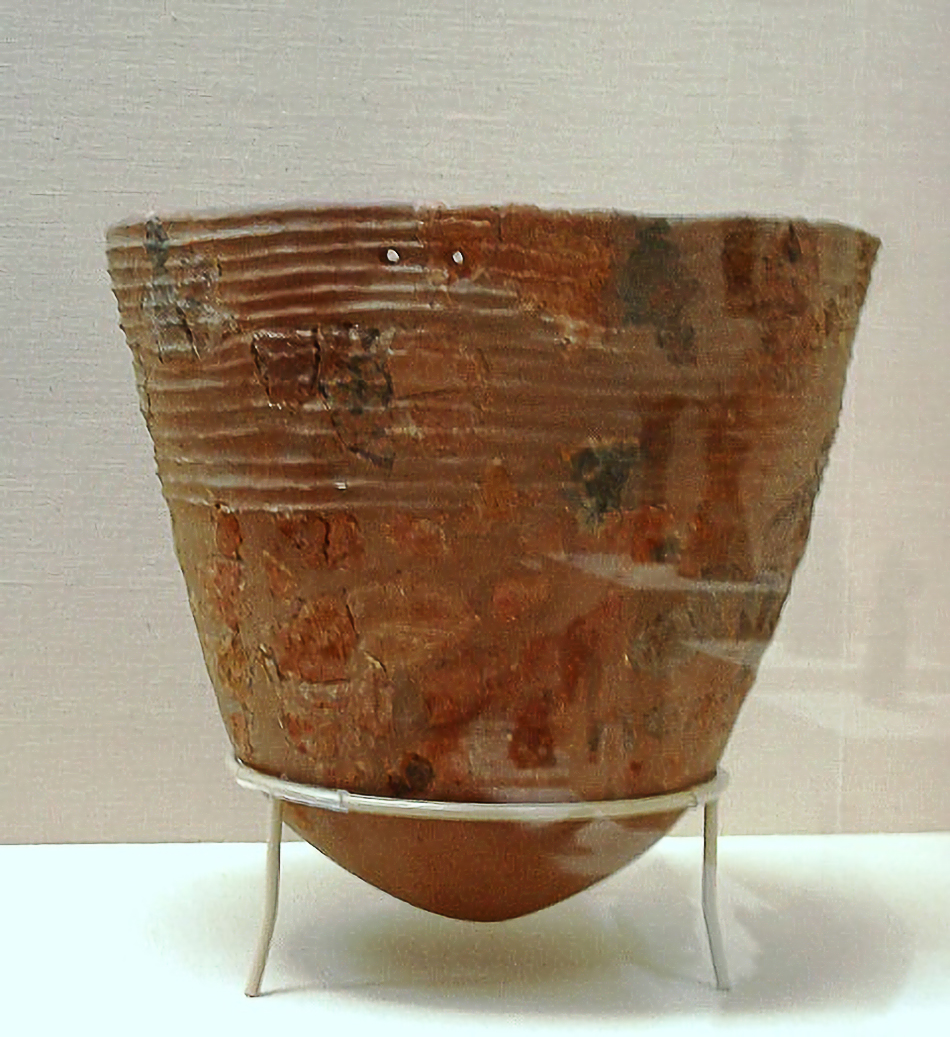
Compare the vessel’s reconstructed overall shape with the evidence an archaeologist may obtain from a small rim fragment. Later Jōmon examples demonstrate hollow-form production and changing container functions but cannot prove that China’s Xianrendong vessel shared their precise profile or decoration.
Later improvements: coiling, handles and controlled shaping
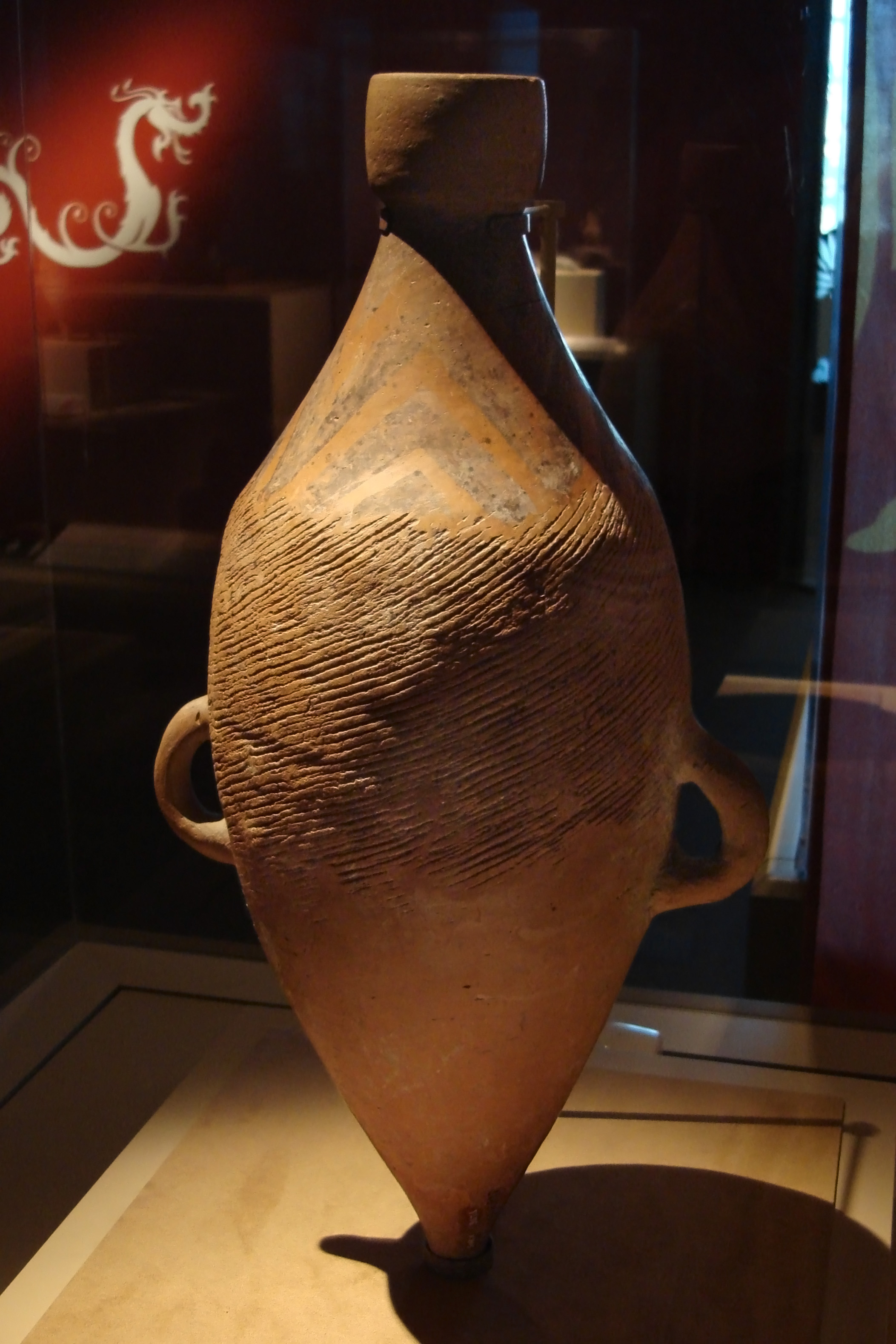
For millennia, pottery makers refined vessel manufacturing by using repeated clay coils, smoothing surfaces and adding handles suited to transport. These are purposeful design choices. The shape of a rim affects pouring; the location of a handle affects lifting force; and uniformity can influence how a pot heats. A later Yangshao water jar from northern China illustrates design adaptation long after the first reported late-Pleistocene sherds.
A safe observational materials exercise
Use an ordinary modern unglazed clay pot or sample and observe it without firing, breaking or modifying an archaeological object. Record surface color, visible pore texture, wall thickness, mass and whether it absorbs a tiny drop of water. Compare the observations with glazed tableware. Do not infer ancient firing temperature from color alone, and avoid handling cultural heritage objects without museum authorization. A qualified ceramics laboratory can separately perform microscopy, X-ray diffraction or thermal tests to investigate mineral phases.
How evidence is graded
| Evidence | What it can establish | Main limit |
|---|---|---|
| Radiocarbon from associated charcoal | Age estimate for an associated occupation context | Association or disturbance must be demonstrated |
| Stratigraphy and micromorphology | Layer order and evidence of mixing | Interpretation depends on excavation quality |
| Pottery fabric and mineral inclusions | Raw materials, temper and manufacture clues | Not a direct absolute date by itself |
| Soot or organic residue | Potential vessel heating or contents | Contamination and alternative uses remain possible |
| Reconstructed vessel geometry | Probable shape from joined fragments | Missing portions may remain conjectural |
Glossary and knowledge check
- Greenware: shaped but unfired clay material.
- Temper: added nonplastic material or inclusions that modify a ceramic body.
- Sherd: a fragment of a broken pottery vessel.
- Sintering: heat-driven bonding and densification of particles without complete melting of the whole body.
- Thermal shock: damage produced by temperature gradients and associated stress.
- Calibrated years BP: years before the conventional reference year 1950, adjusted using radiocarbon calibration.
Questions: Why is a pottery vessel more complicated than a fired figurine? Why does associated charcoal not automatically give the age of a pottery fragment? What evidence would make a cooking interpretation stronger? Why are the Japanese and Yangshao pictures comparative rather than proof of Xianrendong’s appearance?
Answers: Hollow vessels must maintain shape and survive functional thermal and mechanical demands. Charcoal and pottery can be mixed or deposited at different times. Context, soot, residue and wear together improve the use inference. The pictured objects were made thousands of years later at other sites.
Sources and continuation
Read Wu et al. (2012) for the Xianrendong contextual ages; Kuzmin et al. (2017) for a critical reassessment; the 2017 southern-China cave study for another dating analysis; and the American Ceramic Society’s historical overview. Our earlier OSHMS.000 foundational lesson explains the older stone, pigment and figurine technologies. The next chronological study will follow advances in vessel technology, raw-material treatment and manufacturing methods without skipping later traditions.
Editor’s Note: We volunteer daily to ensure the credibility of the information on this platform is Verifiably True. If you would like to support our work and help further secure the integrity of our research initiatives, please scan the QR code below to donate 5,000 sats.

For mobile scanning, open this article on a laptop or larger display and scan the original code using a compatible Bitcoin wallet. Verify the destination address before sending: 3C9o19EH5HSiwEPyCTmEKzxhNCbo2X6TTb.
BitcoinVersus.tech is not a financial advisor. This media platform reports on financial subjects purely for informational purposes.


Leave a Reply