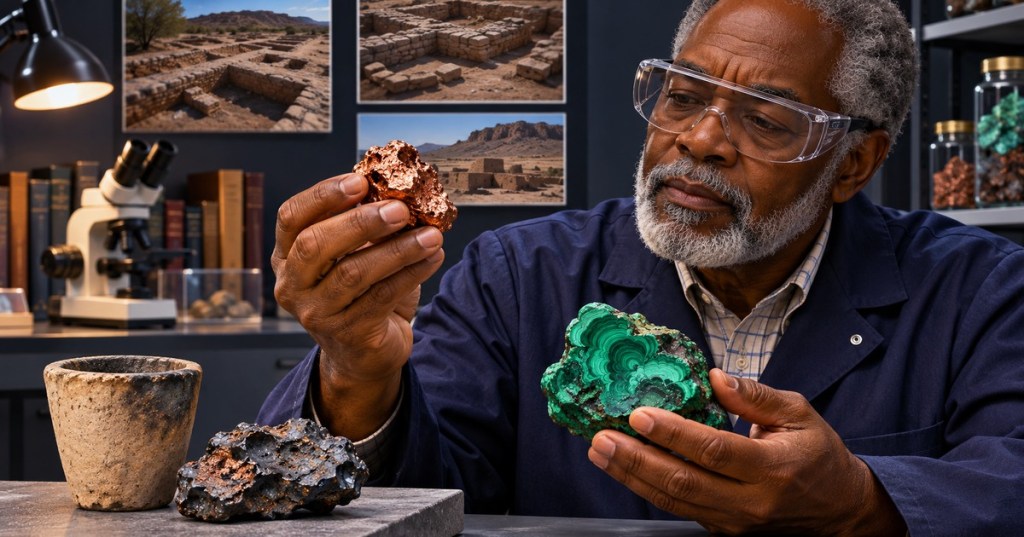
OSHMS.003 explores the transition from working naturally occurring metallic copper to extracting copper from minerals. Native copper can be hammered into shapes without separating metal from ore. Smelting is a different achievement: it chemically reduces a copper compound to produce metal, creating new manufacturing possibilities and new technical hazards. Early evidence from the Vinča-culture site of Belovode in Serbia illustrates how archaeologists reconstruct the development of extractive metallurgy.
The lesson follows OSHMS.002 on early lime plaster and builds on OSHMS.001 on early pottery vessels and OSHMS.000 on the first engineered materials. Ceramics, lime plaster and copper extraction all involve heat-driven transformations, but their technical relationships cannot be reduced to a proven single chain of invention.
Learning Objectives and Prerequisites
By the end, learners should distinguish native copper, copper ore, smelting, melting, casting, slag, and a reducing environment; explain the role of carbonate minerals and carbon monoxide; calculate an ideal copper yield from malachite; and separate archaeological observation from proposed historical explanations. Prerequisites: basic chemistry, percentages, and the distinction between an element and a compound. A calculator, notebook, and the credited photographs are sufficient.
Native Copper and Copper Ore Are Not the Same
Native copper is copper present in elemental metallic form. Early craftspeople could use selected pieces by cutting, hammering, and sometimes annealing them. Cold working changes shape through plastic deformation; annealing uses controlled heating to soften work-hardened material. Neither process, by itself, extracts copper from a chemically bound ore. A copper-bearing mineral such as malachite instead contains copper combined with other elements.
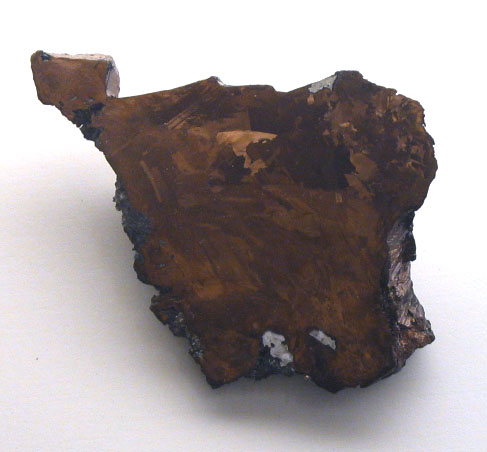
Copper’s malleability and useful electrical conductivity remain significant in modern engineering. For contrast, the later OSPCB.004 lesson on printed-circuit-board copper traces studies a very different manufacturing system that nevertheless depends on copper’s material properties. Modern conductivity cannot establish ancient object use without archaeological context.
Malachite, Heat, and Chemical Reduction
Malachite, commonly green, has the ideal chemical formula Cu2CO3(OH)2. It is a copper carbonate hydroxide, not a piece of metallic copper. Heating malachite can decompose it into copper(II) oxide, carbon dioxide, and water. Under a suitable reducing atmosphere, an oxide can subsequently be converted to elemental copper. Actual historical furnaces contained mixed materials and gases rather than a single clean laboratory reaction.
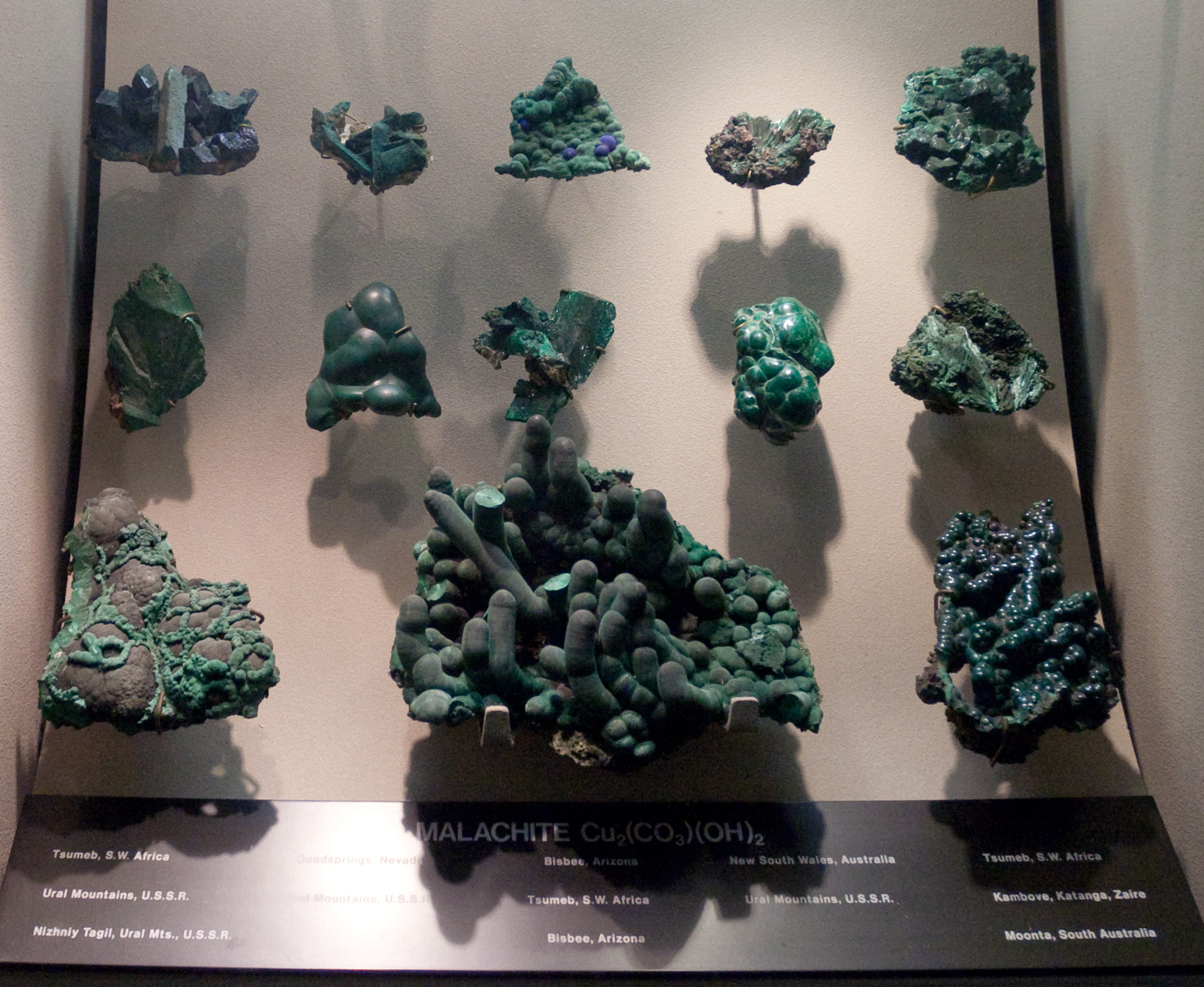
The following balanced equations are simplified chemical models rather than direct recordings of a specific prehistoric smelt:
Decomposition: Cu2CO3(OH)2 → 2CuO + CO2 + H2O
Reduction by carbon monoxide: CuO + CO → Cu + CO2
In industrial chemistry, a reducing agent removes oxygen from a metal oxide while itself undergoing oxidation. Carbonaceous fuel can help produce the chemical environment required, but fuel rate, gas composition, ore impurities, heat losses, temperature distribution, and the furnace design all influence the outcome. Copper’s melting point is approximately 1,085 °C at ordinary pressure; melting already-metallic copper and smelting copper from ore are distinct processes. Metal can sometimes form below its melting point, so visible liquid metal is not a universal prerequisite for reduction.
Archaeological Evidence from Belovode
Researchers examining Belovode, a Vinča-culture settlement in eastern Serbia, reported copper-smelting slag associated with activity around 5000 BCE. University College London’s Rise of Metallurgy in Eurasia project identifies the material as among the earliest direct evidence of copper smelting known to researchers. Miljana Radivojević’s site analysis also examined minerals, slag, and other technical debris across a longer occupation history.
A slag fragment can preserve a chemical and microscopic record of high-temperature ore processing. Investigators compare its mineral phases, trapped metallic droplets, microstructure, trace elements, and excavated context. Colored stones or copper ornaments alone do not prove smelting: they could reflect collection or mechanical shaping of natural materials. The exact location and date of humanity’s first smelting invention remain topics for continuing research. A rare preserved sample documents an early observed instance, not necessarily the first experiment conducted anywhere.
Researchers have also investigated whether pottery traditions helped communities learn how to manage fire, air, and ceramic containers. The 2021 review of early Balkan metallurgy cautions against treating any simple pottery-to-smelting explanation as proved. The conceptual link is useful for learning but remains a historical hypothesis.
Furnaces, Slag, and the Limits of Visual Comparison
Furnaces needed materials that tolerated heat while shaping airflow and maintaining a reaction zone. Archaeologists examine furnace wall fragments, fuel remains, pottery, crucibles, ores, metal droplets, and slag together. A tuyère is an air inlet or tube directing a blast toward the hot zone; the presence or absence of a tuyère at a specific early site must be established by excavated evidence, not assumed from later equipment.
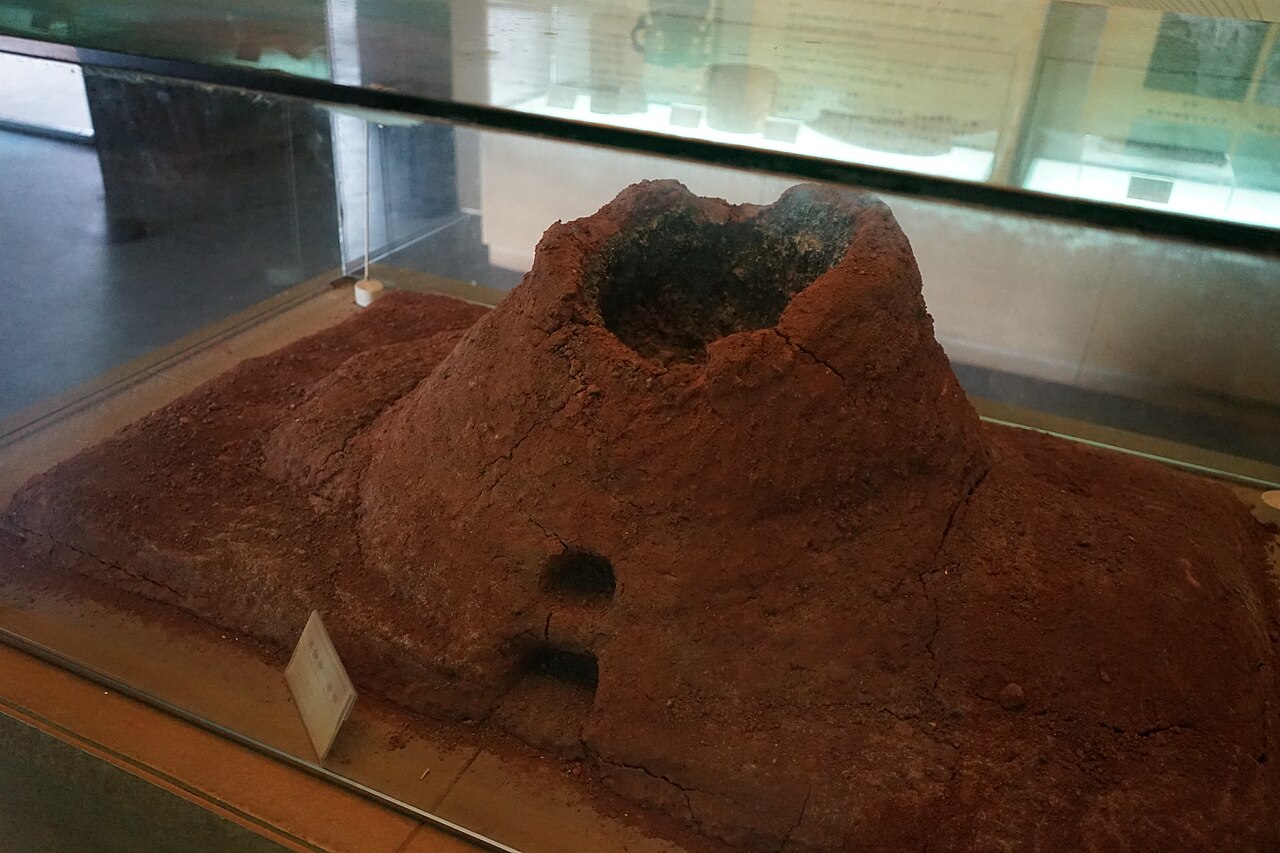
As with the separate OSHE.005 engineering-history investigation, surviving material can constrain possible processes without revealing every original decision. A furnace photograph identifies physical features of its own excavated structure; it cannot independently reconstruct another site’s operating temperature, fuel or output.
Worked Calculation: Theoretical Copper in Malachite
Assume a purely hypothetical 100.0 g sample of ideal, completely pure malachite. Its molar mass is approximately 221.12 g/mol, according to NIH PubChem. Two copper atoms contribute approximately 2 × 63.546 = 127.092 g per mole. The mass fraction of copper is:
127.092 ÷ 221.12 = 0.5748 ≈ 57.48% copper by mass.
Therefore, 100.0 g × 0.5748 = 57.48 g of copper is the theoretical elemental-copper content. A separate hypothetical 80% recovery of that copper would yield 57.48 g × 0.80 = 45.98 g. The 80% recovery is an invented classroom assumption, not a Belovode measurement or a forecast of an ancient furnace’s efficiency. Natural ore contains other minerals; metal may remain in slag or become lost during processing.
Safety and Equipment Requirements
The practical activity below requires only images, a calculator, a notebook, and optional museum-approved mineral observations. Do not attempt ore roasting or copper smelting at home. Metal extraction can generate carbon monoxide, hot particulates, irritating fumes and hazardous residues; it requires trained supervision, industrial ventilation, appropriate protective equipment, and compliant disposal. Never heat unidentified minerals, grind unknown ore indoors, or alter archaeological objects.
Documentation-Only Practical Exercise
- Examine the credited native-copper photograph. Describe the specimen’s metallic appearance without inferring that it was made or worked by an ancient person.
- Examine the malachite photograph. Record visible differences in color and texture. Explain why color cannot alone establish bulk ore chemistry or copper yield.
- Using the published formulas, verify that the malachite decomposition equation conserves Cu, C, O, and H atoms.
- Calculate the theoretical copper content in 250 g of pure malachite, then calculate a hypothetical 70% recovery.
- Read Radivojević and colleagues’ 2010 research abstract. Identify which claims rest on chemical analysis, which on archaeological dating, and which are interpretations.
- Compare the later Tonglüshan furnace photo with the Belovode research summary. State two reasons the later picture is not a direct reconstruction of the earlier furnace.
Expected arithmetic: 250 g × 0.5748 = 143.70 g theoretical copper; at an assumed 70% recovery, 143.70 g × 0.70 = 100.59 g. Answer any difference within normal rounding. These results are a stoichiometric classroom exercise, not a measured yield.
Troubleshooting Evidence and Calculations
- Result above 100% copper: check whether the fraction was multiplied by 100 twice, or copper oxide mass was mistaken for elemental copper mass.
- Claim that malachite is pure copper: return to its compound formula and account for carbon, oxygen and hydrogen.
- Claim that a green mineral proves smelting: require technical debris, context and compositional evidence; color alone is insufficient.
- Claim that the furnace photograph shows Belovode: read its caption; the image records a much later Chinese archaeological find.
- Claim that pottery automatically caused metallurgy: distinguish plausibility from a verified causal sequence.
Knowledge Check and Answers
- What is native copper? Elemental copper occurring naturally, rather than copper chemically bound in an ore mineral.
- What is malachite? A copper carbonate hydroxide with ideal formula Cu2CO3(OH)2.
- How is smelting different from melting? Smelting chemically extracts metal from an ore; melting changes an already-existing metal from solid to liquid.
- What is a reducing agent? A substance that helps reduce another substance, commonly by accepting oxygen from a metal oxide in the simplified example.
- What does slag reveal? Potential evidence of high-temperature processing, requiring microstructural, chemical and contextual investigation.
- What approximate date is associated with Belovode copper smelting evidence? Around 5000 BCE, according to the cited research.
- Why is the precise first invention date uncertain? Preservation, discovery, dating and interpretation of technological debris are incomplete.
- What is the theoretical copper mass in 100 g pure malachite? About 57.48 g, before losses.
- Why does the later furnace image need a warning? It represents another location and era and cannot establish the construction of Belovode furnaces.
- What is the safe classroom procedure? Visual observation, documented sources and paper calculations, not heat-processing copper ore.
References and Further Study
UCL — The Rise of Metallurgy in Eurasia; Radivojević — Archaeometallurgy of Belovode; Radivojević et al. (2010), Journal of Archaeological Science; Early Balkan Metallurgy review (2021); NIH PubChem — Malachite; and the credited Wikimedia Commons photographs linked in the captions. No YouTube video was included without verifying its title, identity and embed status.
Conclusion
The transition from shaping naturally metallic copper to extracting copper from ores introduced new knowledge about chemistry, fuels, heat and materials. Belovode provides important early direct evidence of copper smelting, but a single site does not settle every question about global origins. A careful materials historian learns to move between mineral chemistry, controlled calculations and archaeological context without confusing an ideal reaction with a measured prehistoric manufacturing result.
Editor’s Note: OSHMS.003 follows OSHMS.001. The original 1200 × 630 featured cover is a fictional AI-created illustration depicting an older male materials researcher and a laboratory demonstration, not an authentic archaeological photograph or a real identifiable person. Three real comparative photographs are explicitly credited with licenses. Belovode dating reflects published archaeological interpretation, and the 80% and 70% recovery assumptions are hypothetical classroom inputs. No furnace experiment, ancient output measurement, verified video playback, or independent mobile screenshot inspection is claimed.

On a mobile wallet, display the QR on a second screen or use a supported saved-image scanner. Verify the destination and the 5,000-satoshi amount before authorizing payment.
We volunteer daily to ensure the information on this platform is Verifiably True. If you would like to support the research, please scan the QR code.


Leave a Reply